
Veteran care providers from Presbyterian Disaster Assistance round out six-week course on emotional and spiritual care
The Rev. John Cheek and the Rev. Dr. Kathy Riley share their experiences caring for survivors of human-caused disasters
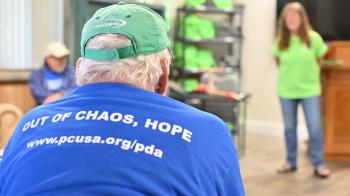
LOUISVILLE — During the last of a six-part series on providing disaster emotional and spiritual care, the Rev. John Cheek, a member of the National Response Team for Presbyterian Disaster Assistance, and the Rev. Dr. Kathy Riley, PDA’s National Associate for Emotional and Spiritual Care, offered up some of what they’ve learned while caring for the survivors of human-caused disasters, including mass shootings, terrorism, arson and other intentional acts of violence.
It was the second straight week that PDA presented among a handful of partners providing training to those caring for people who’ve experienced trauma. Last week, NRT members Marilyn Stone and the Rev. Suzanne Malloy offered a helpful talk on tools for resilience.
“Helping others recover from disaster is hard work. We talk about being able to give our best selves,” Riley said. “Care providers need to pay attention to their own resilience and well-being.” Some of those tools can be found here.
Cheek went over some of the stress reactions survivors often exhibit: shock, numbness, feeling helpless or hopeless, survivor’s guilt, difficulty with sleeping, problems with appetite, restlessness and difficulty concentrating, as well as emotional outbursts, irritability, spiritual questions, doubts and anger, especially toward clergy or even toward God. However, “most people do not develop post-traumatic stress disorder,” said Cheek, a retired pastor who lives in Tucson. “Most recover over time using their own support systems.”
There’s often overlap between the effects of natural disasters and human-caused disasters, Riley said. “We know grief occurs in both kinds,” she said. There may be optimism early on, “then a descent to disillusionment and disappointment.” Care providers can also be survivors, she said.
Survivors of human-caused disasters can feel the loss of “a relative sense of safety” at home or in their school, stores and place or worship. “Entire communities can be affected,” Riley said.
“In a human-caused disaster, there’s always someone to blame,” Riley said. “For some people, no public space will feel safe, at least for a while.”
When there’s loss of life, “there is of course grief and shock, compounded by this feeling of loss of safety” among survivors, Riley said. “But most people do recover.”
When a human-caused disaster occurs, congregational and community leaders “get to work within hours to identify counselors and faith leaders” to care for people of all ages after a tragic loss, she said.
There’s often opportunity for behind-the-scenes care, Riley noted. She once was part of a PDA team responding to a congregation whose worship had been interrupted by a violent intruder. “There were no serious injuries, but there was a great deal of media attention,” Riley said. A nearby faith community created space in its building for staff and volunteers at the affected church to come inside, rest, and have access to coffee, tea and snacks. “There was [church] staff available, but not hovering,” Riley said. “This was a tremendous gift of care and compassion.”
One way to find organizations and individuals who can help following a disaster is the website of the National Voluntary Organizations Active in Disaster. The website of the National Alliance on Mental Illness is also a resource for care providers and those seeking care, as is the website for the Substance Abuse and Mental Health Services Administration.
Cheek said something else care providers should keep in mind is that current trauma is likely to activate some previous trauma. “If you do only one thing to prepare to offer care,” he said, “learn about mental health resources already available in your community.” Those can include state and community mental health agencies, private practitioners, hospital-based services and pastoral counselors, Cheek said.
Human-caused disasters “change communities and change individuals,” Cheek said. “I am part of PDA as the result of a mass shooting here in Tucson. I know what the impact was on me during the days, weeks and months that followed.”
The key to providing quality care is to be a good listener, Cheek said. “Care providers include anyone who is willing to be present to suffering persons,” he said. “Some will want to talk about what’s next. Some will want to vent about not getting the help they need. We may need to refer the person to someone who can help if there’s assistance needed we’re not able to provide.”
Riley said that storytelling “helps us more fully integrate what’s happened. Give people permission to retell their story over and over again,” she recommended, but “we don’t want to urge people to share their story if they’re reluctant.”
Cheek was part of the PDA team that responded following the 2012 theater shooting in Aurora, Colorado, that killed 12 people and injured 70. The team put together materials for pastors to use talking to children in their churches and went to a copy store dressed in their PDA shirts. An employee asked them, “Are you here because of the shooting?”
When the group told him they were, the employee said, “I was there with friends, and I don’t know if they’re OK or not.”
“We were not intending to talk to a survivor, but we were prepared to talk to him,” Cheek said. “We never know, but we need to be ready just in case.”
The two touched on hard questions care providers might hear: Is this divine punishment? How could a loving God let this happen? Why? Did this happen for a reason? Maybe there is no God.
There are many helpful ways to respond, they said:
- Listen deeply and validate emotions
- When a question is asked, take time to discern if an answer is desired
- Avoid premature reassurances like “this is going to be fine.” Cheek said he often says, “I don’t have any answer you’ll find helpful right now. I just want to be with you and listen to you.”
- Validate the lack of a completely satisfying answer.
Responses to hard questions include “I believe God is sad to see your suffering,” “I believe God will be here with you in your loss” and “I believe God will offer hope to you.”
“You have your answers that have been helpful,” Cheek told those on the call. “I think it’s important for us to be able to respond in an authentic way. We need to be clear on our own theology, our own grounding. Be prepared,” he said, “to acknowledge what you don’t know.”
Years ago, when Riley was still a PDA volunteer, someone who was listening to the team said words that have stayed with her: “So you want people to speak into a listening silence.”
“We have used that phrase ever since,” Riley said.
“It’s critical to remember that one of the most important things we can offer to a survivor is simply being present,” Cheek said. “That’s something we can all do.”
With PDA and other organizations, “we respond to human-caused disasters that don’t make the national news,” Riley said. “We remain available as long as we are needed after a disaster. Those of us walking alongside folks must find them new sources of support, or ask them to check with their traditional means of support.”
The two also spoke about self-care, “which often gets neglected,” Cheek said. “You are retying the threads that are fraying in their community,” he said. “Be sure to encourage and practice self-care.”
Years ago, Riley’s mother died unexpectedly. Her pastor told her, “I know everything looks gray to you right now. But someday the daffodils will be yellow again.”
“I have never forgotten that,” Riley said. “It was hope and reassurance, and it wasn’t false hope. That, I think, is the task for all of us. We haven’t been through what they have been through, but we can use our experiences and resources in a way to let people know we are there.”
“You have a gift to offer others,” Cheek said, “and your gift increases in value when you care for yourself.”
Other Presbyterian News Service reports on the series are here, here, here and here.
You may freely reuse and distribute this article in its entirety for non-commercial purposes in any medium. Please include author attribution, photography credits, and a link to the original article. This work is licensed under a Creative Commons Attribution-NonCommercial-NoDeratives 4.0 International License.


