
Faith communities have a big role to play in mental health and substance abuse prevention
A webinar put on by Presbyterian Disaster Assistance and its partners delivers a how-to for faith leaders
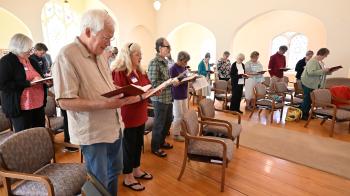
LOUISVILLE — During Tuesday’s second of six online installments in a series called the Disaster Care Academy offered by Presbyterian Disaster Assistance and its partners, participants learned how faith communities can play a vital role in prevention, early intervention and resilience-building when it comes to mental health and the avoidance of drug and alcohol addiction.

Emily Morrow-Mueller, the senior prevention programs manger for the Oklahoma Department of Mental Health & Substance Abuse Services, led Tuesday’s 90-minute webinar.
Before getting to how faith communities can play what is a significant role in the fight for a healthy society, Morrow-Mueller offered descriptions of promotion, prevention, treatment and maintenance.
Promotion is about helping people thrive by improving mental and emotional health for everyone, she said. Examples run from more neighborhood bike paths to improved sleep habits.
Prevention is reducing risk and protecting mental health early on. It can be universal, such as anti-bullying programs; selective, including offering support groups for at-risk groups; and educated, targeted at people with early warning signs including alcohol and drug abuse. Prevention strategies can work upstream to eliminate or reduce the root causes of, say, substance abuse, or downstream.
Treatment and maintenance are included in recovery. “It’s about getting better and staying well over time,” she said.
Risk factors are predictive for half or less of the population, while protective factors are predictive in up to 80% of the high-risk population, she said.
Morrow-Mueller then spent time exploring the different domains or contexts for promotion and prevention strategies as well as treatment and maintenance. Those contexts are individual, family and relationships, community, and societal, and Morrow-Mueller also touched on some of the risk factors associated with each.
She then turned to a brief discussion on Adverse Childhood Experiences, also known as ACEs, including abuse, neglect, separation or divorce, a family member with mental illness, a family member addicted to drugs or alcohol, a family member who is in prison, or witnessing a parent being abused.
Positive Childhood Experiences, or PCEs, are supportive and nurturing experiences in childhood that help a child grow up to be healthy and resilient and able to cope with stress. It impacts lifelong health, behavior and successful relationships.
PCEs, she said, “can buffer the effects of ACEs.”
“The presence of one caring adult can change a life,” she said, and faith leaders are often the ones to buffer those ACEs effects. As Mother Teresa put it, “Faith in action is love, and love in action is service.”
Then she answered the question many were on the call to consider: what is the role of the faith community in all this?
Faith communities have “a long history of leading positive change and supporting the well-being of members,” Morrow-Mueller said. Churches are available and accessible. Many people turn to their faith community when they’re in a crisis because they see it “as a safe place,” she said.
People who serve faith communities have a lot in common with prevention specialists, she noted, including engaging populations across the lifespan, focusing on community wellness and resilience, and employing evidence-based approaches.
Action steps that faith leaders serving in their local faith community can take include:
- Address mental health and addiction in sermons
- Host workshops and panels to explore mental health topics
- Use church bulletins and newsletters to “serve as a gentle reminder that support exists,” Morrow-Mueller suggested
- Educate the community and the congregation
- Strengthen relationships and support systems through mentorship programs, small groups or youth circles
- Engage in “compassionate leadership,” which “helps build trust across the community,” she said
- Foster strong family relationships through parenting workshops and family activities
- Strengthen economic and social stability through resource navigation, skill-building programs and community networks
- Promote positive identity and purpose through values-based education and leadership opportunities, and celebrate milestones
- Provide safe and structured environments through after-school programs and other safe spaces
“Ultimately, your leadership helps create an environment where young people feel guided and grounded,” she told the faith leaders present. “You are strengthening their well-being in meaningful and lasting ways.”
Morrow-Mueller also lifted up community engagement and service through volunteerism, the pairing of someone dealing with a concern with an experienced person “who helps them get connected,” the enhancement of emotional and mental well-being through counseling and pastoral care, partnerships with mental health professionals, and the creation of “a supportive faith community culture through a welcoming environment, intergenerational connections and consistent follow-up” including “regular check-ins” with families in need, she said.
It can also be helpful to “build connections with broader support systems” through school partnerships and collaborations with local organizations as well as provide training for church staff and volunteers.
“I hope you are able to take something away from this to strengthen the communities you serve,” Morrow-Mueller said. “Thank you for everything you do.”
You may freely reuse and distribute this article in its entirety for non-commercial purposes in any medium. Please include author attribution, photography credits, and a link to the original article. This work is licensed under a Creative Commons Attribution-NonCommercial-NoDeratives 4.0 International License.


