A conversation about hope
Presbyterian Disaster Assistance and its ecumenical partners offer a webinar on how faith communities can work to prevent suicide

Editor’s note: This article discusses suicide prevention strategies that faith communities can utilize to protect their members and friends. If you are thinking about harming yourself, call 988, the Suicide and Crisis Hotline.
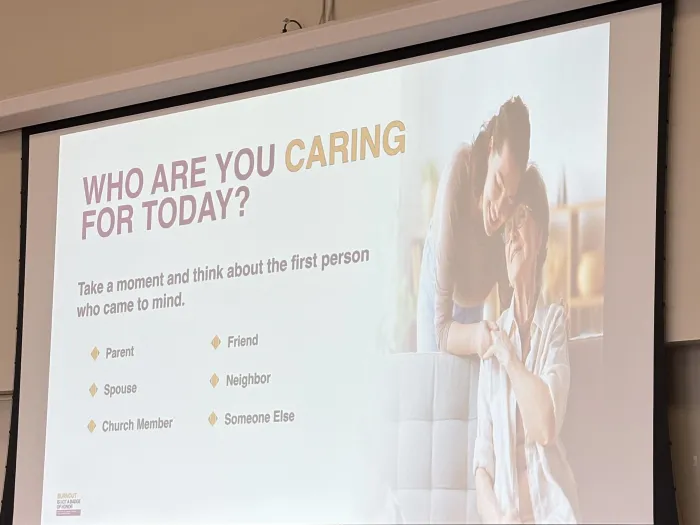
LOUISVILLE — “Preventing Suicide: A Conversation About Hope” was the latest Disaster Care Academy installment put on Tuesday by Presbyterian Disaster Assistance and its ecumenical partners. Meg Cannon, senior prevention program manager at the Oklahoma Department of Mental Health and Substance Abuse Services, was the main speaker and was assisted by her colleague, Daisha Dillard.
“Some of the things we are going to talk about are not easy to hear,” Cannon said at the outset, urging those on the call to practice self-care. “We as leaders cannot do this work if we are not taking care of ourselves.”
In 2023, the most recent year statistics are available, 49,316 Americans died by suicide. Nearly 13 million thought about suicide, and almost 4 million made suicide plans. 1.5 million attempted suicide. Males outnumber females dying by suicide by about 4-1. The highest suicide rates are among people 85 and older.
Cannon went over some of the circumstances that can lead a person to suicidality, including mental health and substance abuse and relationship and life stressors. She also spent some time on risk factors and protective factors, defining the latter as “a personal, environmental or community characteristic that helps well-being and reduces the likelihood of negative outcomes.” Those include strong self-esteem and problem-solving skills and a sense of purpose, supportive relationships with family members and opportunities for positive social and community involvement, including strong support networks.
Cannon shared the story of how the community cared for her the day she was widowed two years ago. Having grown up in Kansas, “I didn’t have any relatives in Oklahoma. These people surrounded me and took care of me,” she said. “They took the single hardest day I have experienced and made it better” by dropping off food, cards and other items that helped her that first day.
Cannon’s team works with “a lot of schools,” and what sometimes happens is students want to erect a memorial when a classmate dies by suicide. She and school authorities tell them no because if someone is struggling with, say, bullying, “and they see a memorial, they say, ‘Look at all the attention Joe is getting now.’”
Leaders of faith communities often know when members are struggling with job loss or the loss of their home, or certainly their partner. “Anytime you host a funeral, this is where follow-up needs to occur,” Cannon said. “Everyone is there, but five or 10 days later, they just disappear. Those were some of my loneliest days. They’ve returned to their lives. [For church leaders] it can mean stepping in weeks after the death.”
In small towns across the country, it’s often the church that hosts the town’s food pantry. “They know what the need is,” she said.
Faith communities and others have resources as they work to prevent death by suicide, and some are designed for young children. One is “Gizmo’s Pawesome Guide to Mental Health,” which can be viewed here. The book is targeted at children 4 and up.
“Talk Saves Lives” is an hour-long online or in-person training offered by the American Foundation for Suicide Prevention. It’s described as “community-based prevention that covers the general scope of suicide, the research on prevention, and what people can do to help save lives.”
There’s also a “train the trainer” course that’s about 3½ hours. Completing the course enables people to present “Talk Saves Lives” in their congregation or community, Cannon noted.
988 Suicide and Crisis Lifeline
Cannon described the 988 Suicide and Crisis Lifeline system in Oklahoma and said it’s similar in other states. She encouraged those on the call to learn how the system is operated in their state.
People calling or texting 988 are quickly connected with a mental health professional, she said. The conversation is confidential and free.
“They will provide personal, judgment-free support and share resources that may be helpful,” she said. About 90% of the time, “things get sorted out with just a phone call.”
If more help is needed, callers are connected with a mobile crisis team “to assess things and intervene if necessary,” she said. In Oklahoma, about 7 in 10 cases can be resolved at this touchpoint.
If even more help is needed, the person can get transported to an urgent care and crisis care to get stabilized.
In Oklahoma, 98% of 988 calls are answered within 90 seconds.
In a brief presentation labeled “Pulling It All Together,” Cannon urged faith communities to “normalize the conversation” and “talk openly about mental health.” Be direct and ask open-ended questions, she advised. Most importantly, “create safe spaces for hard conversations.”
She sometimes wears a T-shirt that says, “I told my therapist about you.” On her computer is a sticker that advises people to “Get in! We’re going to therapy.”
“I have those things,” she said, “so I can normalize the conversation.”
You may freely reuse and distribute this article in its entirety for non-commercial purposes in any medium. Please include author attribution, photography credits, and a link to the original article. This work is licensed under a Creative Commons Attribution-NonCommercial-NoDeratives 4.0 International License.