Historic Florida church reopens eight years after Hurricane Michael, with ecumenical support
‘This is the type of thing that gives glory to God’

LOUISVILLE — For almost eight years, there was no light at the site of First Presbyterian Church - Wewahitchka, about 28 miles west of Panama City, Florida.
The church, whose history dates back to the early 1900s, was shuttered by Hurricane Michael, a powerful, category 5 storm that caused severe damage in the Florida Panhandle in 2018.
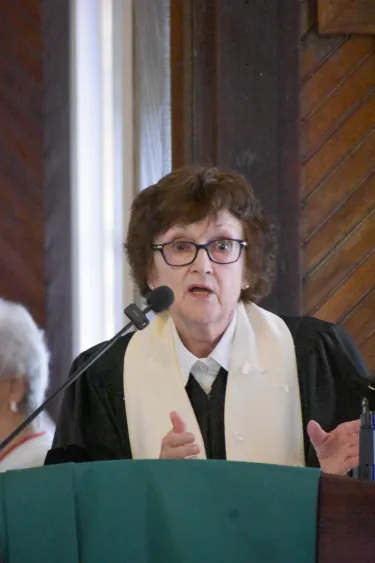
While the church was dormant, “it just looked so forlorn, you know, with the peeling paint,” said the Rev. Carol Wood, stated supply pastor. “It was a sad, sad time to see that building in such disrepair.”
Fast-forward to today, and the church has reopened, thanks to the dogged determination of Wood and the congregation of less than 15 people who endured a series of challenges during the project.
“This is the type of thing that gives glory to God,” and serves as an example to other congregations, especially those that are small, “because you know that the only way that they were able to be successful is because God was with them,” said the Rev. Mario Bolivar, equipping presbyter and stated clerk for the Presbytery of Florida.
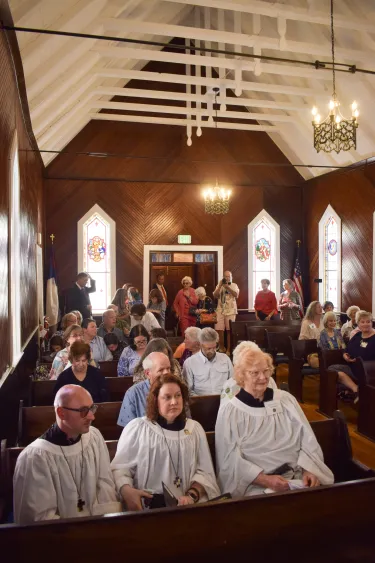
The church’s LED-powered chandeliers shine brightly through stained glass windows since the completion of the project, which included rebuilding the foundation, strengthening the beam supports of the high-ceilinged church and bringing the electrical wiring up to code.
“We've had so many people comment about how lovely that is — to drive by and see lights on in the church,” which was consecrated in 1903 as an Episcopal church and became a Presbyterian church in 1943, Wood said. By reopening, she said they want to honor the people “whose vision and whose hard work created that church” and “to try to be a light in the community.”
Wood, who spent much of her career in chaplaincy, had just recently taken on her leadership role at the church when Hurricane Michael came barreling into the area, battering the church with high winds that caused the building, hewn from pine and cypress wood, to become tilted on its brick piers.
Though it was difficult to tell from the outside, the elegant, Carpenter Gothic style building with a white exterior and red doors “was leaning very significantly,” Wood said. “You almost felt like you had to hold on or something because it was so tilted. It did not slip off of the brick piers entirely, but it was precariously placed.”
Also damaged was the church’s bell tower which Wood said, “separated at the top of the church, so there was a huge V,” which was “attached at the bottom but open to the weather at the top,” allowing rain to flow in.
The building also sustained damage to tin panels on the roof, paint was peeling from the ceiling, and there was storm debris inside.
“Our first engineer said, ‘It will cost too much to fix it. Tear it down,’” Wood said.
However, “the tiny Wewahitchka congregation's determination and perseverance was even mightier than the storm,” said the Rev. Kathy Broyard, executive director of the Florida Presbyterian Disaster Assistance Network (FLAPDAN), who visited the church in the wake of Hurricane Michael.
Members knew how special the church was and how it had served as a worship place for multiple denominations and faiths over the years, including Episcopalians, Catholics and Presbyterians.
“It is a landmark. It's the oldest building in Gulf County,” said Elder Lisa Dorman, who is also the current treasurer.
Wood added in a video about the restoration, “When I walk in, I have the sense that in these walls … there are these vestiges of prayer.”
So the congregation decided to forge ahead to try to get the structure repaired despite its small size and having no insurance except liability. It would take years to get FEMA approval for the scope of the work.
“We had countless phone calls with FEMA,” Wood said of the agency that would eventually provide key funding as did the State of Florida Division of Historical Resources.
Along with many FEMA liaisons, there were also multiple engineers and contractors, a failed bid to obtain a small business loan and a number of other hitches that came during the project, including a contractor who did unsatisfactory work and an engineer who died.
“We had a lot of slowdowns, stops and starts through the process,” while the congregation worshipped at the church’s fellowship hall next door.
And even that was not without challenges. The congregation had to do a temporary stint at First Methodist Church across the street after the fellowship hall was affected by a sewer backup that required throwing away some furniture and salvaging other items with the help of volunteers.
“It’s been a journey,” Wood said. “There were people like the Methodists who were helpful, supporting us along the way. Right after the hurricane … there were men from Westside Baptist Church who came and helped move the pews out of the church over to the fellowship hall, so there has been goodwill and help and encouragement from a lot of people.”
The church also is grateful for prayers, visits and financial support from the Presbytery of Florida. For example, the presbytery “helped us with a bridge loan when FEMA payments were so delayed and provided an emergency repairs grant to install an air conditioner in the fellowship hall, where we worshiped for eight years,” Wood said.
However, “Carol was the person that helped this congregation stand firm,” Bolivar said. “They rejoiced in every small victory. They prayed and gave thanks every step of the way. They really kept doing what they had learned already” — what it means to be a vital congregation.
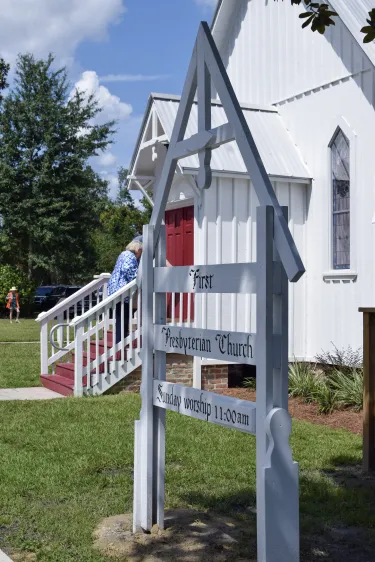
A major part of the restoration included getting a moving company to lift the building so that the foundation could be strengthened. To complete the effort, workers also had to “pour concrete, put in rebar and hurricane straps, lower the church back down, attach all of that, and then make a false brick pier,” Wood said.
The congregation spent seven weeks cleaning bricks for the project, with “wonderful help from locals and particularly from some volunteers from the Wewahitchka Historical Society,” Wood said.
Final work was completed in July 2026 and a rededication service was held on Aug. 16.
“You walk in and it's just breathtaking,” especially the different tones of the wood and a beautiful cross in memory of a member’s daughter, Dorman said.
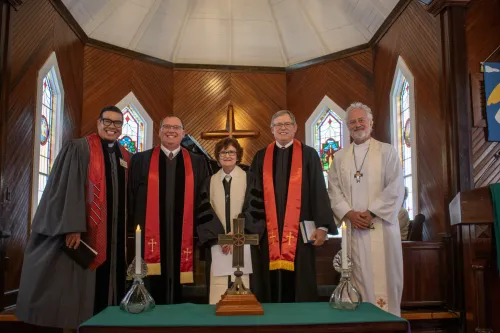
About 80 people — as many as the church could hold — were in attendance for the rededication service, which was a jubilant occasion, with supporters from the community and various faiths that have had ties to the church in its 123-year history.
“It was truly a day of Pentecost where the tapestry of Christianity was really revealed and you didn't know who was what,” said Bolivar. “You just knew that they were all there to praise God, and it was amazing.”
Dorman added: “There's just something special, being back in that building that just has gone through so much.”
Wood recalls the day being filled with joyful, ecumenical worship. “We picked hymns that are in the Episcopal hymn book and the Presbyterian hymn book. We really tried to be intentional about that, and it was a lovely, lovely service.”
It included the ringing of a restored bell in the once-damaged bell tower.
“We gave thanks for the bell and … we gave thanks for the stained-glass windows, which were installed in 1989, and they were a joint project between First Presbyterian and St. John's Episcopal,” Wood said.
Bolivar features the Wewahitchka restoration in the first episode of a new docuseries, “To the Glory of God,” on YouTube to show what a small group of faithful people can accomplish. “Everybody wants the fame and the big crowds,” he said. “The gospel isn't about that, not one bit … We have to take those stories and to share them and build others through them.”
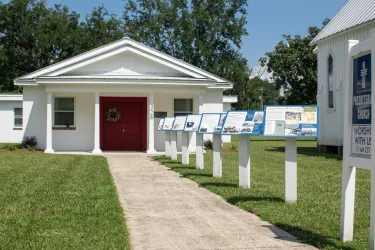
Besides his viewers, people are getting to know the church through plaques outside the fellowship hall that provide education about the history of the town and the development of churches, including First Presbyterian Church – Wewahitchka.
“We do hope sometime in the future to offer tours of the church,” Dorman said. Meanwhile, “we just love it. It's calm and peaceful and (we’re) just so thankful that the journey is finally over.”
You may freely reuse and distribute this article in its entirety for non-commercial purposes in any medium. Please include author attribution, photography credits, and a link to the original article. This work is licensed under a Creative Commons Attribution-NonCommercial-NoDeratives 4.0 International License.