Justice remixed for the next generation
Keynote speakers at Young Adult Advocacy Conference explore the prophetic and personal work of justice across the ages
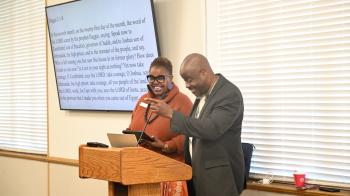
DECATUR, Georgia — “What would you tell your younger self?” asked the Rev. Dr. Aisha Brooks-Johnson, executive presbyter for the Presbytery of Greater Atlanta. Standing before young adults ages 18-30 gathered at Columbia Theological Seminary for the Jesus and Justice Young Adult Advocacy Conference, held Oct. 23-25, Brooks Johnson invited her spouse, the Rev. Dr. Alonzo Johnson, to answer first, then supplied her own response.
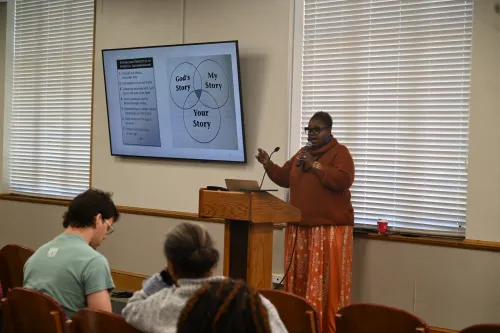
“I would say, ‘Just wait, Aisha, because you have no idea what lies ahead,’” she said. “I would say, ‘You will not always be this broke.’ I would say, ‘You won't always be this broken-hearted,’ and I would say, ‘You will be pleasantly surprised by God's handiwork in your life and in the world around you.’” That blend of honesty, humor and hope carried through a keynote co-presented by the couple and rooted in Haggai 2:1-9 and its vision of a people returning from exile to rebuild what had been lost.
Brooks0Johnson described exile as “terrible,” “violent” and “dehumanizing,” while reminding participants that the story does not end there. “God is bigger than what we’ve been through.”
Johnson, who serves as manager of the Self-Development of People and a part-time pastor for Hillside Presbyterian Church in Decatur, highlighted a key feature of Haggai's vision: Rebuilding belonged to the people themselves.
“The rebuilding that happens, people actually have a say in this,” he said. “They are invested in the life of the community.”
The couple depicted Haggai as “a community organizer,” “a trauma truth-teller” and “a courage builder,” urging participants to engage both the pain and possibility found in the text. Brooks-Johnson spoke of rebuilding “brick by brick” and “stone by stone” as communities recover from loss and disruption.
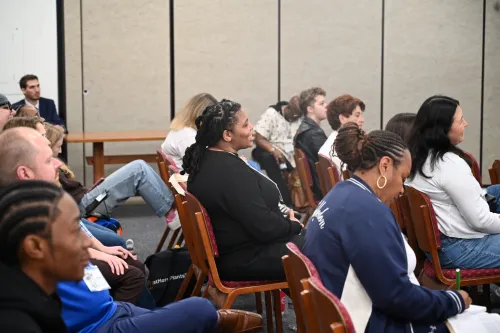
Throughout the presentation, biblical reflection was woven together with personal stories. Johnson recalled being a child whose milk money was repeatedly stolen at school. After he finally told his parents, his statuesque father came to the classroom, handed him new money and announced, “That is my son, and I'm proud of him.” The room chuckled as Johnson remembered what happened next: “The bullying stopped immediately.”
Brooks-Johnson also spoke about caring for her first husband through a long neurological illness while continuing her ministry and advocacy work before his death in 2018. Johnson described a period he was called to be present and rebuild a family in the wake of his divorce as a way of inviting participants to consider how the call to act justly carries through seasons of loss, transition and renewal.
The keynote included practical exercises inviting participants to connect those larger themes with their own lives. One practice, adapted from Richard L. Morgan’s work on spiritual autobiography, asked attendees to map significant moments from the previous six years, including experiences of joy, grief, challenge and growth. Brooks-Johnson encouraged participants to consider where God had been present in their stories. “Painful memories can be healed through stories,” she said.
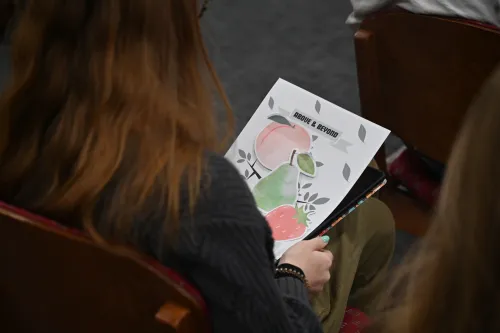
A second exercise invited participants to fill a tree diagram with fruit-shaped sticky notes naming gifts, challenges and hopes for the future. Lower branches held “low-hanging fruit,” middle branches named obstacles and upper branches pointed toward growth still to come. Johnson described the activity as a way of identifying “the fruits of the Spirit that God has given you.”
The keynote also ranged across race, class, gender, vocation and other overlapping dimensions of identity. Citing writer and activist Audre Lorde, Johnson reminded participants: “There is no such thing as a single-issue struggle because we do not live single-issue lives.”
As the session moved toward its conclusion, the speakers turned to Ephesians 3, describing the New Testament passage as a continuation and reimagining of themes first heard in Haggai. Brooks-Johnson called Ephesians a “remix” of Haggai's message, while Johnson likened the apostle Paul to a DJ drawing from an earlier track and bringing it to a new audience.
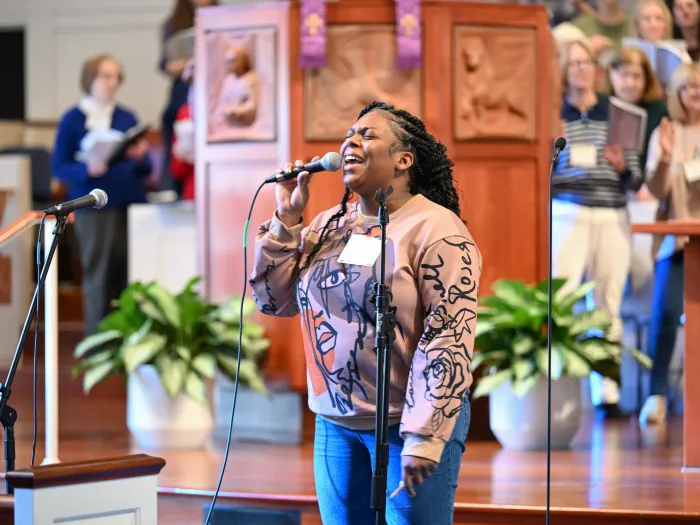
“The remix is reminding us that it’s the remix of something that’s already good and powerful,” Johnson said. “Your story is a remix.” The session closed with Johnson drumming and Brooks-Johnson leading song, inviting participants to imagine a future beyond what they could ask or expect.
In those final moments, Haggai’s vision of rebuilding and Ephesians’ promise of God’s abundance met in a shared refrain. The ancient story, the speakers suggested, is never simply repeated. It is remixed, carrying earlier traditions forward into the present work of faith, justice and community.
You may freely reuse and distribute this article in its entirety for non-commercial purposes in any medium. Please include author attribution, photography credits, and a link to the original article. This work is licensed under a Creative Commons Attribution-NonCommercial-NoDeratives 4.0 International License.