How to craft a ‘wonderfully human sermon’ in the age of AI
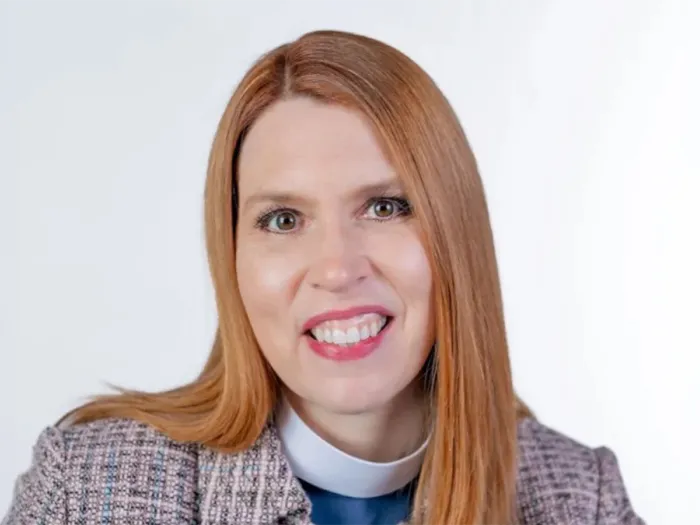
The Rev. Alison Gerber leads an engaging webinar for the Synod of the Covenant
LOUISVILLE — “The truth is, all of us at some point will likely feel the pressure to say, ‘forget it, I’m just going to get AI’” to write an upcoming sermon, the Rev. Alison Gerber, a doctoral student studying homiletics at Baylor University, told those attending a preaching webinar last week offered by the Synod of the Covenant. “There’s no shame if this has already happened to you.”

“I want to give you something to think about in those moments, a few reasons to pause,” Gerber told the preachers on the call. “The truth is that there are abilities that you as a human being uniquely have, that regardless of your skill level make you a better preacher than AI.”
Watch Gerber’s 88-minute talk here. The Rev. Dr. Chip Hardwick, the synod’s executive, hosted the webinar.
Gerber posed this question: of these nine sermon preparation steps, what can AI do and not do? Select the passage, study it, discover the main idea of the biblical text, formulate the main idea of the sermon, determine the sermon’s purpose, decide how to accomplish the purpose, outline the sermon, explain and illustrate and apply, and write the introduction and conclusion.
“It can do all of them, but not specific to my context,” said one participant. “It’s not anything I’m going to want to preach from the pulpit.”
“Some of this has to come from the head and the heart,” said another.
Gerber found that preachers who leave it to AI to select the biblical text for their sermon ended up with John 3:16 or Psalm 23 nearly 3 in 4 times. “The problem wasn’t solved by giving it the lectionary either,” Gerber said. “It overwhelmingly picked the gospel passage.”
Why? “It’s because that’s the way large language models work. These AI systems are not actually answering your question in the way you or I would,” Gerber said. “When we make a decision, we make it through something more than just retrieving information and making a probability assessment from that information. We might call that discernment,” a process that involves listening and reasoning “and integrates these with morality, intuition and, for some, spiritual practice. It’s often experienced in the body, with something like an emotional or intuitive sense.”
“Christians understand their ability to discern things involving a special encounter with the Divine,” Gerber said. “It’s a gift from God.”
Preachers are called to discern during key moments in sermon preparation and delivery: when they choose a passage, what to focus on in the passage, how they’re going to structure the sermon, whose voices need to be heard in the sermon, and the sermonic moment Gerber calls “when to get passionate. AI can’t understand when it needs to get angry and when it needs to be passionate.”

Hardwick pointed out that “in the Reformed tradition, we think about God being wholly other and speaking to us when we’re discerning. Large language models are just a group of human writings joined together to respond to.”
“There can be the work of the Spirit as we discern what to do with the suggestions [LLMs] make,” Hardwick said, “but if we just mindlessly go with it, it’s as if we are eliminating the wholly other who inspires us as we preach and discern.”
Gerber noted that ChatGPT “writes terrible sermon illustrations. The ones I get are so generic and so bland — so many monarch butterflies, or lighthouses helping to keep us safe, or the road less traveled.”
But “there is beauty and wonder in routine repetition,” as Dr. Sam Chan points out in this video.
Chan, a popular speaker and an orthopedic surgeon, told Gerber about his method for creating illustrations that can make lasting impressions. First, use 10 words to tell the who, when and where of the illustration. Then, in the body, tell the what why and how by painting the illustration in just a few sentences, using vivid detail and expression. Chan concludes with “the powerline,” a single sentence with a punch that, as Gerber described it, “links your illustration back to the message of your sermon.”
Two years ago, Gerber was teaching undergraduates about AI and human preaching. A student she called Steve chose Romans 12:1-2 for a sermon Gerber asked everyone to preach using AI. Steve told his fellow students, in part, “Conformed: the word Paul uses implies pressure. Molding. Being squeezed into a pattern. We know this pressure.”
Afterward, Steve called the sermon “a load of rubbish,” or words to that effect. Gerber later found out that five days before class, Steve had been in prison.
On the last day of class, students used the same passage they’d selected earlier to preach a sermon they’d written themselves. Steve read the passage from Romans, put his Bible down, and rolled up his shirtsleeve. His classmates and their instructor saw a massive tattoo with these words: “Loyal to the gang.”
“Steve said, ‘This is how much I was conformed to the world.’ As Steve preached, the entire class had tears in their eyes,” Gerber said. “It wasn’t just a sermon to Steve. He was sharing something he had personally experienced. This wasn’t just information to Steve; this was an embodied experience of suffering and redemption.”
AI can provide us massive amounts of information, “but that doesn’t mean AI understands any of it,” Gerber said, displaying a slide with a 4-by-4 grid of pictures of either a chihuahua or a blueberry muffin. AI, Gerber pointed out, can’t distinguish between the two.
“You have a series of embodied experiences that have transformed you and implanted in you a profound understanding of things,” Gerber told the preachers. “Sermons are so compelling when people speak of their own lives transformed.”
“When somebody speaks about wholeness, it carries more weight to me if I know they have, like me, felt broken,” Gerber said. “Christianity is not the story of information delivered from a data center. It’s the story of the Word made flesh.”
You may freely reuse and distribute this article in its entirety for non-commercial purposes in any medium. Please include author attribution, photography credits, and a link to the original article. This work is licensed under a Creative Commons Attribution-NonCommercial-NoDeratives 4.0 International License.