Loving others in between the mountaintop and the valley
The Rev. Dr. William Yoo wraps up a fruitful week of teaching and learning at Synod School
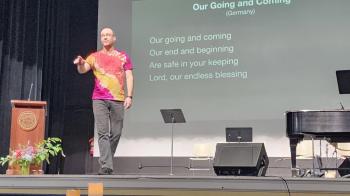
STORM LAKE, Iowa — The final Synod School convocation address offered Friday morning by the Rev. Dr. William Yoo was on “Love in Between the Mountaintop and the Valley,” with about 650 Synod Schoolers nearly set to descend from their mountaintop experience to the valley below.
“Another way to think of it is love between heaven and Earth,” said Yoo, Associate Professor of American Religious and Cultural History at Columbia Theological Seminary.
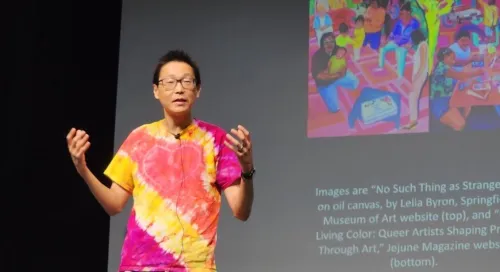
Yoo opened his final address by thanking those gathered in Schaller Memorial Chapel on the campus of Buena Vista University.
“I have learned a lot from all of you — the neighborhoods and churches and communities you represent and the beautiful and powerful ministry going on” in places including Lakeside Presbyterian Church in Storm Lake, Iowa, and First Presbyterian Church in Mankato, Minnesota. “People of faith are showing up to make a difference.”
Yoo spoke briefly on Matthew 4:4, suggesting another translation could have Jesus saying instead, “In addition to daily bread, we will feed on words from Scripture.”
He focused much of his Friday talk on the social gospel, work that’s described by the Rev. Walter Rauschenbusch in his 1917 book, “A Theology for the Social Gospel.”
Yoo described the social gospel in the United States as “simultaneously a specific historical movement at the turn of the 20th century and a broader theological conception that emphasizes how Christianity must address individual salvation and social reform.”
A Baptist pastor, Rauschenbusch worked in Hell’s Kitchen in New York, where he saw children working as many as 16 hours each day. “He wrote the pivotal book on the social gospel,” Yoo said.
Yoo also touched on the advocacy work of the Women’s Christian Temperance Union, founded about 150 years ago to curb excessive alcohol consumption.
Yoo shared a story on a WCTU chapter in Xenia, Ohio, which in the mid-1870s convinced a saloonkeeper named Steve Phillips to voluntarily go out of business. When he announced his plan, all the liquor in the saloon was poured into the streets as the women sang the Doxology. The WCTU leader then announced that “if Mr. Phillips went into any other business in Xenia, they would feel it a duty to support him,” Yoo said.
Yoo displayed a pair of amusing slides. In one, women are vowing, “Lips that touch liquor shall not touch ours,” to which Yoo said, “I imagine that was motivating to some men.” In another, men are marching and carrying signs that say, “We want beer.”
Prohibition began in 1919 and ended 14 years later.
“A lesson to be learned is how Christians can be inspired to move from micro to mezzo to macro” to overcome sinful systems including child labor, Yoo said, drawing here on the Synod School talk he delivered on July 27. “At the micro level, we’re going to help kids who have to work. At the mezzo level, we will mobilize in churches and civic groups. At the macro level, there is consensus and momentum to change things.”
“This is our work today, and there is more than one challenge,” Yoo said. “My encouragement to all of us is to work through how to inspire and motivate the people in our lives, the churches we belong to or [for clergy and commissioned pastors] the churches we serve and lead.” He then asked: “How do we motivate in ways that are honest and hopeful?”
“We want all of God’s people to be welcomed and to belong,” no matter “who we love and who we are. The color of our skin and our gender identification — these are the things of God,” he said. “We want everyone to have access to material flourishing. This is our work.”
Yoo drew from a 1978 play by Kim Chi Ha, who wrote “The Gold-Crowned Jesus and Other Writings.” In the play, lepers in Seoul, South Korea seek refuge outside a big-steeple church that features a huge statue of Jesus wearing a gold crown. The statue comes to life and begins talking to the lepers. Eventually, Jesus begs the lepers to remove the gold crown.
“Please set me free from the statue. I want to be among you,” Jesus tells them. Yoo noted that “Jesus the liberator is asking the vulnerable lepers to free him to be among the people, to love them, laugh with them and care for them.”
They get the crown off, but the authorities are summoned, and in the end Jesus is crying as the golden crown goes back on.
“For some of us, this liberates our interpretation of Jesus,” Yoo said. “We want to liberate people from their understandings of Jesus so they can worship this big Jesus.”
As he’s rubbed shoulders with Synod Schoolers, “I see this work happening in your churches and communities,” Yoo said. “I want to end with that encouragement: Let’s keep going with the work of liberation. It is hard but possible.”
Yoo was then given a standing ovation from a grateful Synod School, a ministry of the Synod of Lakes and Prairies.
You may freely reuse and distribute this article in its entirety for non-commercial purposes in any medium. Please include author attribution, photography credits, and a link to the original article. This work is licensed under a Creative Commons Attribution-NonCommercial-NoDeratives 4.0 International License.