Dinner bell prophets
Some of us are called to call out corrupt systems. The Rev. Dr. William Yoo reminds Synod School that God calls most of us to listen, grow and form partnerships
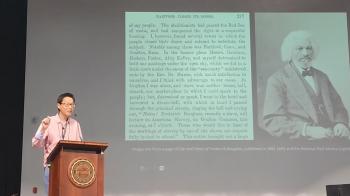
STORM LAKE, Iowa — The Rev. Dr. William Yoo, a scholar of American Religious and Cultural History at Columbia Theological Seminary, told the story during his Synod School convocation on Monday that reformers including Frederick Douglass used to walk through communities ringing a dinner bell, alerting residents to an evening talk he was offering.
“Certainly God is calling some of us to be dinner bell prophets, to be out in the streets and proclaim the most pressing uses of injustice today,” Yoo said. Today, social media is one such dinner bell, but it’s “not the only call.”
“I want to note the vital work of partnership all of us can do,” Yoo said. “How do we listen and grow” and “let those teachings [of the dinner bell prophets] illuminate how we think about what God is calling us to do in such a time as this?”
Yoo turned to the origin story found in Genesis 12. Prof. Walter Brueggemann taught that while the theme of covenantal promise is the theological focus of this origin story, “it’s been used to justify terrible sins of conquest, destruction and violence. What right can one have to the promised land when it is already occupied by others?”
The American origin story dating back to the Massachusetts Bay Colony is also complicated and messy, Yoo noted. Roger Williams advocated for co-existing rather than stealing land and forcing unfair treaties, and “for that honest yet controversial idea, he was banished from Massachusetts” and instead founded Rhode Island.
Dr. Kathleen O’Connor reminds us Abram and Sarai are called to be a blessing so that all the families of the Earth can be blessed. “God’s promises are the glue that holds the episodic lives of the ancestors together” is the way O’Connor put it.
“Perhaps you and I most relate to the in-between people who are neither the most vulnerable nor the most powerful,” Yoo said. “How do we, then, act justly, love mercy and walk humbly with our God? Our churches must discern what it means for middle-class people of faith to seek first the kingdom of God and God’s righteousness.”
God “enables and empowers us to do good, to shine light in dark places, and to enact love and justice in our churches, communities, nation and world,” Yoo said, discussing briefly how social workers go about their work:
- Micro involves one-on-one interventions between a social worker and client and includes school social work and mental health case management.
- Mezzo focuses on groups and circumstances. Examples include counseling at a harm reduction center or implementing a behavioral health program within a corporation.
- Macro takes on the big picture — addressing systemic injustices and dysfunctions to effect large-scale and long-term change through research, academia, leadership, changes to policies and public awareness.
“What I overlook sometimes is where God is calling us in the mezzo, where we live most of our lives and where God is calling us to do the most good,” Yoo said. Churches are a mezzo space, “with lots of different people who don’t look the same and think the same.”
While our church may not feature “as much diversity as we would like to see, there is a lot of ideological diversity at the mezzo level. It’s messy and complicated, but I hope it’s an opportunity where we can learn to worship, live and discern together,” Yoo said.
That can and should include figuring out “how to be good neighbors and making sense of what’s happening with immigration,” he said. “We want to reform [Immigration and Customs Enforcement] and support those who are vulnerable, but we need order and justice and good sensible laws in ways that might be a compromise. No one needs to live in the shadows.”
“One thing I lament is there is a lot of fragmentation — we call it polarization — even in the mezzos we live in,” Yoo said. “Some of our issues are complex and messy, yet the call of God remains clear. In the midst of mess and complexity, God is calling us to do good, and God enables us to do good. All of that is possible. It’s here and within our grasp. The challenge is how do we get that out there.”
Prof. Yoo continues as convocation speaker all week at Synod School, a ministry of the Synod of Lakes and Prairies.
You may freely reuse and distribute this article in its entirety for non-commercial purposes in any medium. Please include author attribution, photography credits, and a link to the original article. This work is licensed under a Creative Commons Attribution-NonCommercial-NoDeratives 4.0 International License.