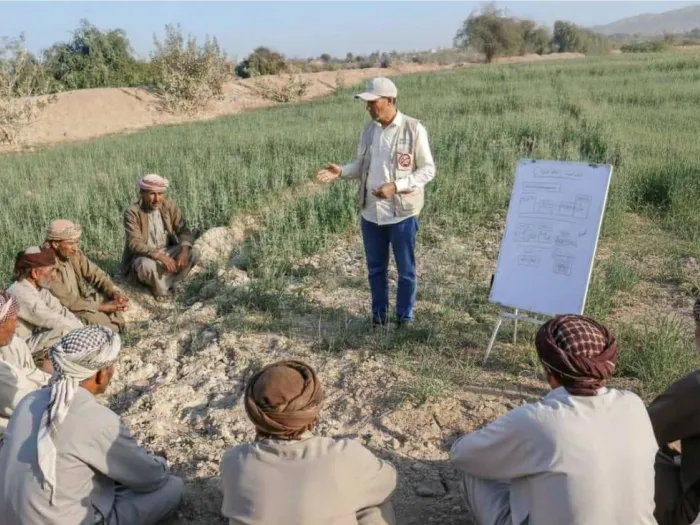
From sending to walking alongside
Relational accompaniment is a model for the PC(USA)'s Global Ecumenical Liaisons
LOUISVILLE — When the Presbyterian Church (U.S.A.) replaced the title of “missionary” with “mission co-worker” decades ago, it signaled a theological shift that had been taking shape since after World War II: The denomination was no longer primarily a sender but a partner. The launch of Global Ecumenical Partnerships (GEP) in 2025 deepened that shift, centering relational accompaniment — a posture of walking with rather than going to — as the defining practice of faithful ministry.
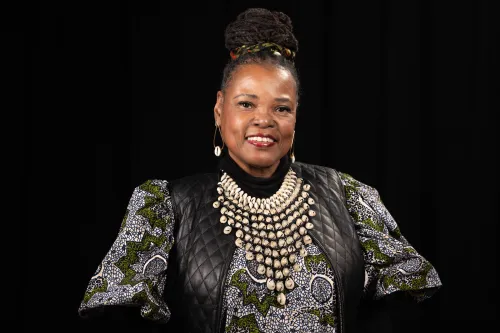
The move reflects hard-won institutional wisdom. The Rev. Cheryl Barnes, previously a mission co-worker in Africa and now manager for U.S.-based Global Ecumenical Liaisons (GLPs) within GEP, has spoken candidly about the limits of earlier approaches. In remarks at a recent symposium on missiology held at Union Presbyterian Seminary in Richmond, Virginia, Barnes said, “As a former mission co-worker to Africa, I can testify that while deep and beautiful relationships were formed, outside of a few exceptions, our partnerships were more or less transactional and not mutual.” Before the presentation, Barnes stated that she was not speaking on behalf of the denomination but that the views she was sharing were from her own perspective and experiences as an African American woman engaging in the legacy system of World Mission.
The imbalance of sending ‘the West to the rest’
Barnes argued that even good people with good intentions sometimes failed to carry good news in ways that honored local wisdom, autonomy and agency. The structural shift to mission co-workers improved language, she said, but changing titles did not always change the underlying dynamics. She pointed to a pattern that extended beyond nomenclature — one in which the cultural values of the sender as an incorporated institution shape the terms of engagement, regardless of what the institutional letterhead says.
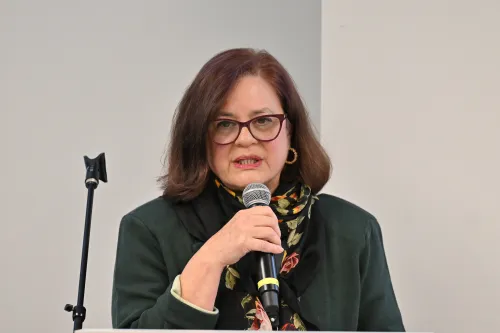
In March 2025, the Rev. Mienda Uriarte, now senior director for Partnerships Beyond the PC(USA) of Presbyterian Life & Witness, identified the same tension. “Since at least World War II, the PC(USA)’s approach to global mission has been continuously evolving beyond the former practice of sending ‘the West to the rest.’” While much of that engagement led to greater love, health, justice and equity, some of it also fostered what she called “a toxic charity kind of relationship” — one that inhibited the growth of partner churches and, in some cases, caused relational and cultural harm. Global partners, she wrote, “keep telling us we have further to go to ‘decolonize’ our theology, missiology and practical engagement.”
GELs are designed to embody a different posture. They do not initiate top-down programs or add layers of approval. They do not replace existing relationships. Instead, they accompany and connect people in shared mission and ministry.
Liaisons within the global network
“The move to de-center mission and center partnerships came out of conversations over many years,” said the Rev. Ellen Sherby, who manages international GELs. “Consultation with partners was part of that.”
Reflecting on his transition from a mission co-worker to a GEL for Asia and the Pacific, the Rev. Kurt Esslinger used the metaphor of a net. “This framing underlies a model in which ecumenical liaisons function not as isolated representatives (‘knots’) but as relational connectors within a living global network.” Esslinger, who is based in Seoul, South Korea, explained that this insight resonates strongly in Asian and Pacific contexts, where collective identity and relational accountability shape ecumenical engagement across cultures and traditions.
“We are all part of God's global net, something bigger than one individual or one partnership. This situation requires us to focus more on how we relate to the whole net, rather than our individual knots,” said Esslinger, who noted that there is both a strategic and a theological opportunity in having fewer internationally based staff. “We must focus on the connectivity of the whole net to ensure it is strong.”
Esslinger described two scenarios to demonstrate how the liaison work starts through regional connections but easily expands to global networks through the framework of GEP. On a recent trip to Japan, Esslinger met with pastors who were part of a demilitarization network near Hiroshima and Iwakuni. “As soon as I attended, they said, ‘We want to do our next forum on Costa Rica.’” Esslinger was able to connect them with a scholar who could help create a forum around Costa Rica’s constitutional abolishment of the military in 1948 and its impact since. Even this connection was comprised of several knots in the net, said Esslinger, who made the introduction through the help of another GEL serving in South America and a former mission co-worker.
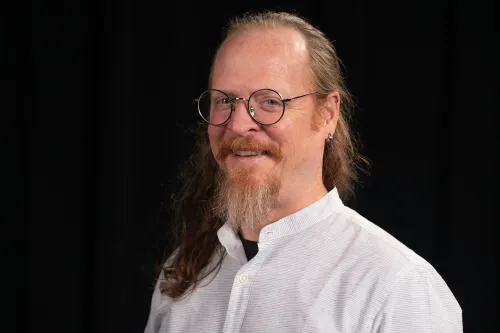
Esslinger is also involved in connecting Schreiner University, a PC(USA)-affiliated university in Kerrville, Texas, to several academic institutions around Asia. He recently presented to a consultation hosted by the World Communion of Reformed Churches working on a new strategic plan for the ecumenical body. Esslinger traveled to Jakarta, Indonesia, to meet with this group that he said is “particularly interested in bringing in more excluded voices into this sort of strategic conversations.”
“In many cases over the past several decades, mission co-workers were embedded with global partners, working with them as colleagues,” explained Sherby, who noted that some mission co-workers were regionally focused. “Now, GELs are regionally and also globally focused.”
“The other difference is that ‘global’ now explicitly includes the U.S.,” said Sherby. “We have U.S. GELs and international GELs, and they are connected in a web of relationships and work both regionally and around the world.”
In her presentations with mid councils in recent months, Sherby has lifted up accompaniment models within congregations in the United States, like the partnership between Beechmont Presbyterian Church in Louisville and El Ministerio Presbiteriano Hispano/Latino de Preston Highway, a ministry she co-leads with her spouse, the Rev. Elmer Zavala.
Accompaniment in the U.S. context is local and global
Barnes also has argued that the same relational commitment to global partnership must apply domestically — and with equal urgency. In her address to the missiology symposium at Union Presbyterian Seminary, she called on the denomination to stop treating the voices of marginalized communities as peripheral and to recognize them as theologically essential to the church’s witness.
“The time is now to invite to the table of discourse Black South Africans who endured the systematic oppression of apartheid so that we may be informed by their theological understanding of empire,” Barnes said. “The time is now to listen to the cries for land justice in Palestine, centering the voices of our Middle Eastern siblings as they resist Christian Zionism. The time is now to sit at the table with and learn from our Korean and Asian siblings as they show us the way to congregational growth and vitality.”
Barnes’ vision of relational accompaniment is a theological commitment to show up — persistently, humbly and without the presumption of having answers — alongside communities whose experiences the church has too often sidelined. But it is also logistical, as she oversees the U.S.-based liaisons. Five of those are in synod-facing positions and serve to connect mid councils, churches and mission networks to the vision, principles and resources of GEP, while the other liaisons support churches and new worshiping communities in the U.S. that identify as Native American, African, African American, Middle Eastern, Asian American, Korean American, and Latino/a/é and Hispanic.
“Our nation has turned her back on our global citizens living here. The church should not do the same,” said Barnes.

As a U.S.-based global ecumenical liaison supporting African congregations and the mid councils in whose bounds they grow, the Rev. Princeton Abaraoha helped the Presbytery of Minnesota Valleys in its efforts to integrate the ministry of the Rev. Elizabeth Tot, a refugee from South Sudan ordained in the Presbyterian Church of East Africa, as a new worshiping community and a focus of their presbytery-wide commitment to the Matthew 25 invitation.
Tot and her son’s ministries to Sudanese refugees, which began over a decade ago when the First Presbyterian Church of St. Cloud, Minnesota, offered them a place to hold a Bible study, are now bi-continental, with worship, prayer and outreach in St. Cloud and a new church plant for a South Sudanese refugee community in Ethiopia, where Tot and her presbytery partners are helping to create access to clean water and care for orphaned children.
In his consultations with mid councils and conference presentations, Abaraoha often lifts up how the African immigrant communities he serves are deeply rooted in communalism, emphasizing shared responsibility, reciprocity and interdependency.
Humility on the road to mutuality and repair
The practice of accompaniment that GEP is building toward has roots in the denomination’s own stated commitments. The 215th General Assembly’s policy on mission established that doing mission in partnership opens the church to “mutual encouragement, mutual transformation, mutual service, and mutual renewal” — not a one-directional transfer of resources or expertise but a circle of reciprocal relationship. Sherby has named what living that out honestly requires. “Yes, we must serve this present age with the people, resources and finances we have,” she said, “not from a place of scarcity, but from a posture of humility with a willingness to listen, to practice equity and to engage in repair where it is needed.”
Barnes has been equally unsparing about what repair demands. “The reason we are here is because, for decades, people have been saying it’s not the time — it’s not the time to talk about racism, it’s not the time to talk about empire, it’s not the time to talk about colonization,” she said. “And what we’ve done is kept kicking it down the road.”
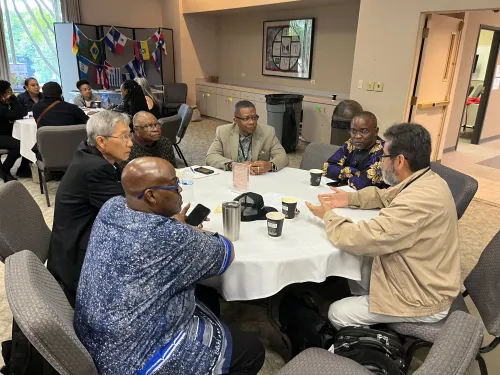
GEPs' relational accompaniment model is, in part, an institutional answer to that indictment — a commitment to match steps with partners as the PC(USA) walks alongside in the United States and around the world, with the humility the 2003 policy always envisioned and the urgency the present moment demands.
“We know that many individuals and churches have already engaged in mission in partnership; this has been a strong tenet of Presbyterian mission for decades and was made into policy through ‘Presbyterians Do Mission in Partnership,’" said the Rev. Carlton Johnson, director of GEP, which includes the GELs as well as the Presbyterian Hunger Program. Johnson became director of GEP in November 2025 after having served as interim director of Racial Equity & Women’s Intercultural Ministries during the unification process of the Presbyterian Mission Agency and the Office of the General Assembly. Before working on denominational staff, Johnson served as associate pastor of First Afrikan Church in Georgia and continues to worship there with his wife.
The metaphor of the net resonates deeply with Johnson, who pointed out a similar concept in the Rev. Dr. Martin Luther King Jr.’s “Letter from a Birmingham Jail.” In April 1963, King wrote, “We are caught in an inescapable network of mutuality, tied in a single garment of destiny. Whatever affects one directly affects all indirectly.”
The network of mutuality ties together not only people and places in the present but also past realities and future destinies.
“Now, we are building on the good work of mission co-workers and Presbyterians passionate about partnership to move into new forms of global and mutual mission,” said Johnson.
You may freely reuse and distribute this article in its entirety for non-commercial purposes in any medium. Please include author attribution, photography credits, and a link to the original article. This work is licensed under a Creative Commons Attribution-NonCommercial-NoDeratives 4.0 International License.