The future is not ours to lose
At COP31, a faith call for climate justice is sounded
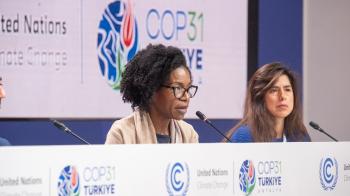
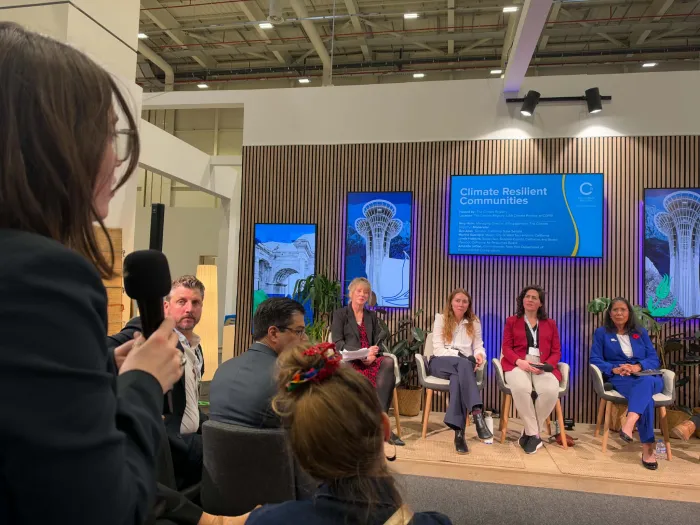
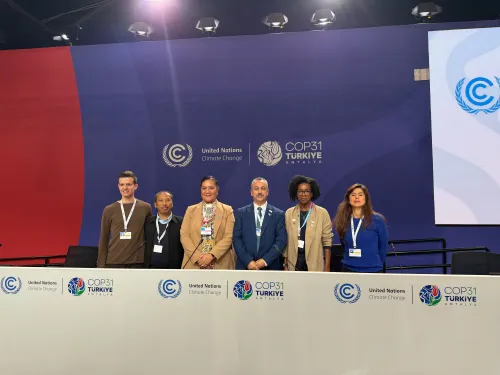
ANTALYA, Türkiye — On Thursday at COP31, members of the Presbyterian Church (U.S.A.) delegation supported the ecumenical faith community by attending a press conference hosted by The Lutheran World Federation, ACT Alliance, Franciscans International and the World Council of Churches as they sought to bring a united faith perspective to the global climate negotiations.
Their message was that the climate crisis is not simply an environmental challenge. It is a crisis of justice, human dignity, human rights and our responsibility to care for Creation. The future is not ours to lose, and governments must move beyond promises to deliver climate action that protects people, communities and the web of life.
As part of this joint call, faith-based organizations highlighted the moral and ethical dimensions of climate justice, urging governments to put human rights, the needs of those most affected by climate change, and the integrity of ecosystems at the heart of climate decisions.
Regina Q. Banks, the director the Lutheran Office of Public Policy — California, was particularly powerful in her remarks:
“I am often asked why the faith community — why the church — invests so much time and energy in the COP process … the faith community belongs wherever decisions are being made about the lives of the people in our communities. We are the ones who accompany communities day in and day out as they experience climate change's increasingly violent impacts. We help people adapt to a changing world. We mourn climate losses and damages alongside them. And through the long, difficult work of rebuilding, we preach hope, resilience and the promise that suffering and death do not have the final word.
“But here’s the thing. Governments and nation-states are comfortable with the church feeding families after floods, sheltering neighbors displaced by wildfires and burying the dead after hurricanes. They become considerably less comfortable when we ask them why these disasters are becoming more destructive, who is being left most vulnerable and who bears responsibility.
“It’s women and girls, indigenous people, minoritized people and the poor who are most affected by climate change. We cannot be expected to minister endlessly to the consequences of the injustice while remaining silent about its causes.
“And we don’t come to COP simply to speak. We come to listen. We belong to a global communion whose members are already living with the consequences of decisions being made far beyond their borders. Our siblings in Africa, Asia, Latin America and the Pacific are not merely victims of climate change. They are theologians, organizers, advocates and leaders whose wisdom must shape our common response.
“But for those of us from the United States, this moment is even more crucial: When our federal government abdicates its international commitments, the American faith community must become memory-keepers and justice- makers. …
“We are memory-keepers who refuse to let our nation forget its historic responsibilities for the climate crisis, the promises we have made or the communities already paying the price for our prosperity. We are justice-makers who maintain relationships across borders, stand in solidarity with our global neighbors, and insist that climate finance, adaptation, and loss and damage are matters of justice, not charity. We have been doing this work since long before the Paris Agreement, and we will be doing it long after this COP.
“Presidential administrations come and go. Our obligations to our neighbors do not. The church’s vocation is not contingent upon who occupies the White House. We are called to love our neighbors, care for Creation, and bear witness to God's justice in the world. We are here because our neighbors are here, and we will not abandon them.”
The press conference also emphasized the responsibility of governments to accelerate a just transition away from fossil fuels, strengthen climate action and ensure that commitments translate into meaningful action, particularly for communities on the frontlines of the climate crisis.
The message is clear: Protecting our common home is not optional. It is a shared responsibility, and the time to act is now.
The full press conference is can be seen here. Regina Q. Banks is introduced at the 13:25 mark.
Jessica Maudlin is Associate for Sustainable Living and Earth Care Concerns in the Presbyterian Hunger Program. Read previous reporting from COP31 here and here.
You may freely reuse and distribute this article in its entirety for non-commercial purposes in any medium. Please include author attribution, photography credits, and a link to the original article. This work is licensed under a Creative Commons Attribution-NonCommercial-NoDeratives 4.0 International License.