‘A common fight that is organized’
Presbyterian Hunger Program’s ‘Centering Partners’ Voices’ looks at mining’s impacts on indigenous people in the Amazon region

LOUISVILLE — Faith and partnerships are playing an increasingly important role in standing up for the rights of indigenous people impacted by mining, especially of critical minerals.
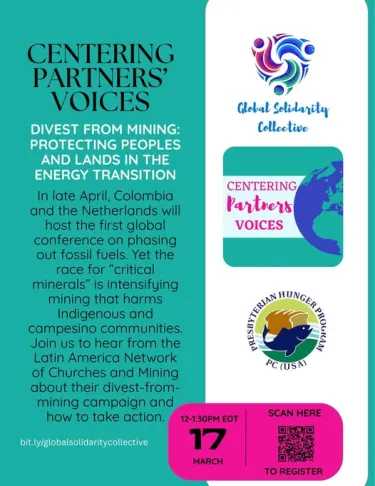
On Tuesday, the bi-monthly “Centering Partners’ Voices” webinar featured Daniela Andrade of the Latin American Churches and Mining Network. Andrade was interviewed by the Rev. Jed Koball, a Lima, Peru-based Global Ecumenical Liaison for the Presbyterian Church (U.S.A.). The Global Solidarity Collective, an initiative of the Presbyterian Hunger Program, sponsored the webinar, the first offered in 2026.
“It is beautiful to be here sharing this morning,” Andrade said. “It gives us a lot of hope to talk with brothers and sisters who are united in this mission.” She said she spoke Tuesday “as a woman, a mother and a person of faith.”
During the pandemic, Andrade gave birth to her first child on indigenous land that has been impacted by oil production. “I felt what it means to be abandoned by the state,” she said. “You can feel their idea of a model of development. It’s not for the people.”
“Oil and minerals are being extracted, but we don’t have the equipment to take care of women and children,” she said. “Their lives are at risk because of the water they drink.”
Peru is a top producer of copper, silver and zinc, and has significant deposits of lithium. American and Chinese companies have large mining interests there. Critical minerals are important for developing clean energy technologies, but environmental challenges related to their extraction remain problematic.
“This is not the first wave of extraction we’ve had,” Andrade said. “For the past hundred years, entire populations have disappeared due to extractivism. First it was wood, then oil, and now they are trying to bully the [indigenous] territories. The value [of resources being mined] is very high, and that’s why it keeps being extracted, over and over. But people are rebelling and saying no to this.”
“Extraction hurts our bodies,” she said, “and its wounds run deep in our souls.”
Koball called the extraction of critical minerals “a clash between two worlds. It’s not just taking resources — it’s hurting a relationship with the Earth that’s so valuable.”
Andrade said the more she works with indigenous people, the more she learns from them. “I don’t defend the [Amazon] river just because it’s a space where we don’t want to see trash,” she said. “Obviously that’s part of the reason, but for the original people, it’s the strength of the river, the place where they go to heal diseases. It’s where the spirits gather, and it encompasses other types of life.”
“Imagine if my brother and sister live in the water — how damaged their lives are. Incarnating this truth is the main reason to defend life. It’s what unites people,” Andrade said. Indigenous people “gather around this topic no matter how strong the division is. For them, that’s the power of spirituality.”
For people in the resistance movement, it’s more than just fighting against companies and the state, she said. “It’s also joy and celebrating life, saying hi to your neighbor and celebrating different types of spirituality,” she said. She thanked the PC(USA) and other faith communities “for your commitment, including the empowerment of women so they can become activists.”
“I see spaces full of love and support by the church, which says ‘We believe in what you can do and we’re going to support you,’” she said. “People are organized around their spirituality.”
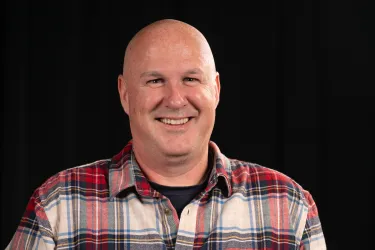
For Koball, “imagining our future sharing a common home is a spiritual transformation.” He asked Andrade to outline some of the networks being built around Latin America.
“One of the actions that brings the most hope is connection — creating networks and believing in the power of the networks when it comes to resistance,” Andrade said. It requires cooperating for “a common fight that is organized, finding motivation in the stories of others and promoting their resistance.”
The Latin American Churches and Mining Network has hosted healing and listening spaces for indigenous women in Argentina, Bolivia and other countries. “It’s essential to gather and find similarities in the midst of our differences,” she said, calling spirituality “our common denominator. It’s where we find resistance and hope.”
Koball noted that as they were speaking Tuesday, the network was sending a contingent to Rome to discuss with church leaders possible divestment from some mining companies.
Andrade said the group hopes to meet with up to 40 organizations and church leaders, including bishops. “A main ideas we have is creating ethical codes or restructuring the ones we have” in order to “align with the victims of capitalism and extractivism.”
“We hope this will be an important event that sets a precedent for the future,” Andrade said. “It’s a work in progress, a path to be walked. With fossil fuels, it was years before we saw any results.”
The network hopes to promote divestment from mining by establishing communication channels with banks and investment funds and building basic ethical criteria and codes for religious institutions and congregations. It also plans to raise awareness about mining projects and document impacts in affected communities as well as facilitate seminars and dialogues with experts, including environmentalists, academics, theologians and indigenous leaders.
“It’s not just energy transformation from this technology to another one. It’s not just keep the rivers clean so we can swim in them,” Koball said. “It’s a fundamental and spiritual transformation.”
“We are the church,” Andrade said. “To recover and make this transition, we must reshape our churches.”
“The church has something to say,” Andrade said, “and that’s why the world has eyes on churches.”
You may freely reuse and distribute this article in its entirety for non-commercial purposes in any medium. Please include author attribution, photography credits, and a link to the original article. This work is licensed under a Creative Commons Attribution-NonCommercial-NoDeratives 4.0 International License.