Iowa partner uses people power to address grassroots issues
Watchdog group takes on corporate agriculture and factory farming
LOUISVILLE — Whether it’s fighting a pipeline or big factory farms, Iowa Citizens for Community Improvement believes in people power.
A longtime partner of the Presbyterian Hunger Program, Iowa CCI engages in grassroots organizing to make the voices of residents heard on issues affecting the state and its various communities.

People power is “like the feet in the street to move the work,” said Ava Auen-Ryan, Iowa CCI’s environment organizing director. “We wouldn’t be able to do anything we do without our members or just the people who get involved to help take action.”
As part of its work, Iowa CCI focuses on a range of issues, from strengthening public schools to advocating for better water quality, she said. “We also work on data centers, trying to get moratoriums and ordinances that would protect our communities and our water.”
The group, whose main office is located in Des Moines, has members in approximately 90 of Iowa’s 99 counties.
Their work takes place in a part of the country that is “dominated by corporate agriculture and factory farming,” according to the group. “These massive, tax-payer-supported, environmentally harmful systems damage our water and land and health.”
Also, the crops tend to be “grown for feed and fuel rather than (table) food,” the group notes. “In the ‘breadbasket’ of the world, no one should be hungry; yet, 1 in 8 people in Iowa faced food insecurity in 2025.”
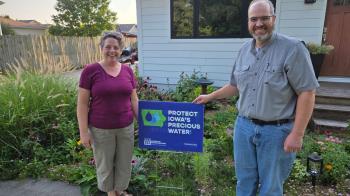
One of Iowa CCI’s ongoing projects is “Healthy Water! Healthy Iowa!” a campaign to build awareness about water quality issues. It has involved going door-to-door to speak with residents and posting as many yard signs as possible. The group also has spent time getting Polk County residents to sign a petition urging state legislators to put mandatory measures in place for factory farms to clean up the water and for a statewide water quality monitoring network to be fully funded.
“It is no secret Iowa has a water quality crisis,” Iowa CCI has stated. “Many peer-reviewed studies show the correlation between nitrates and cancer, pesticides and cancer, and an increased risk when paired with processed food consumption. These foods are often the same foods available to those who are experiencing hunger.”
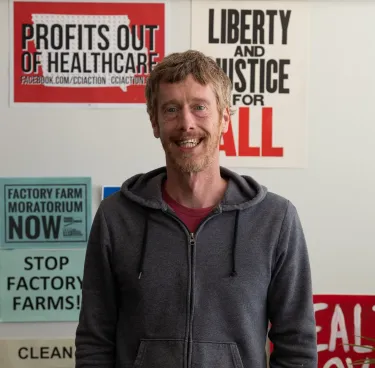
Matthew Covington, the group’s strategic operations director, noted that the campaign is helping to spark new interest. “We just received a call at our office … from someone in this area who said, ‘I saw this sign in my neighbor's yard. Where can I get one? What are you guys all about? I want to join,’ so it’s another way to build public awareness and visibility and exposure on this [issue] and these signs … are evergreen until we fully clean up our water.”
Another advocacy issue that Iowa CCI and others are targeting is a plan by Summit Carbon Solutions to build a carbon sequestration pipeline in Iowa. Iowa CCI opposes the project because of various safety and environmental concerns.
“We have stalled it for five years now,” Auen-Ryan said. “It’s all tied into just this way-too-intensive agriculture system that we would want to just put a pause on and then transition away from.”
Iowa CCI’s other passion topics include maintaining a group of people to test local waterways for nitrates, advocating for strong public schools and promoting soil conservation, a topic that was embraced by the 227th General Assembly earlier this year in an overture about regenerative farming.
The group would like it to be mandatory for farmers to use buffer strips to help prevent soil erosion and help protect waterways.
A buffer strip is “basically an area between a body of water, or the side of the road, and where your crops start,” Auen-Ryan said. “Ideally, it'd be great if there was some native plants planted there to hold the soil, improve it.”
Iowa CCI relies on its members and others in the community to decide which issues to tackle.

“It's like, ‘Well, what do our members care about?’ That's kind of like the first test,” Auen-Ryan said. “If people don't care about it, or they don't want us working on it, then that kind of defeats the purpose of what we do.”
PHP also plays an important role in the organization.
Long-time funders such as PHP “are just so near and dear to us because they've been with us through all of the ups and downs,” Covington said. “They get that these are long-haul fights,” and PHP’s consistent support is both “humbling and a testament to the work.”
The Rev. Meghan Davis-Brass, a PHP Advisory Committee member, was excited to hear about PHP’s partnership with Iowa CCI, whose offices are less than 2 miles from her home and church in Des Moines.
"Iowa CCI is working on so many problems that concern me and my neighbors,” Davis-Brass said. “While we all know that there is a direct link between Big Ag and Iowa cancer rates, the political will is lacking to address farming practices and keep our waterways safe and clean. I am extremely grateful for the work of Iowa CCI on these and so many other issues."
The Presbyterian Hunger Program is a ministry of Presbyterian Life & Witness. For more information, go here.
You may freely reuse and distribute this article in its entirety for non-commercial purposes in any medium. Please include author attribution, photography credits, and a link to the original article. This work is licensed under a Creative Commons Attribution-NonCommercial-NoDeratives 4.0 International License.