Gun violence prevention is a group project
Presbyterians are leaders in the effort that includes ecumenical, interfaith and community partners

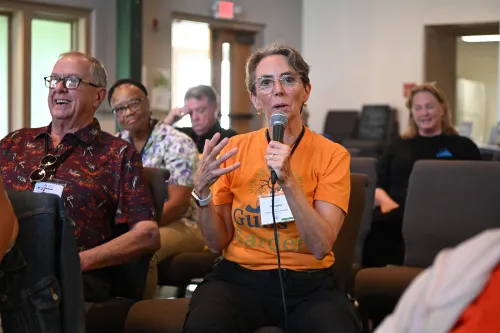
PARKVILLE, Missouri — The gun violence problem in the United States is bigger than any one Christian denomination. It is bigger than any one faith group or community.
That is why the Presbyterian Peace Fellowship’s James Atwood Institute for Congregational Courage in mid-September included representatives of more than a half-dozen Christian traditions and heard from several community leaders during its four days at the Heartland Retreat Center on the outskirts of Kansas City.
“On our planning team for the Atwood Institute, we have an Episcopal priest, we have a Roman Catholic laywoman, we have a Lutheran pastor,” the Rev. Margery Rossi, gun violence prevention minister for the Presbyterian Peace Fellowship, said. “We’ve got on our gun violence prevention working group a member of the Disciples denomination. We’ve got folks from a number of different denominations that we are making connections with so that we can be stronger together.”
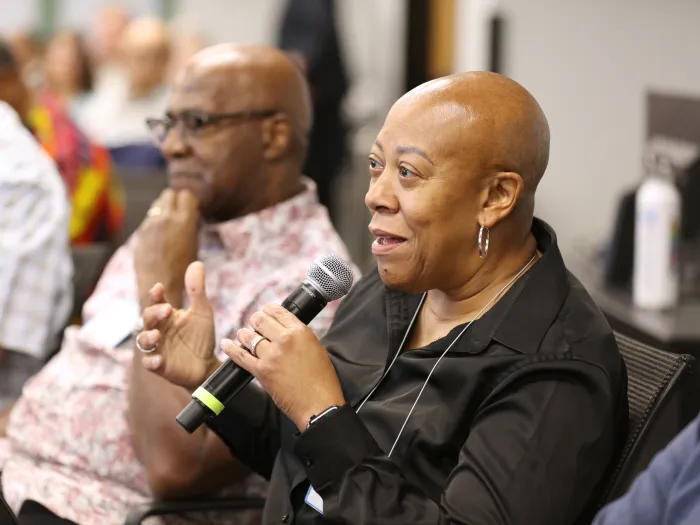
The second morning of the Institute, participants heard from Cheryl Fleetwood and Rita Niblack who hail from Colorado Faith Communities United (CFCU), an interfaith organization that collaborates to address gun violence in a state that has seen more than its fair share of high-profile gun violence incidents.
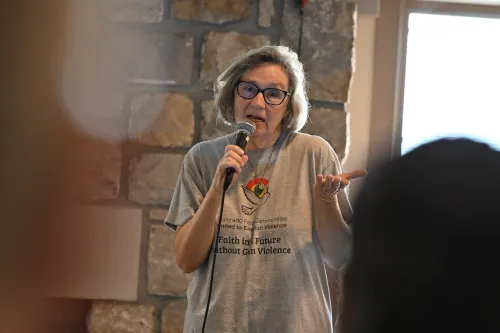
“We're the only faith-based statewide organization, and we collaborate with all of these entities, and it's powerful,” Fleetwood, of Denver’s Central Presbyterian Church, said to Institute participants. “We really build those relationships to try to not duplicate services, but how can people sitting in our pews who care about gun violence take action, add action to our thoughts and prayers.”
Niblack, of Most Precious Blood Catholic Church in Denver, talked to the participants about what that action can look like.
“We have a rapid response network,” Niblack said. That goes to work when a bill is before the Colorado State Legislature that CFCU has a position on and “we send something out to all our members and ask them to share this with their community, their faith community as a whole, and who they need to write to, who’s on the committee about the bill, when the hearing is going to be, when they need to write the letter by, email addresses so they can send that, and then we also have training for how you can testify at the Capitol in relationship to the bill and how to sign up.”
“All faith traditions have a value around the sacredness of life, and so that is a core foundational unifying value and theme for all of us,” Fleetwood said in an interview.
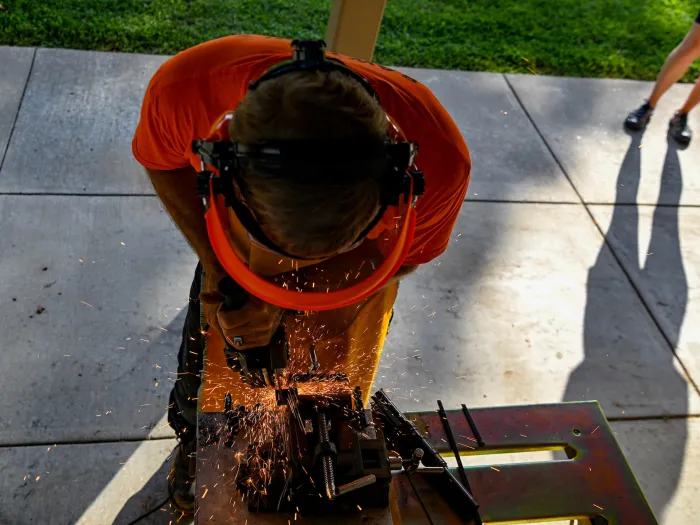
Other actions CFCU and other communities can take are Guns to Gardens events where people bring unwanted guns to be safely destroyed and often turned into gardening tools, echoing the vision in Isaiah 2:4 that God will bring peace to the nations and, “they shall beat their swords into plowshares and their spears into pruning hooks” — an image echoed in Micah and Joel. The Atwood Institute welcomed several Guns to Gardens blacksmiths, including the Rev. Jeff Wild, a retired pastor in the Evangelical Lutheran Church in America who demonstrated his skills this past summer for participants in the Walk to End Gun Violence at the 227th General Assembly of the PC(USA) in Milwaukee.
Watch Presbyterian News Service for more on Guns to Gardens later this week.
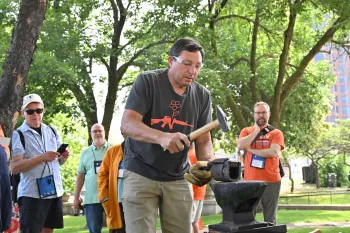
Wild said the Peace Fellowship reached out to him three years ago to present a blacksmithing demonstration and since then he has gotten more involved in the organization and made connections with people from numerous denominations.
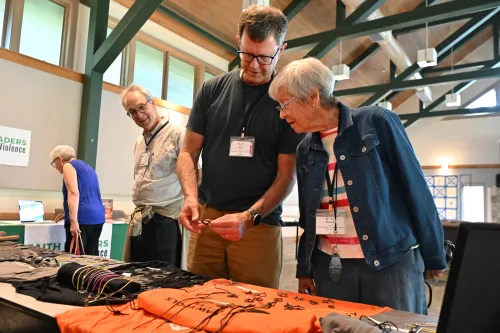
“What I’ve learned especially from Mennonites and Quakers is their historical commitment to peace and nonviolence, and that witness that I see from them has led me into a deeper study of peace and nonviolence,” Wild said. “I’ve come to realize that the biblical understanding of peace is just so robust and how Jesus is an expression of God’s peace, an incarnation of God’s peace, and what a gift God’s peace is to us as individuals.”
The primary Guns to Gardens representatives at the Institute were a Quaker, Scotty Utz, and the Rev. Stan Wilson, a Baptist minister, who co-founded RAWtools South, a North Carolina-based organization that leads and trains people in Guns to Gardens work.
“We are big fans of Presbyterians, even though we’re not Presbyterians,” said Utz, who did study at Princeton Theological Seminary.
Wilson added, “We do a lot of gun disposal events, and most of them are made possible because of grants that come from the Presbyterian Church.”
While gun violence prevention is a distinctly ecumenical movement, the Presbyterian Church (U.S.A.) gets a lot of credit for taking a lead on the issue.
“Backbone,” Wilson said. “Seriously, a church with some backbone to stand up and say we’re going to have a decade that we’re going to address this, and there’s going to be a little conflict about it, I bet, and that’s just going to be something we’re going to work through.”
Wilson was referring an action of the 225th General Assembly in 2022 to launch The Decade to End Gun Violence (2022-2032) at all levels of the church. That was a follow-up to “Gun Violence, Gospel Values: Mobilizing in Response to God’s Call,” a policy of the 219th General Assembly in 2010 that established a theological grounding for the church’s gun violence prevention efforts.
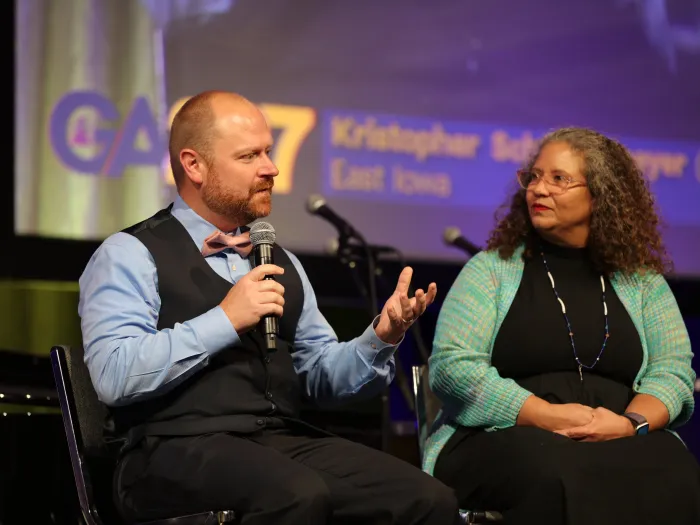
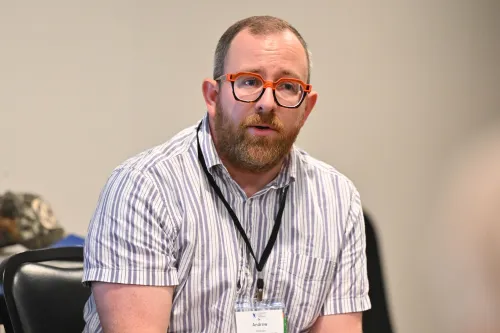
“We have long-standing and very good gun policy, lots of it dating back to the kind of high-profile public assassinations in the late ’60s and early ’70s, and that have been kind of like iteratively updated as gun violence in this country has evolved,” said Dr. Andrew Peterson, Representative for Peacemaking in the PC(USA)’s Office of Public Witness (OPW). “Last year, the extension of that was especially focused around children and what we can do to help them live lives that are free from gun violence and that the trauma of gun violence that they experience is something that the church has something to say about and resources to help work on. That also identified explicitly a number of partners for us to reach out to."
During the Institute, Peterson joined with Episcopal Rev. Hope Christensen, Executive Director of Faith Leaders for Ending Gun Violence, to introduce “Extreme Risk Protection Orders: A Clergy Resource Guide,” a new resource to help faith leaders recognize warning signs and obtain protection, where available, during crises involving firearms. Peterson and Christensen are co-authors of the resource, along with others, that was co-published by the Office of Public Witness and the Johns Hopkins Center for Gun Violence Solutions.
“There are a lot of folks doing good work on this already,” Peterson said. “We don't have to have our own Presbyterian version of every piece of it. Instead, what we could do is be good partners in ministry.”
The Atwood Institute, he said, is a great resource for connecting the policy work that OPW does with the work being done in faith and secular communities across the country.
“It’s not just for Presbyterians,” Peterson said. “It’s a way for us to get in touch with and build relationships with the kind of partners that the General Assembly has identified as worthy of really deepening those relationships.”
In addition to fellow faith leaders, Atwood participants heard from public and community leaders who reiterated the importance of the church having a voice in gun violence prevention.
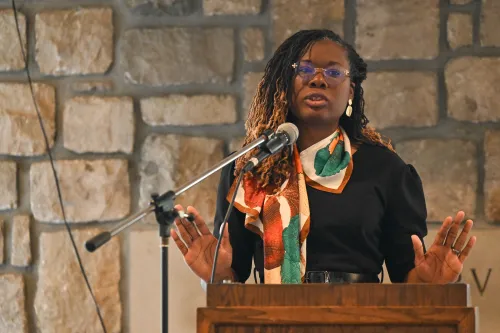
"You all, as faith leaders, you all as people who care and love and know inherently that we all have value and that we all are image bearers of God are uniquely situated to remind people that we bear God's image in our beloved,” Dr. Marvia Jones, Director of Public Health for Kansas City, Missouri, said in a morning talk. “And I want to thank you for doing that because I know that it gets tiring, and I know that it gets stressful. I know that it can feel discouraging.”
Read more about the event:
Presbyterian peace leader: Gun violence prevention is our lane
You may freely reuse and distribute this article in its entirety for non-commercial purposes in any medium. Please include author attribution, photography credits, and a link to the original article. This work is licensed under a Creative Commons Attribution-NonCommercial-NoDeratives 4.0 International License.