Mid council leaders hear from women with plenty to offer them
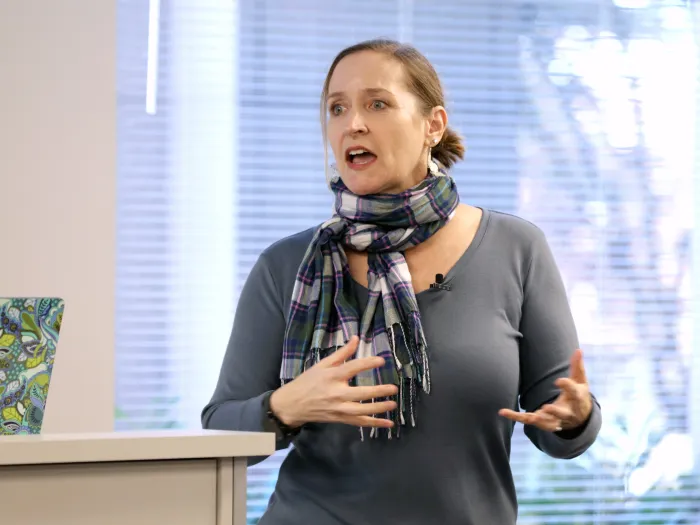
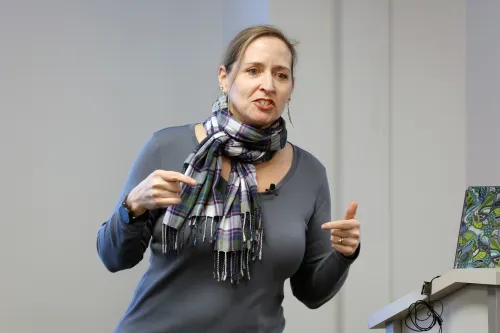
The Rev. Jihyun Oh and the Rev. MaryAnn McKibben Dana speak to the Mid Council Leaders Gathering
LOUISVILLE — During their second day gathering at the Presbyterian Center in Louisville, Kentucky, and online, mid council leaders from across the country heard from two pastors with plenty to offer them — the Rev. Jihyun Oh and the Rev. MaryAnn McKibben Dana, who also spoke on Monday.
Speaking first, Oh, the Stated Clerk of the General Assembly of the Presbyterian Church (U.S.A.) and Executive Director of Presbyterian Life & Witness, built on some of what she told mid council leaders during their gathering last year. Her 2025 address focused on curiosity “as an innate characteristic that needs to be nurtured amidst all the challenges we’re undergoing — many of which you are midwifing and stewarding in your councils,” as well as changes to the PC(USA)’s national structure, including PL&W, Oh said.
Curiosity can help us “to wonder more openly about God’s vision for the world and our changing call as God continues to do a new thing,” she said, “and it’s something that helps deepen compassion.”
For Oh, new curiosities for 2026 include artificial intelligence, where there are “knowledge and curiosity implications.”
“We often forget to consider what’s not there,” Oh said. “What is missing and how will we know? How will we be a church that lives into our greatest aspirations for equity and full participation, and live into our values of unity and diversity in the midst of all that?”
What questions can we ask, she wondered, “to lean into our values and our best aspirations to be able to do the human work alongside what’s being done by machines now?”
Oh spoke about the AI implication of cognitive surrender. “More and more humans are rendering their cognitive processes through machines because it’s easier,” Oh said. “If we say democracy relies on us having a well-educated and critical base of people who are participating and doing all the things, that can have huge implications.”
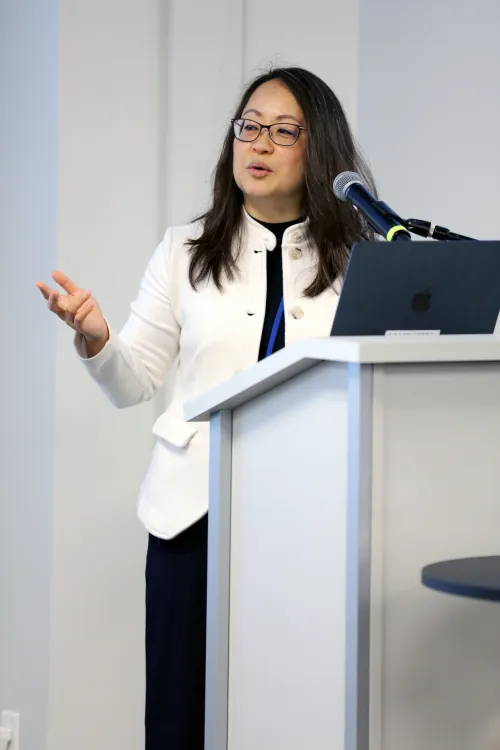
“If curiosity is a way of seeing God’s activity in the world, a question I wonder about is what are the narratives we live out and what are the prevailing narratives in the church,” Oh said. “Does God show up in our narratives? How will we be a church that brings forth Christological values in this time?”
She also wondered about “what needs to shift” in formation and education “to equip and inform leaders for now and the future.”
Oh asked mid council leaders to turn to their neighbors to discuss the narratives they’re hearing. Some reported back to the group, including one mid council leader who’s hearing “narratives of scarcity and how the church is dying, and yet we’re still here and somehow we are finding resources to do the work God is calling us to do.”
Another said that “much of the narrative of local congregations is expressed through the songs they sing. Themes of suffering and hope are consistent themes that find expression through the biblical narratives in Exodus, and feed other dimensions of life.”
“Narratives can help us endure,” Oh replied. “There are communities that have been practicing this for a long time and can help us find another way.”
“There are so many narratives on how broken things are,” another mid council leader shared. “It’s easy to get caught up in that downward spiral.” But churches in the presbytery she serves have helped people to secure work visas. One church “built a food pantry that looks like a mini supermarket.”
“What you do matters,” Oh said. “The stories of the early church were that people looked at them and said, ‘See how they love one another,’ not how they overthrew the Roman oppression.”
Another mid council leader noted that ordination vows call for serving with energy, intelligence, imagination and love, “but we skipped over imagination. How do we tap into that piece in order to be creative? We have to be willing to do experiments,” without fear of failure.
“You are speaking to my heart,” Oh said.
“We talked about the false narrative that young people don’t care about the church anymore,” another leader said. “Their faith and their spirituality may be deeper than ours was at the time, and it’s been interesting to see how the younger generation experiences faith.”
Another prevailing narrative “is one of polarization, creating boundaries of us versus them,” Oh said. “The question for me is, if curiosity is a path toward deepening compassion, what are we judging in people that is merely different? They aren’t seeking it in the way we are, so we can’t recognize it. How will we be a church that holds spaces of belonging and not othering? How will we be a church that bridges and doesn’t break?”
We do love our hero narratives, Oh said, accounts of someone riding in and solving our problems in just a few hours. “We look for magic bullets and magic pills,” she said. “It is unsurprising that some churches believe the one right person will fix all that’s broken and they will return to their glory days.”
Or we trust that a single General Assembly overture will fix racism or ensure gender justice. “General Assembly is important, but that overture or that committee will not save us when we ignore underlying health and vitality,” Oh said, adding, “There is no more low-hanging fruit. All that remains are intractable things that we think about over and over again. How can we work on short-, medium- and long-term horizons that help us dream of the church 50 or 100 years from now … so we have hope for the future and not just kick cans down the road for the church that comes after us to fix?”
As she did last year, Oh left mid council leaders with Romans 2:12, telling them that “wondering together is so necessary for us to get to these transformative actions that give witness to the voice and praxis that really shows forth the good news of Jesus Christ in the world. At the end of the day, isn’t that what the church is called to do?”
After a break, McKibben Dana took to the lectern. Her most recent book is “Better Than Normal: Virtues for an Off-Script Life.” She also spoke at the 2025 edition of Synod School, offered each summer by the Synod of Lakes and Prairies. Read more of what she had at Synod School here, here, here, here and here.
McKibben Dana picked up on some of the themes Oh touched on. Why, McKibben Dana wondered, are we so interested in anti-heroes and grim narratives? We may be waiting for a hero to fix it for us, but “right now we are in a phase where we are more interested in the nuanced middle ground, the villains who may have a point or heroes who have flaws and frailties,” she said.
The novelist Alexandra Rowland coined the term hopepunk, work “that’s ours to do, even if we fail,” McKibben Dana said. “It’s the aesthetic of kindness and gentleness. What are the values Jesus embodied? Those are the ones we are called to embody as well.”
McKibben Dana touched on some of those values, which she expands on in her book, including embracing:
- Community over competition
- Curiosity over comfort
- Presence over productivity
- Authenticity over artifice
- Beauty over blandness
- Community over competition.
An executive presbyter told the group, “A phrase I was given is to stay curious a little longer. As the mother of a neurodivergent child, I wish someone had provided that to me.”
McKibben Dana also cited the work of Amy Julia Becker and the disability advocacy work she does “with organizations that take belonging seriously and those who do not.”
“It’s culture work,” McKibben Dana said, “and it’s gospel work.”
On that final value, community over competition, McKibben Dana called the gathering she was addressing “an expression of this.”
“What I overhear when I pass by conversations is we are working together and refusing to accept that you need to lose in order for me to win,” she said. “I commend you for being in that space with one another.”
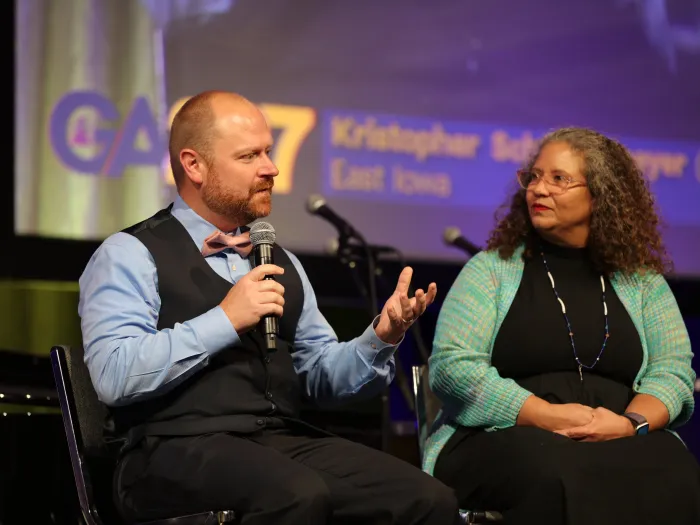
Before lunch, the Co-Moderators of the 227th General Assembly, the Rev. Dr. Kris Schondelmeyer and the Rev. Marta Pumroy-Cordero, thanked mid council leaders for the work they’re doing “to help us walk together,” as Schondelmeyer put it.
They also asked mid council leaders to help identify Presbyterians to serve on General Assembly boards and commissions. Application deadlines are nearing. Learn more here.
“We are truly trying to discern the call of the Spirit in this moment,” Schondelmeyer said. “We will continue to discern until we find the right people to do the work God has for us to do.”
Pumroy-Cordero offered the blessing before lunch.
You may freely reuse and distribute this article in its entirety for non-commercial purposes in any medium. Please include author attribution, photography credits, and a link to the original article. This work is licensed under a Creative Commons Attribution-NonCommercial-NoDeratives 4.0 International License.