Figuring out the healing activities that are ours to do
Synod School convocation speaker the Rev. MaryAnn McKibben Dana explores what courage looks like

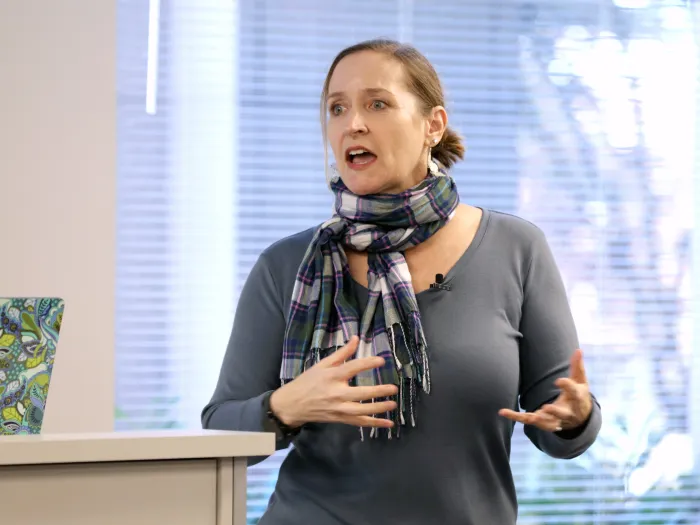
STORM LAKE, Iowa — The Rev. MaryAnn McKibben Dana, the adult convocation speaker at Synod School this week, took on a timely topic Wednesday: what it means to be courageous in this difficult time we’re in.

Her engaging talk included a myth from Oceania, the thousands of Pacific Ocean islands that include New Zealand.
While bathing in a river, a tribal leader used to shed her old skin and return to her village anew. One day, her daughter didn’t recognize her in her new skin and ran away in terror. The tribal leader returned to the river, found her old tangled skin, and put it on again so her daughter could recognize her. But from that day on, the people lost their ability to be transformed.
That reminded McKibben Dana, an author and pastor, of the occasion in the Exodus account when people grumbled about returning to Egypt.
“This world we’re trying to build will feel uncomfortable,” she said with a nod to this quote from Dr. Harold Clarke Goddard: “The destiny of the world is determined less by the battles that are lost and won than the stories it loves and believes in.”
Or, as Father Richard Rohr put it: “If you don’t mythologize, all you can do is pathologize.”
A myth, McKibben Dana pointed out, is a “story that’s deeply true.” Therapy “is a helpful tool, but it is insufficient. We heal people when we say, ‘you are part of a bigger story.’”
The science fiction writer Ted Chiang teaches there are two basic story structures, conservative and progressive, and they have nothing to do with politics.
In a conservative story, the world starts out in a good place. Evil threatens and is defeated, and the world goes back to being a good place. In the Bible, McKibben Dana noted, we start in a garden and end up in a city. There is struggle and restoration.
In a progressive story, the world starts out as a familiar place. That familiarity is disrupted, and the world will never be the same — in good ways, hard ways, or both. There is no going back.
“Conservative stories can uphold comfort in a way that may not be healthy for us as a culture,” she said. “Progressive stories are hard to hear, but they can help us build capacity for courage.”
The Superman movies of the late 1970s are examples of conservative stories. “It’s an origin story. Lex Luthor is wreaking havoc,” she said. At one point, Superman circles the globe to turn back time. Eventually, he plants a flag at the White House and tells the president he won’t have to worry again.
The Avengers movies are progressive stories. “Right at the end, there is the undercurrent that all is not well. We now have enhanced beings who have superpowers the rest of us don’t have. Will they be looking out for our interest?” McKibben Dana wondered. “They aren’t accountable and they invite struggle and adversaries to come at us. They make the planet a target, and the world is no longer a familiar place.”
We ought to understand the Christian story as “a deeply progressive story,” she said. “The resurrection of Jesus does not restore us to utopian reality. It asks something of us: What does it mean to live in the new reality Christ brought to us?”
She used this C-SPAN 2 clip to highlight Dr. Bettina Love’s explanation of the difference between an ally and a co-conspirator. The story includes a white man, James Tyson, touching a flagpole to prevent the possible tazing of a Black woman, Bree Newsome, who’d climbed the flagpole outside the South Carolina State House to remove the Confederate flag.
“Use your privilege!” Love urged the audience during a 2019 talk, comparing whiteness to an ATM card that keeps on replenishing itself. “James Tyson just put his hand on a pole.”
McKibben Dana said her husband told her that tazing a pole “wouldn’t do what Love describes, but it’s a powerful parable,” McKibben Dana said. “His being in proximity made a difference. We take the steps we are capable of taking.”
“The courage we are trying to live toward is a vulnerable courage,” she said. “It’s not impervious to harm. It’s soft and kind.”
She explained grimdark and noblebright, two forms of fantasy stories. In grimdark stories, everyone is out for themselves. “We are irredeemable. It is total depravity,” McKibben Dana said. Noblebright stories feature “a conquering hero who rides in and saves the day.” We have elements of that in our Christian story as well, such as Christus Victor, in which Jesus’ death and resurrection are victorious over evil, sin and death.
There is also a middle ground, HopePunk, a term coined by Alexandra Rowland. It centers an ethic of kindness and gentleness. In HopePunk stories, the fight to build a positive world is worth having, even if we don’t succeed. The emphasis is on community over competition, but there’s not necessarily a happy ending.
McKibben Dana said she finds elements of the HopePunk genre in biblical stories, including the Good Samaritan and Jesus’ parables about ordinary elements including salt, yeast and the mustard seed. It’s also in the Last Supper, “Jesus loving his friends to the end.” A friend described that to McKibben Dana as “the final meal of a death row inmate.”
It's also found in pronouncing forgiveness from the Cross to two criminals. “It’s courage that’s not impervious, but it’s soft,” she said. It’s the civil rights movement, including people linking arms to walk across the Edmund Pettus Bridge.
McKenna Dana sent out those gathered “to be courageous. Be open to an idea that feels challenging,” to “figure out what is ours to do to heal the world.”
You may freely reuse and distribute this article in its entirety for non-commercial purposes in any medium. Please include author attribution, photography credits, and a link to the original article. This work is licensed under a Creative Commons Attribution-NonCommercial-NoDeratives 4.0 International License.