The road to wisdom
Dr. Francis Collins, a renowned scientist and physician, delivers the Gotto Lecture at Fifth Avenue Presbyterian Church in New York
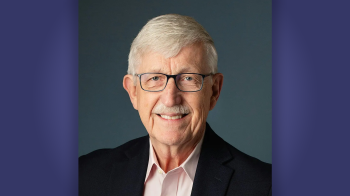
LOUISVILLE — Dr. Francis Collins, who led both the Human Genome Project and the National Institutes of Health and has been described as “a geneticist, physician and faithful soul,” delivered the Anita and Antonio Gotto Lecture last week at Fifth Avenue Presbyterian Church in New York. The Rev. Dr. Scott Black Johnston, senior pastor at the church, introduced Collins and then asked a few questions following Collins’ engaging talk, which can be seen here.
For good measure, Collins capped his 65-minute appearance by playing his guitar named Rosalind, named for renowned scientist Dr. Rosalind Franklin, whose photo first revealed the double helix of DNA. The guitar, which features a double helix along the fretboard, was a gift from staff at the National Human Genome Research Institute when Collins stepped down from leadership there in 2008. Collins asked those gathered in the sanctuary Thursday to join him singing Thomas Troeger’s “Praise the Source of Faith and Learning,” set to HYFRYDOL.
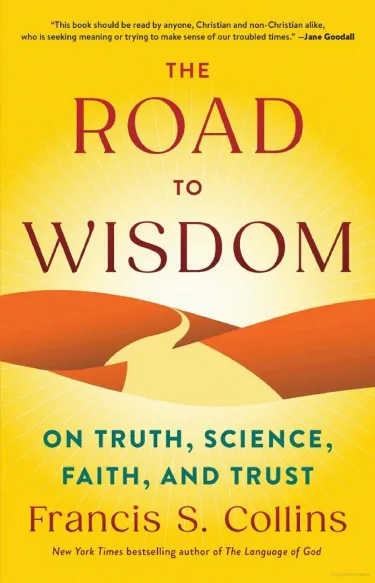
Collins spoke on “The Road to Wisdom,” which matches the name of his most recent book, published in 2024. “I think our country has been struggling a bit with that road and with distractions that have caused us not to move in a happy linear pathway … toward greater knowledge and greater opportunities to spread that knowledge,” he said, calling wisdom “not just knowledge, although if the knowledge is wrong the wisdom is not going to get very far.” Wisdom “really kicks in,” he said, when knowledge is deepened by moral guidance.
Collins talked about growing up on a farm in the Shenandoah Valley in the 1950s and early 1960s. Until 6th grade, he was taught at home by his parents “because they thought they were better teachers than the local county schools, and they were probably right about that.” His parents “were not interested” in matters of faith, he noted.
His love of science caught fire in 10th grade when his chemistry teacher “helped me understand that science is a detective story,” Collins said. “Why wouldn’t you want to do that?”
His undergraduate degree and doctorate are both in chemistry. “Along the way I realized I had narrowed my horizons a little early, and there was this other chemical I had kind of ignored: the most amazing chemical of all, and that was DNA,” which is “made up of atoms in a particular arrangement. Think of these as letters in an alphabet — A, C, G and T. That’s enough, apparently, to carry from parent to child down through the generations and the eons information about how to build a really complicated body, including yours.”
This DNA molecule — all 3.1 billion letters of A, C, G and T — is sufficient to instruct “that one cell over the course of time to be able to develop into something truly amazing. If that doesn’t make you feel in awe, I don’t know what will,” he said, “because I am still in awe of that.”
As long as Collins was taking his interest in chemistry and moving it into life science, he concluded that “I might as well go to medical school.” He trained in internal medicine and did a fellowship where he could learn molecular biology. He ended up as an assistant professor at the University of Michigan, where he carved out a career as a gene hunter. In 1989, he and his main competitor joined to work on fighting cystic fibrosis. They found just three out of more than 3.1 billion letters are missing from the DNA of most people who have the disease. “Although it took 30 years, if you are a cystic fibrosis patient where you have those three letters missing, you can plan for retirement,” he said, “and that was not the case when we started.”
Collins and his lab worked on other diseases as well, including Huntington’s disease, and then he was asked to run the Human Genome Project at NIH. “Most scientific people were against it because they thought it was going to fail,” he said. But with “a lot of incredible talent” recruited by Collins and others, the project’s biggest milestone was completed two years ahead of schedule and $400 million under budget, which “made Congress happy,” he said.
He credited “2,500 scientists from six countries who all agreed to drop everything and put forth their best efforts,” including giving away all their data every 24 hours. “This is our shared inheritance, the human genome,” he said, “and it ought to be accessible to everybody.”
From there he was called to direct the entire NIH, work he did for 12 years under three presidents until he finally retired last year. “I had the chance to build a project on trying to understand the most complicated structure in the known universe, which is your brain, as well as starting projects that could really put together everything we’ve learned about genetics and environment and health behaviors and socio-economic status, and understand how it is you could keep people healthy … by actually curing them, which has now been achieved for sickle cell anemia, an enormously important source of achievement.”
In 2021, “I was asked to leave, along with 2,000 other people at NIH, which has been a very difficult time for what was an amazing institution to be set so far back on its heels,” Collins said.
A scientist walks the path of faith
“That’s my scientific journey,” he said, “but what about the part about being a Christian?”
A turning point for Collins was his third year of medical school, when students were turned out of the classroom to care for patients, “many of whom were really sick.”
One patient, a warm and friendly woman who reminded Collins of his grandmother, had “really bad heart disease.”
“She shared her faith with me on a regular basis, and I would feel awkward,” he said. One afternoon, she suffered a bad episode of chest pain. Collins sat at her bedside while she prayed, and she got through the pain.
“She asked me, ‘Doctor, I’ve shared my faith with you a few times and you never say anything. What do you believe?’”
“I guess I don’t really know,” he told her, “and she looked at me like, ‘you don’t know? You haven’t thought about this?’ I realized I was in trouble,” Collins said. “I had never spent more than a minute or two thinking about why do people believe.”
“I was worshiping a particular faith called scientism, which is to say science is all there is, and everything else is ruled out of order,” he said. “I needed a plan to strengthen my atheism, but it didn’t turn out that way. I thought, if there is a creator outside of nature, what would that look like? I realized I’d been studying nature, and all along the pointers were right in front of me. Nature provides some interesting pointers to God.”
“There is something instead of nothing, and science can’t tell you why that is,” Collins said. “Somebody seems to have set the dials, and that was pretty compelling. More and more, a Creator God was looming in front of me, just as it did for Einstein and just as it did for Stephen Hawking.”
“Does this God care for me? That was a harder question,” Collins said. A pastor who lived down the street handed the young doctor a copy of “Mere Christianity” by C.S. Lewis. “We’ve all had those experiences when something comes along — maybe it’s in a church like this, maybe it’s a musical experience — when you just feel lifted out of yourself,” Collins said. “It’s almost like you’re longing for something. It’s joyful and maybe a little painful because you think ‘this is where I should be,’ and yet as quick as it’s there, it’s gone.”
“Lewis calls that joy, and we’re surprised by joy when it happens, but it does seem to be another signpost” pointing toward God, he said.
“Everything that happens in the laboratory is beautiful. It’s a glimpse of an amazing creative genius,” he said. “The laboratory is not that different from a cathedral, and maybe science isn’t that different from worship, because we are given an opportunity to see God’s Creation in all of its beauty.”
On a hike in the Pacific Northwest on a fall day, “beauty got to me,” Collins said. “I turned the corner and saw the amazing sight of a sort of frozen river cascading down a cliff. I fell on my knees and gave my life to Christ in the dewy grass.”
He said he’s never found his faith “to be a place of conflict with what I know as a scientist.”
“They’re both gifts from God,” Collins said. Seventeen years ago, he founded BioLogos, a foundation “that aims to bring together serious Christians who are also serious about science” to explore how civil discourse “can lift us all into a place of even greater awe.”
The state of the nation and our world
“We see glimmers of getting together, but we’ve got a long way to go,” Collins said. Our tribalism is killing people, and there’s no better example than Covid, he said. The NIH director at the time of the pandemic, Collins noted the mRNA vaccines developed by Moderna and Pfizer saved 3.1 million American lives and an estimated 20 million people worldwide. “Some of you may be among them. I might be one of them, too.”
Yet between fall 2021 and spring 2022, more than 50 million Americans declined the vaccine, and more than 230,000 unvaccinated people died in the U.S. after vaccines were freely available. The current administration is now discouraging the development of mRNA vaccines for future pandemics.
“Something is really wrong here,” Collins said. “I will take some responsibility along with some of my colleagues in the government for having failed in certain ways to communicate why the vaccines should have been seen as safe and effective. I think we didn’t do a compelling job of competing with all the messages that were coming from social media and from some politicians, and that is something we should learn from.”
To his “great amazement,” Collins now finds himself as the CEO of a startup, Discovery Lives in Us, which seeks to boost public support for research. Collins shared some participants’ personal testimony found here.
“The most important thing we’re trying to do is to try to tell stories, because that’s what people respond to,” he said. “I don’t think our politicians are going to solve this and I don’t think the media is going to solve it. It’s up to us.”
Re-anchor your worldview to the timeless principles of service and love for neighbor, Collins suggested. Re-read the Sermon on the Mount. Develop better intellectual radar to distinguish facts from fakes. “Social media and cable news bay not be your friend here,” he said.
Engage with family and friends outside your bubble. Collins has joined Braver Angels, “which has taught me a lot about how to do this.
“‘Here’s what I heard you say.’ ‘Yeah, that’s what I said,’” the Braver Angels conversation generally goes.
“Does that sound like marriage counseling? Does our country need marriage counseling? We need to do more of that,” he said.
So how can we get wisdom? For Collins, it’s spelled out in the Epistle of James, especially in 1:5 and 3:17.
“If we could all stand up for that kind of wisdom and share it with those around us, then I think we’d find a path forward of flourishing in our society and the church could be right out in front,” he said. “Thank you all.”
You may freely reuse and distribute this article in its entirety for non-commercial purposes in any medium. Please include author attribution, photography credits, and a link to the original article. This work is licensed under a Creative Commons Attribution-NonCommercial-NoDeratives 4.0 International License.