Final session of religious liberty webinar series to explore church's responsibility in civil life
The Oct. 30 session will feature the Stated Clerk of the General Assembly and the Director of Advocacy and Witness for PL&W
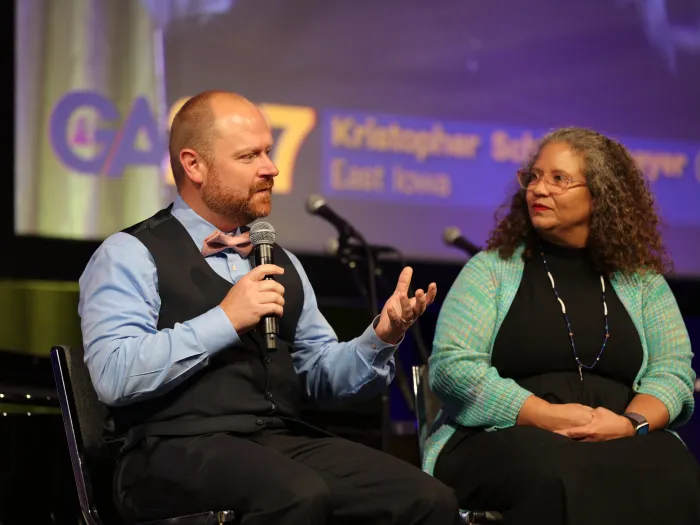
The Rev. Dr. Kris Schondelmeyer and the Rev. Marta Pumroy-Cordero, Co-Moderators of the 227th General Assembly of the Presbyterian Church (U.S.A.), are gearing up for the third and final session of their online series, “Why 'Presbyterian' Will Never Be a Political Party.” The conclusion of the series is titled, “The Church’s Role in Civil Society” and will take place via Zoom on Friday, Oct. 30, at 1 p.m. Eastern Time.
Like the previous sessions, the webinar will feature two prominent PC(USA) leaders as guests: the Rev. Jihyun Oh, Stated Clerk of the General Assembly and Executive Director of Presbyterian Life & Witness, and the Rev. Jimmie Hawkins, Director of Advocacy and Witness for PL&W. Alongside the Co-Moderators, Oh and Hawkins will explore what the church is — and isn’t — called to do in public life.
The series draws from a resource of the same name that was developed in the lead-up to the United States’ 250th anniversary and distributed to participants at the 227th General Assembly in Milwaukee this past summer. That resource, in turn, is based on a 1988 social witness policy from the 200th General Assembly called “God Alone is Lord of the Conscience.”
During the second webinar, Schondelmeyer said the purpose of the series is to explore together “how our faith shapes the way that we discern, disagree and participate in public life, and live faithfully with our neighbors.”
Pumroy-Cordero also emphasized that the series isn’t about “telling Presbyterians how to vote, or asking everyone to agree politically.”
The Co-Moderators planned for each session of the series to correspond to one of the three major sections of the resource on which it is based. The section on the church and civil society describes the Reformed understanding that — in accordance with Scripture — “the church is called to bear witness in the civil society to the insight and vision freely given by the free Spirit.” It goes on to say that the church should seek to function as “a sentry” that cries out when it sees something wrong and that it has a responsibility to “prepare its members to serve peace, justice, and order in the vocations and governance of the common life.“
The Oct. 30 webinar will examine what this Reformed understanding means for the PC(USA) in the modern political and social landscape.
Hundreds attended the series’ first two sessions, which took place on Oct. 2 and Oct. 16.
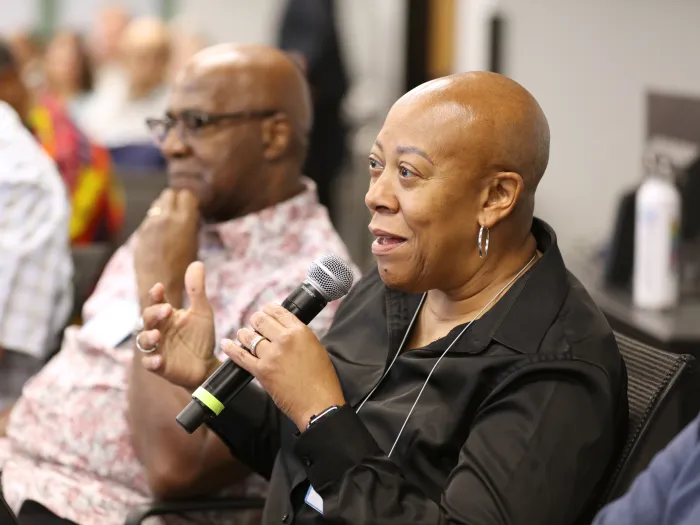
The first session dove into the denomination’s theological convictions around religious liberty, featuring insights from the Rev. Denise Anderson, Director of Restorative Justice Ministries for PL&W, and Flor Vélez-Díaz, a ruling elder and Manager of Judicial Process for PL&W. Vélez-Díaz has a law degree.
Last Friday’s session, called “State and Citizen,” turned attention to what the denomination’s theology around religious liberty means for individual Presbyterians and their responsibilities as both Christians and citizens of their governments. For that conversation, the Co-Moderators brought in the Rev. Dr. Aimee Moiso, who is the Manager of Social Witness Policy for PL&W and developed the resource on which the series is based. The session also featured the co-chairs of the Advisory Committee of Social Witness Policy, the Rev. Jeromey Howard and the Rev. Sue Trigger.
Early in the session, Schondelmeyer referenced the upcoming midterm elections, telling participants, “this is an important time for us to ground ourselves before we engage in civic action.” He went on to encourage everyone to register to vote if they had not already, saying, “We do have a responsibility to be engaged in public life.”
During the hour-long conversation, the panelists discussed how Christians should balance respecting governmental authority and challenging injustice.
“We know by Jesus' own example that there were times when he challenged the government, he challenged authority because what they were doing was causing harm and injustice,” Trigger said.
Howard, an Air Force veteran, pointed out, “This requirement to blindly obey the civil authority is not ingrained into the traditions of our own nation, even.” He explained that the oath and expectation in the military was not to obey any order that was unlawful.
“We as Christians have been asked to adhere to something higher that has more authority than the civil government.” Howard said. He emphasized Jesus’ command to love our neighbors, saying that when our neighbors are being harmed, we are called to respond.
“The tension lies in what does that action look like," Howard said.
Schondelmeyer acknowledged that people might disagree about how Christians should respond to their governments in the face of harm, and asked panelists to consider how individual Presbyterians should interpret the official social witness policies of the church. Trigger pointed out that our faith does not call us as individuals but as community.
“One of the gifts of our Presbyterian and Reformed system is that we listen to one another in these voices that we feel are messages and are callings from God, and then we discern them together, understanding that love is the foundation of all we do.” Trigger said. “When we come from that perspective, there's room for different opinions.”
Moiso clarified that the official social witness policies voted on by the General Assembly are meant to guide the actions of the church, its leaders, and its individual members. How that guidance is implemented can vary widely in form and context. Referencing specifically the policy that "God Alone is Lord of the Conscience," she explained that it means God is the one to whom we ultimately answer, and our faith calls us to hold in tension our individual understanding of God’s calling and our collective discernment.
“None of us has the whole vision of what God's will is, so we need the body to help us discern together, and none of us should be subject to an over, an overarching rule to which we have to comply that supersedes our individual contents of what we believe God is calling us to do,” she said, adding that this tension is the foundation of all of the church’s social witness policy.
Moiso also pointed out that our faith calls us to interact as citizens not only in terms of how we engage with elected officials at the highest levels of government, but also how we engage with our local communities and the ways in which they support their members.
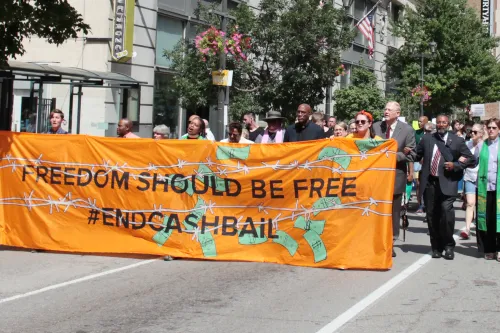
“Who's building parks? Who's making sure schools have enough teachers and resources? Who's collecting trash? Who's getting paid a fair wage? Some of these are electoral decisions and some of them are community-based decisions,” Moiso said. She also lifted up questions of how one connects with their neighbors and supports communal flourishing, access and welcome.
“These are all sort of government and they're also sort of liberation for everyone so that everyone can live a life in fullness.”
The final portion of the conversation focused on how to love one’s neighbors in the face of disagreement about what faithful citizenship looks like.
Each of the panelists emphasized the importance of being in authentic and honest relationship with others while acknowledging that sometimes disagreements cannot be overcome. Even in those cases, however, they said Christians are called to remember and respect one another’s humanity.
“Every single human being is part of this conversation and relationship,” Howard said. “They are our neighbor, and we must be in conversation with them, and in relationship with them, whether we agree with them or not. So when we engage in this conversation, it's not about the state and the citizen as much as God and all of us in relation together.”
Pumroy-Cordero then set the stage for the final webinar session, asking, “If Christians are sometimes called to challenge the state, what responsibility does the church have to speak and act in public life? When should the church raise its voice?”
Registration is open for the final installment, addressing “The Church’s Role in Civil Society,” and it is open to all, including those who have not attended previous sessions. The Co-Moderators encourage people to read the resource in preparation, but no advanced preparation is required for participation. More information is here.
You may freely reuse and distribute this article in its entirety for non-commercial purposes in any medium. Please include author attribution, photography credits, and a link to the original article. This work is licensed under a Creative Commons Attribution-NonCommercial-NoDeratives 4.0 International License.