Walking wisely in these days
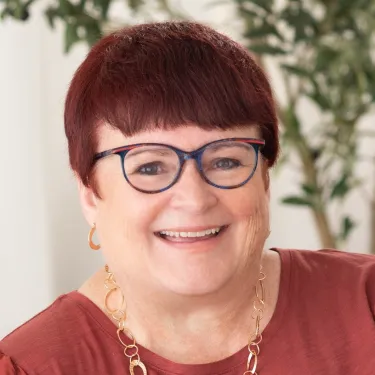
The Rev. Denise Shannon leads a workshop for the Presbyterian Older Adult Ministries Network
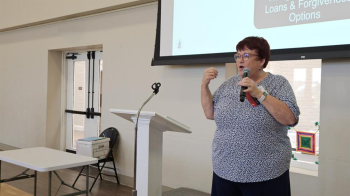
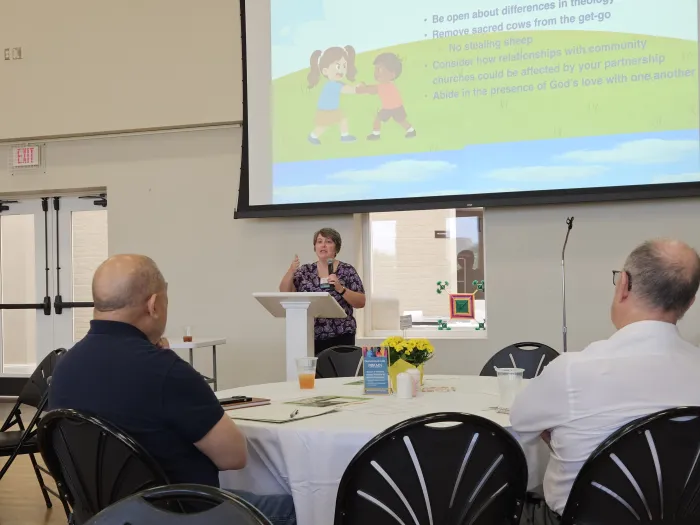
LOUISVILLE — The Rev. Denise Shannon has been helping the congregation she serves, Westminster Presbyterian Church in Westminster, Colorado, to walk wisely as it navigates troubling times in the nation and around the world. Shannon, who’s also moderator of the Presbyterian Older Adult Ministry Network, brought what she’s learned to a workshop at POAMN’s “Rooted in Hope” conference held earlier this month at First Presbyterian Church in Knoxville, Tennessee.
Shannon called her workshop “Walking Wisely in These Days: Faithful Discernment for an Anxious World.” Her workshop slides are here.
“We are living in a time where almost every issue seems to be a dividing line,” Shannon said, naming as the reason for the Walking Wisely series: “People needed a place to ask hard questions and discuss the difficult issues in the world without arguing or having conversation shut down.”
“The question became, can we be a place where we disagree without losing one another?”
Westminster Presbyterian Church launched Walking Wisely, “which came from the posture we wanted — not winning, proving or fixing,” Shannon said. “Wisdom asks us to listen for more than information — it askes us to listen for understanding.”
“What kind of world are we living in,” was a question central to launching Walking Wisely, “and what are we going to leave our grandkids?”
Among the goals for Walking Wisely was making room “for lived experience alongside Scripture, history, science and current realities,” she said, and “leaving the room more connected and not necessarily more certain.”
“’I don’t know’ is a faithful answer,” Shannon said.
She said the approach works well with older adults because they’ve “lived through enormous cultural technological, medical and theological change.”
In addition, “they often have both deep convictions and deep questions,” according to Shannon.
The architecture of a typical Walking Wisely session is this, she said:
- Center with an opening prayer, Scripture or grounding question
- Frame — why this topic matters, and “what we’re actually asking”
- Explore information, Scripture, context and lived experience
- Practice a question, scenario or small-group exercise
- Integrate — what did I hear? What challenged me? What remains?
- Close with a prayer “and a way to carry the conversation into the week.”
To date, Walking Wisely conversations have included Christian nationalism; violence, war and peace; the question of whether science and faith coexist; immigration and ICE; poverty, hunger and homelessness; health and healthcare; and others.
Shannon said four threads have through every Walking Wisely conversation:
- Faith — what does Scripture say, and what does it not say? What theological assumptions are we bringing with us?
- Humanity — whose story or lived experience might we be missing?
- Complexity — what gets lost when we reduce a complicated issue to a slogan?
- Practice — how might our faith change the way we speak, listen, vote, serve, advocate or love?
During the POAMN conference workshop, Shannon had participants engage in a briefer version of the “can science and faith coexist” conversation. She asked, “When you hear the words ‘science’ and ‘faith,’ what emotions come up?” Subsequent inquiries included, “Have you ever felt you had to choose what science says over what your faith says?” and a discussion on the assertion that “God is not threatened by discovery.”
Discussion questions included “One scientific discovery that fills me with awe is …” and “How does that discovery help me appreciate God even more?”
Shannon said she learned a few lessons about facilitating such a gathering, such as “you cannot facilitate safely if you are afraid of disagreement,” “people need to know what is expected,” “a good question is often more powerful than a good lecture,” and “facts matter, but facts alone rarely change hearts.”
“Walking Wisely treats older adults as thinkers, theologians, storytellers and contributors,” she said. “They still have something to say and to share.”
“You really can have a hard conversation with others if you want to,” Shannon noted. “It moves beyond keeping people busy toward helping people make meaning. It says, ‘Your life experience belongs in the conversation.’”
Shannon has ideas for future conversations, including AI and human wisdom; aging, dignity and end-of-life decisions; loneliness and belonging; faith in a post-Christian culture; mental health and the church; money, wealth and faith; and what does it mean to be a good neighbor?
She said she’s been approached to publish the curriculum, an undertaking planned for early 2027.
Among the takeaways Shannon wanted workshop attendees to take home with them:
- Hard conversations are part of discipleship
- Older adults have wisdom to contribute, and not just needs to meet
- A covenant can make a courageous conversation possible
- Curiosity is a spiritual discipline
- The goal is not consensus. “The goal is faithful presence, deeper understanding and stronger community,” Shannon said.
You may freely reuse and distribute this article in its entirety for non-commercial purposes in any medium. Please include author attribution, photography credits, and a link to the original article. This work is licensed under a Creative Commons Attribution-NonCommercial-NoDeratives 4.0 International License.