‘In old age, they still produce fruit’
Closing worship at the Presbyterian Older Adult Ministries Network conference turns to Psalm 92 for wisdom
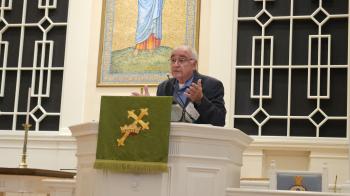
LOUISVILLE — The Rev. Dr. Dennis Falasco, pastor of First Presbyterian Church in La Follette, Tennessee, opened his sermon during closing worship at last month’s conference of the Presbyterian Older Adult Ministries Network with a few statistics, including the fact that nearly 3 in 10 Americans live alone and about 1.2 million live in nursing homes.
“These numbers tell us something about the world we live in, a world in which you and I are called to be in ministry,” he said. “But they don’t tell us the most important thing about older adults, do they?” That understanding comes in part from Scripture, and Falasco turned to Psalm 92:12-15, which says the righteous “flourish like the palm tree … in old age they still produce fruit; they are always green and full of sap.”
The “Rooted in Hope” gathering, hosted by First Presbyterian Church in Knoxville, Tennessee, “has helped us face growing questions about aging, caregiving, loneliness, retirement, dementia and lifelong discipleship,” Falasco said. It’s also “offered something many leaders increasingly need: encouragement from colleagues who understand the realities of what it means to serve older adults.” Such a gathering “is critical, because if we are transformed, then we go forward and transform. There is so much value in what you’re bringing into this and what you’re taking home with you.”
“Ministry with and for older adults is not simply about care,” he said. “It’s about discipleship, purpose and helping God’s people continually bear fruit throughout every season of life.”
Falasco has been in ministry for 45 years. Because people have been asking him if he’s close to retirement, he turned to the Bible for any indication of what an appropriate retirement age might be.
Abraham was 75 years old when God called him to leave his home. “Oh, it gets worse,” Falasco said. Moses was 80 when he stood before Pharaoh, demanding freedom for his people. Anna “was of a great age” when she praised God and spoke “about the child to all who were looking for the redemption of Jerusalem,” as Luke’s gospel says.
The Bible is replete with stories that tell us our age “doesn’t cancel our calling,” he said. “You’re still God’s person, and God still has a purpose. God’s plan for you is from birth to death.”
We don’t know why God calls us. “We know that God calls us in spite of us. We know that in spite of us, God uses us,” he said. “Resilience is not simply surviving. It’s becoming spiritually fruitful.”
Older adults “have often walked through things that younger people have no experience in,” Falasco said. Those can include caregiving, illness, retirement, disappointment, changing family structures, loneliness and loss of independence. Those experiences can produce “a wisdom born of fruitfulness, born with God at the center, born with the understanding that God’s center is in us and through us.”
As Paul assured the church in Rome, “affliction produces endurance, and endurance produces character, and character produces hope.”
The church has a gift that the world needs: memory.
“Think about it. Older adults remember what God has done,” Falasco said. “They remember prayers that were answered. They remember [their church] surviving a difficult season. They remember marriages that endured. They remember prodigal children who wandered off and then came home. They remember grief that eventually gave way to hope.”
Congregations need older adults to help younger members remember God’s faithfulness, he said. “We’re not called simply to care for older adults. We’re called to disciple them, listen to them, learn from them and unleash the gifts God has placed within them,” Falasco said. “We’re not called simply to help them finish well. We’re called to help them continue.”
Citing Shel Silverstein’s classic children’s book, “The Giving Tree,” Falasco said the gospel offers “an even more beautiful picture than that.”
“God doesn’t call older adults to give up everything until there’s nothing left to give. God calls us to recognize that we are still God’s beloved children at any age,” he said. “They don’t have to prove their worth by what they produce” and “they don’t have to be young to remain valuable.”
Falasco said it’s his prayer that “as we leave this time together, we become the kind of church that doesn’t ask, ‘What can we do for our older adults?’ but instead asks, ‘What fruit is God still wanting to grow through them?’”
You may freely reuse and distribute this article in its entirety for non-commercial purposes in any medium. Please include author attribution, photography credits, and a link to the original article. This work is licensed under a Creative Commons Attribution-NonCommercial-NoDeratives 4.0 International License.