Reclaiming Christian womanhood beyond patriarchy
Author and lay theologian Chelsea Kim Long appears on ‘A Matter of Faith: A Presby Podcast’
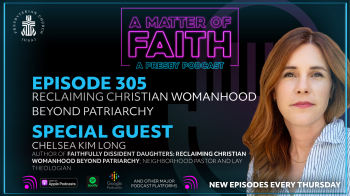
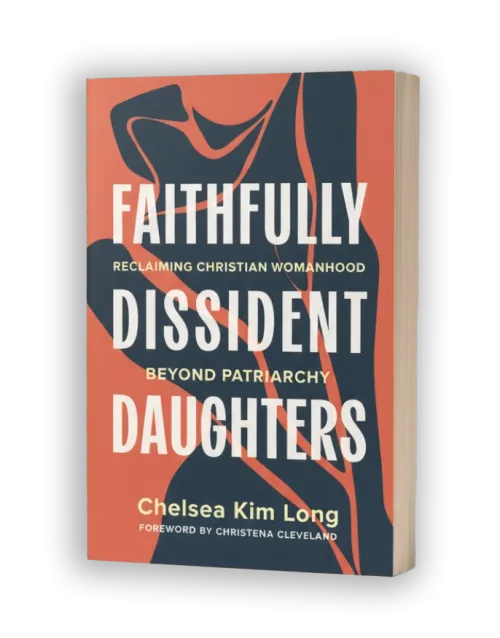
LOUISVILLE — Chelsea Kim Long, who wrote “Faithfully Dissident Daughters: Reclaiming Christian Womanhood Beyond Patriarchy” published this month by Westminster John Knox Press, joined hosts Simon Doong and the Rev. Lee Catoe during the most recent episode of “A Matter of Faith: A Presby Podcast,” which can be heard here.
Long is a writer, lay theologian and meditation teacher exploring Christianity through the lens of women’s embodied experiences and contemplative spirituality.
The hosts opened their time with Long with these questions: How do patriarchal views of Christianity undermine women and womanhood? How can progressive faith communities help empower women to reimagine their faith and relationship with God?
“I will say I don’t necessarily know that progressive churches are the solution,” Long said. “Patriarchy exists even in progressive church spaces.”
Long grew up in “a nondenominational white evangelical church,” she said. “This is a book for people from all kinds of backgrounds.” Her editor grew up “in a more progressive Presbyterian space, and I got to work with her on making this [book] relevant for all people, not just those who grew up really conservative and then entered into more progressive spaces.”
“For people who didn’t grow up in Christianity, patriarchy impacts all of us in the ways it assigns roles and requires us to perform masculinity or femininity in specific ways,” Long said.
Patriarchy shows up “in a lot of ways,” according to Long. “For women, it shows up in our bodies, in mistrusting our bodies. It shows up in an inability to see ourselves in the image of God, even though we all know we are made in the image of God.”
“Even in a church of really nice guys,” she said, “there’s still this hierarchy, and it’s still inherently harmful.”
“When our faith lives are more about compliance and obedience than anything else, it creates a sense of fragmentation, because we have to suppress parts of ourselves in order to continue to belong,” she said. What can help “is to go deeper than even our own theology. We have to go to this baseline level of how do we see God? We have to work to reshape our imagination.”
Long performed an experiment with the hosts, asking them to close their eyes and say what God looks like. “What’s the first image that comes to mind?” she asked them.
For Doong, it was “some kind of fusion between a grandparent from each side of my family. One’s a man and one’s a woman, but I see the dude more often,” he said. “It’s someone who looks wise and understanding at the same time. I associate it with a male image, even if I have other depictions in my mind.”
“I’m a queer person. Pink clouds are the things I think about,” Catoe said. “When I see a pink sunset, to me that’s God.”
“I imagine if you ask most people, it’s some version of Santa or Zeus, or some sky daddy,” Long said. She recalled “a sweet meditation from college” where she imagined herself sitting in God’s lap. “It was grandfatherly — very comforting and nurturing, but a male image.”
In progressive spaces, it can be easy to say, “Of course God is not a man. We know that,” Long said. “But if I ask you to do that exercise and 9 out of 10 people see a man, then we have to engage it on a deeper level, an imaginative and conscious level, and there will probably be this level of discomfort.”
“So many of our systems,” including patriarchy, misogyny and racism, “have stemmed from this white Jesus, male God thing that has been the norm throughout a lot of church history,” Long told the hosts. “That’s why I love reading feminist and womanist and queer theologians. All of those perspectives shine a lens on who God is that is always filtered through our own human experience.”
If we see God as a woman, we’re better able to battle misogyny, Long said. If we see God as Black, “we have a way better ability to honor and revere Black people.”
“If God is always a white man, of course we’re going to think that white men are better than everyone else.”
We know that Jesus was not a white man with blue eyes and blond hair, “and we know the disciples were all Middle Eastern folks,” she said, “and yet when we close our eyes or watch movies, that is not who we see.”
“If we’re all made in the image of God, it flattens the hierarchy and it gives permission for all of us to have a little more freedom around who God created me to be.”
Long was raised “with almost no awareness of mainline denominations. She said she’s enjoyed speaking with pastors and other mainline leaders for a podcast that will be available here beginning in January 2027. She and her family moved to San Diego about 11 years ago and found a nontraditional faith community. She’s since also become involved in the Post-Evangelical Collective, which according to its website exists “to connect, cultivate and resource post evangelical churches.”
“We aren’t quite sure what we’re going to become,” Long said. When she works with clergy from mainline churches and leaders in the Collective, “it’s, ‘hey guys, what if we talk to each other?’” Long said. “There’s a whole group of spiritually homeless folks who have left conservative churches and wonder where they belong, and a whole amazing group of churches across denominations who are saying, ‘yes, come on over.’”
“I don’t necessarily think progressive churches are the answer,” Long said, “but I am aware progressive churches can be a really good landing spot for folks who have felt pushed out of conservative spaces.”
As she’s worked on her podcast, Long as taken to calling herself “an ecclesiastical free agent.”
“Lets just try stuff. There’s no one right path,” she told the hosts. “There’s so much upheaval in this generation about church and belief.”
Long expressed gratitude to Westminster John Knox Press for publishing her book, noting it’s also published books by Willie James Jennings and Wil Gafney, authors and scholars she greatly admires.
“I have tried to bring these ideas that might be basic feminist or womanist theology into a very accessible level,” Long said. “I hope my book sparks conversations and ultimately gives people the ability to be honest about whatever they’re questioning and find spaces that allow that.”
New editions of “A Matter of Faith: A Presby Podcast” drop every Thursday. Listen to previous episodes here.
You may freely reuse and distribute this article in its entirety for non-commercial purposes in any medium. Please include author attribution, photography credits, and a link to the original article. This work is licensed under a Creative Commons Attribution-NonCommercial-NoDeratives 4.0 International License.