Spending Advent with the Psalms
Author Lib Caldwell stops by the ‘A Matter of Faith: A Presby Podcast’ virtual studio
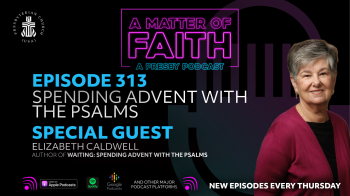
LOUISVILLE — Yes, Advent is a time for waiting. But throughout the days between Christmas and Epiphany, it’s a time for abiding as well.
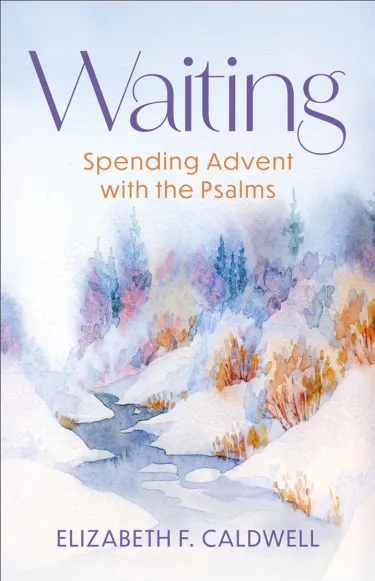
“Waiting: Spending Advent with the Psalms,” published by Westminster John Knox Press, is Elizabeth F. “Lib” Caldwell’s most recent book, following up on her 2024 book also published by WJK, “Pause: Spending Lent with the Psalms.” Caldwell appeared last week on “A Matter of Faith: A Presby Podcast,” hosted each week by the Rev. Lee Catoe and Simon Doong. Listen to their 43-minute conversation here.
Caldwell told the hosts she scoured the Revised Common Lectionary for the Psalms that appear over the three-year cycle. Many of the Psalms selected for her book are part of the current cycle. This year, Advent begins Sunday, Nov. 29. The first and second Sundays of Christmas are Dec. 27 and Jan. 3, 2027, while Epiphany is celebrated on Jan. 6, 2027.
With Lent and Advent, “we have two seasons we can be intentional with our own spiritual practices,” Caldwell said. “I think it’s easier for people when they have a defined amount of time. You can actually try some things.”
For Christians, Advent may well be a time for slowing down, preparing and waiting, “but waiting is just not what the culture says do, right?” Caldwell said. “There’s a frenzied culture to get it all done.”
She said the Psalms invite us “to imagine the context of the poet and think about these Psalms in more intimate ways.”
Advent can be “a hard season” for some, she said, and the Psalms can provide them with pleas, confessions and laments. “Walter Brueggemann used to say there are more Psalms of lament than there are Psalms of praise and joy and thanksgiving,” Caldwell noted.
“They are expressions of God’s people in another day,” she said. “When you read these Psalms, these complaints — Where are you, God? Why aren’t you here? — I plead that every day.”
Advent isn’t always joyful for everyone, Caldwell pointed out. Many PC(USA) churches offer a Blue Christmas or Longest Night service to help worshipers remember a lost family member “or just the difficulty of getting through a holiday that’s not happy for you,” she said. “The Psalms speak to all those kinds of emotions.”
The psalmists “always reveal who God is,” she said, and so in her book Caldwell explores “God whose face shines” in Psalm 80, “God who speaks peace” in Psalm 85, “God who does great things” in Psalm 126 and “God who cares for humans” in Psalm 8. For Christmas Day, Caldwell looks at Psalm 97, and for the following two Sundays it’s Psalm 148 and Psalm 96. On Epiphany, it’s Psalm 29. She concludes her book with a set of brief devotions for the Twelve Days of Christmas, Dec. 25 through Jan. 5.
“When you think of all these descriptions of who God is, for me that helps reveal how Jesus then incarnates all these same qualities,” Caldwell said. “Rather than being these two different books, they are just interwoven.”
We don’t know who wrote most of the Psalms. Caldwell pointed out that editors ascribed David’s name to many of them. “They looked at his life and what was going on, after he made that really bad mistake” of committing adultery with Bathsheba. The great Psalm of confession, Psalm 51, is ascribed to David.
“They were people who felt deeply and emotionally,” Caldwell said of the psalmists. “I’m amazed at how old [the Psalms] are and how relevant they are.”
“I like it when we sing a Psalm or read it responsively or do something [with a Psalm] in worship, but it’s rare they get preached,” she said. “They’re tangential, almost, to reading and study.”
Caldwell’s editor suggested the “Abiding” theme for Christmas Day as well as for the two Sundays that follow Christmas and Epiphany. “I thought that was great,” Caldwell said. “You have celebrated, and then all the stuff comes down, the tree and the lights.” But “the nativity needs to stay out. You put Jesus in on Christmas Day, but the Magi aren’t there yet. They’re still traveling, and so you leave the nativity out” on display.
Once we’ve celebrated Jesus’ birth, “how do we abide in God’s presence continually? I hope it’s a chance to think about intention and commitment to a spiritual practice,” Caldwell said. In her book, Caldwell ends each chapter with a prayer practice to go with the Psalm being highlighted.
“It goes to show that the Advent season is more dynamic than we might think,” Doong said. “The Psalms reflect the emotions and the feelings we might have this time of year, both in a liturgical sense and a life calendar sense.”
“I’m a big fan of letting the liturgical calendar have a central place in your life,” Caldwell replied. “I think it’s grounding, it’s feeding, and Lord knows we need that kind of sustenance in this culture we live in.”
Caldwell told the story of her sister, a PC(USA) pastor who collects nativity settings. When Caldwell decided to ask a friend, a woodworker and retired PC(USA) pastor, to carve a shepherd and sheep for her sister, the sister told her she wanted a midwife instead.
“My friend rose to the challenge,” Caldwell said. When he unwrapped his creations, there stood a pregnant midwife with a bag of supplies in one hand and a shofar in the other.
“He said, ‘I thought that since she’s working with women, she would need to be pregnant,’” Caldwell said. “Now when my sister puts out the nativity, on the mantel she puts Mary and the midwife and the angel all together.”
The scene is reminiscent of one of Caldwell’s favorite poems, “The Queens Came Late” by Norma Farber.
“Those images are fun to play with,” Caldwell said. “If we have ears to hear and eyes to see, we’re not living in a world where God is absent.”
Asked to add any additional details about her book, Caldwell thanked Westminster John Knox Press for a series of brief videos groups can use to study the book, found here, here, here, here, here, here, here, here and here. A friend of Caldwell who’s a professional cellist adds music to each of the videos.
“Music and art contribute to how the experience comes together,” Caldwell said, “rather than just open head and pour in information.”
Catoe called the Psalms “emotive.”
“We don’t necessarily get that in the gospels, where it’s more narrative,” he said. “Pairing the Psalms with [those narratives] is a more wholesome approach to the stories.”
New episodes of “A Matter of Faith: A Presby Podcast” drop every Thursday. Listen to previous editions here.
You may freely reuse and distribute this article in its entirety for non-commercial purposes in any medium. Please include author attribution, photography credits, and a link to the original article. This work is licensed under a Creative Commons Attribution-NonCommercial-NoDeratives 4.0 International License.