
No longer male and female
Chaplain and author Will Brown shares some of what he’s learned about gender on ‘A Matter of Faith: A Presby Podcast’
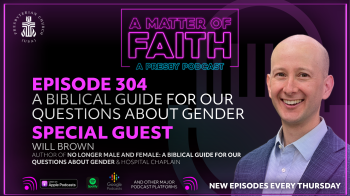
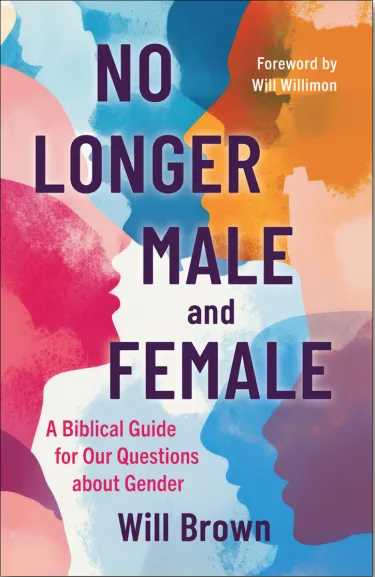
LOUISVILLE — The Rev. Will Brown, the author of a book published this month by Westminster John Knox Press, “No Longer Male and Female: A Biblical Guide for Our Questions About Gender,” was the most recent guest on “A Matter of Faith: A Presby Podcast.” Listen to Brown’s 56-minute conversation with hosts the Rev. Lee Catoe and Simon Doong here.
The hosts opened with this question for Brown: How can faith communities invite people who see gender as only male and female to have a wider understanding of human experience and what it means to be made in the image of God?
So often we come to these questions “from an almost oppositional standpoint” of “we are right and they are wrong, and so we try to change the wrong in the person’s mind,” Brown said. “We end up in this antagonistic binary, and it’s a hard place to start a conversation.”
Instead, we might open with curiosity and “an invitation to how we can better understand each other and ourselves,” Brown said. “When our church can start there, we have a much better chance of finding insight and understanding instead of debating and arguing.”
Pastors and congregations can become anxious about the conversation “when it means we’re going to have this whole long process that ends with a vote over whether we’re going to be affirming or not,” Brown said. “Those processes are important for congregations to do, but it’s not the only way this conversation takes place.” Something small such as including pronouns on church nametags can begin the conversation. “There are places we can turn that will help us enter into it better without it being a contentious yes or no question.”
Another conversation starter is through sharing stories of real people’s lives, he said. “Many of our congregations have people in our pews who may not fit in the black and white, neat boxes of gender that we have,” Brown said. Without putting people on the spot, “this is not just a hypothetical question about something we’re wondering about,” Brown said. When Brown speaks in churches, “almost always I’ve had someone come up and say, ‘my grandchild is nonbinary,’ or a neighbor is. We may not see a person in our pews as a person who’s transgender or nonbinary or gender expansive in some way, but in their families or one level removed, it’s real for many people.”
“When we’re not talking about these things in our churches, we’re doing a disservice to people in our pews who are trying to understand more and make sense of the world they’re living in.”
“I wonder about grace in the midst of all of this,” Catoe said. “We want to respect the pronouns that people want, but there are going to be mistakes. When we do make a mistake, we apologize and note it in our mind. I also wonder about accountability.”
“These conversations do require grace along with accountability,” Brown said. “As a parent to a nonbinary child who uses they/them pronouns, I mess up so much. It’s frustrating and baffling to me that even after we use pronouns every single day our brains slip up.”
“Our kid has been nothing but gracious about that, in part because there’s a relationship of love,” Brown said. “They know I’m doing my best.”
The Bible can help here, Brown said.
“There’s so much language in the New Testament about the ways we take care of each other, even as the New Testament is also full of quite a lot of disagreement and arguing,” Brown said. “Trying to figure this out is not simple work, but it is the work of the church.”
Doong put in a word for figuring it out together as a faith community. “It’s hard for anyone to turn a corner on their own,” he said.
Thinking about the gender of God can also make for interesting conversation, Brown said.
“Many of us grew up using he/him pronouns for God and hearing about God as ‘father’ exclusively,” Brown said. “Along the way, we may have wondered, is God a man? Does God have a male body? I don’t know, but I don’t think so.”
Maybe we’ve encountered someone using “she” or “they” pronouns for God, Brown said. We might think, “does God have a gender, or do we think of God as beyond gender, transcending gender?”
“Does that show us something about the way human beings can look at gender as well?” Brown asked. “We hear something similar from nonbinary folks who say, ‘I’m not strictly male or female. Those terms don’t summarize my experience.’ Maybe thinking about the nature of God helps us think about the nature of human beings,” as well as by listening to our nonbinary siblings. “There is a mutual enriching that happens there when we talk about God and our fellow human beings and understand each other more deeply.”
We want to make sense of things and to describe “how things are in the world,” Brown said. “Yet over and over again, we discover these mental models are inadequate for how uniquely God has made each one of us. We all have our quirks and individuality, and that’s also true with gender. It’s a beautiful, God-given gift of the diversity of what it means to be a human being rather than an imperfection.”
Doong asked Brown to share what he could about accompanying his child on their journey.
“For my wife and I, from an early age we knew our kid was not fitting into the gendered expectations that we were carrying,” Brown said. “There was something about our kid that was different, and we had a lot of learning to do as parents.”
“Fortunately, the bubble we live in is very supportive and has been a safe and loving and nurturing place for our kids to grow up,” Brown said. “But we also know that the world around us is not always that way, and many times is the opposite of that.”
“We want to shelter them to prepare them for the world we’re living in, and we want to try to change that world they’re living in so it’s a safer and better place for them to be.”
“I hope that when we are being advocates for a deeper understanding and safter systems around us that we are enabling everyone to live more authentically,” Brown said, “especially creating space for queer kids and their families to be able to thrive and participate.”
Many of us were taught things in the Bible are clear-cut, Brown said. “In the Bible we don’t read about people who are transgender or nonbinary in those terms, but of course we couldn’t. But we do read about people who don’t fit into the gendered expectations of that day,” including eunuchs. “We see verses in Deuteronomy that are very strict and say, there is not place for this. We read Isaiah imagining a day when everyone is invited into the house of the Lord. We see Jesus speaking with affirmation about eunuchs and adding some complexity to the conversation about different kinds of eunuchs.”
The story we read most often is Luke’s account of Philip baptizing the Ethiopian eunuch, Brown noted.
“For many of us, that mirrors a journey we’ve been on. I appreciate that the Bible allows all of those voices to be heard” because “all those voices are part of the conversation,” Brown said. “When we listen well to each other and say, ‘oh, I think there’s something each of us can contribute here,’ that’s a really rich conversation.”
The title of Brown’s book is of course taken from Paul’s letter to the church at Galatia. Brown called it “a balancing act of taking seriously this vision for unity without squishing us into uniformity where differences don’t matter. Male and female, slave and free, Jew and Greek — these are significant categories of people, especially at the time [this letter] was written.”
It’s something we wrestle with even today, Brown said.
“Where are we honoring our differences and where are we emphasizing our differences? I think gender is a place where we do that as a congregation out of habit without really meaning to,” including having men’s groups and women’s groups and classes for boys and girls. “Perhaps we don’t need to give that a gendered label,” Brown said.
Asked to talk about the book, Brown said it’s “organized around questions rather than answers,” including “what does gender mean?” and “how do we think of this from the standpoint of faith?”
“What I keep coming back to is the Bible is our guide for carrying these questions well,” Brown said. “Maybe it’s my background as a [hospital] chaplain, my experience sitting with people with difficult questions when a simplistic answer is not going to be adequate to the gravity of what they’re facing.”
“My hope is to help people put those questions into words and have good conversations with people in their church or their family” to “get people to some deeper insight on the ways our neighbors experience gender and the ways we ourselves experience gender and how we as the people of God can live more faithfully into that vision of the community of God that embraces us all.”
Access a video series on “No Longer Male and Female” here.
New episodes of A Matter of Faith: A Presby Podcast drop every Thursday. Watch previous editions here.
You may freely reuse and distribute this article in its entirety for non-commercial purposes in any medium. Please include author attribution, photography credits, and a link to the original article. This work is licensed under a Creative Commons Attribution-NonCommercial-NoDeratives 4.0 International License.


