
The way forward
Panel at the Christianity without Christian Zionism conference helps attendees plan their next steps

LOUISVILLE — The Christianity without Christian Zionism conference concluded Saturday with panelists helping attendees to chart a way forward.
In addition to Dr. Dianna Wright and the Rev. Dr. Ray Jones III of Presbyterian Life & Witness, panelists — including Zoom appearances by theologian and author the Rev. Dr. Mitri Raheb and Muna Nassar of the World Communion of Reformed Churches — had spoken to conference-goers on Friday. They were keynoter, the Rev. Dr. Robert O. Smith of the Lutheran School of Theology at Chicago, the Rev. Dr. Cristal Silva McCormick of Austin Seminary and Dr. Santiago Slabodsky of Hofstra University.
“What can we do?” Jones asked panelists. “How can the denomination support mid councils and denominations along this journey?”
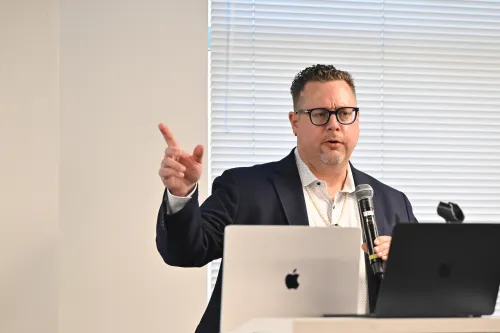
“We are not talking about regaining credibility,” Smith said. “We are instead invited to guerilla Christianity.”
“We’re not called to respectability,” Smith added. “We are called to resist from the margins and be the resistors of this forming world order.”
For Slabodsky, the song “La Cucaracha” is instructive for Presbyterians and others. In the song, the cockroach can’t dance because it’s missing a leg.
“What happens when a denomination is used to walking with all of its legs and, all of a sudden, a leg is missing?” Slabodsky asked. “What do you do? You can decide it’s too difficult and you stay there and do nothing, or you say, ‘who will lend me a leg?’”
To engage in the work that’s needed to turn back the influence of Christian Zionism, “you may not find it with your usual partners,” he said. “Some have departed to be tools of state oppression. Some justify ICE raids. Some justify what’s going on in Palestine.”
That leg many Presbyterians are seeking may be found in organizations including the Palestine Justice Network or the interreligious Jewish Voice for Peace, he said.
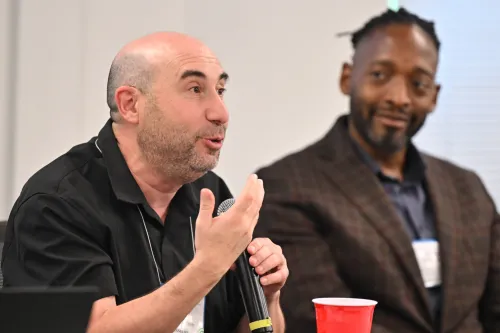
“Perhaps it’s time to jump into a secular space, or a space with other traditions. You want a leg to walk with to bring the gospel you’re trying to bring,” said Slabodsky. “From a Jewish professor’s perspective, look at safety in solidarity. Find the space to actively walk together.”
“Let’s find that other leg,” Slabodsky suggested. “It might feel a little bit weird,” but seeking new partners may be “the only way to walk the way you want to walk.”
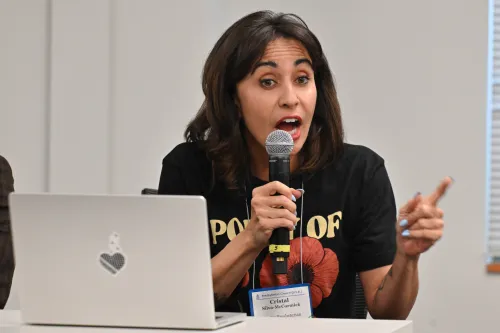
“What are the communities who are most affected asking for?” asked Silva McCormick. “Bring your voice of faith. I can love my enemy without permitting their violence. If safety is our number one value, we will not be good allies.”
“The work is still relevant, but the way we do it needs to be evaluated,” Nassar said.
“It would be good to be humble and learn from the Muslim community in the United States,” Raheb said. “Though they are small, they can mobilize people much better than we [in Christian churches] can. Jewish Voice for Peace is able to mobilize Christian churches, and that’s something we can learn from as well.”
“We really can’t stop now,” Wright said. “We’ve got to mobilize and get this action going.”
Slabodsky said he was mulling whether the Presbyterian Church (U.S.A.) “is the cockroach missing the leg, or is it the leg that has left the cockroach? The second one means you are the leg who is saying, ‘no, we are not going to walk there.’”
“The Presbyterian Church has a ‘leggish’ role to play, but you need to find other legs to respond to that call,” he said. “If we come out with a strategy today, we will fail. But if we go home and get things together with people who have been doing this for a long time, we can develop a strategy that is coherent.”
“In the ecumenical world, it feels like we are always preaching to the same people,” Nassar said. “We need to venture out to new ways of thinking about liberating and mobilizing people.”
“Christian Zionism is about Western Protestant Christianity,” Smith said. “Part of how we take action is for our denominations to say, ‘We will no longer participate in conversations with those who participate in genocide.’ Then we’d have something to talk about.”
“Part of our problem is we have been talking to ourselves alone,” he said. “Go be with the people who are being charged with crimes for chalking sidewalks in Dallas. Join the people who are taking real action. Go be with the people who have been doing the work — not just for decades, but for generations.”
Smith said he met Slabodsky in Bethlehem in 2003, when the Church of the Nativity there was being used as target practice. “He crawled through a rabbinical library that had been bombed in an attempt to save people and books,” Smith said of his old friend. “We are under threat, and we’ve got to learn fast from our siblings who have been under threat because of being on the wrong side of ideology.”
“Keep talking about Palestine. This is so important. Center Palestinian voices,” said Raheb, the founder and president of Dar al-Kalima University in Bethlehem. The university is home to more than 3,000 pieces of art made by the children of Gaza.
“Use that art,” even if it’s just online use, Rahab said. “You aren’t only sharing a story, but you’re supporting a student whose voice is being heard.”
“This is a creative way of looking at Palestine — not as victims but as agents of change with agency and a message they want to share.”
You may freely reuse and distribute this article in its entirety for non-commercial purposes in any medium. Please include author attribution, photography credits, and a link to the original article. This work is licensed under a Creative Commons Attribution-NonCommercial-NoDeratives 4.0 International License.


