
The two covenants and the concept of Israel
Workshop during the Christianity without Christian Zionism conference offers up a paradigm for modern people of faith

LOUISVILLE — When the Rev. Alex Awad was teaching at Bethlehem Bible College, he developed a one-page chart he calls “The Two Covenants.” Across the top row are “Nation,” “Land,” “City,” “Temple,” “Priesthood,” and “Sacrifice,” which in the Old Covenant are, respectively, “Israel,” “Promised Land,” “Jerusalem,” “Temple Mount-Zion,” “Levitical,” and “Animal.”
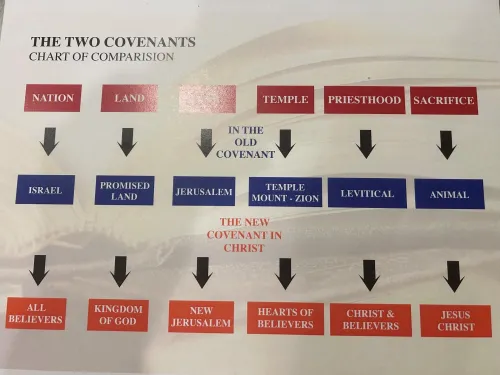
The bottom row represents the new covenant in Christ: “All Believers,” “Kingdom of God,” “New Jerusalem,” “Hearts of Believers,” “Christ & Believers,” and “Jesus Christ.”
Although the rows are laid out horizontally, Awad, during a workshop Saturday as part of the Christianity without Christian Zionism conference, taught his chart vertically, grouping “Nation, Israel, All Believers,” “Land, Promised Land, Kingdom of God,” “City, Jerusalem, New Jerusalem,” “Temple, Temple Mount-Zion, Hearts of Believers,” “Priesthood, Levitical, Christ & Believers” and “Sacrifice, Animal, Jesus Christ.”
Awad’s central question is “What does the Bible say about all of this?”
For the “Nation, Israel, All Believers” grouping, Awad notes that Paul states in Colossians 3:12 that all believers are God’s chosen people, echoing John 1:11-13. “The key word here is ‘all,’ all Gentiles and all Jews who believe,” said Awad, a Palestinian Christian now living in the U.S. In 1 Peter 2:9-10, Peter “is talking to people in Asia Minor, calling them God’s chosen people. This was revolutionary at the time,” Awad said.
As for the “Land, Promised Land, Kingdom of God” grouping, Awad cited John 4:19-23, where Jesus tells the Samaritan woman, “The hour is coming when you will worship the Father neither on this mountain nor in Jerusalem. … The hour is coming and is now here when the true worshipers will worship the Father in spirit and truth, for the Father seeks such as these to worship him.”
“Two thousand years after Jesus said these words, people say this land belongs to this or that people,” Awad said. “Jesus said what matters is the condition of the heart.”
After outlining the chart, Awad said people often ask him, “Isn’t this replacement theology or supersessionism?”
No, he tells them, because “a covenant is like a contract, and God modified the contract, but never rejected people. God is God.”
Then what did change?
“Not God’s love for the Jewish people, but rather, God’s contract (covenant) with the Jewish people and the rest of humanity,” Awad said.
The Rev. Dr. Chauncey Diego Francisco Handy, an Assistant Professor of Religion and Humanities at Reed College in Portland, Oregon, taught the second half of the workshop.

He asked: What do we mean when we are talking about Israel? Is there correspondence between the Bible and the modern nation-state?
The political discourse in the United States “is deeply intertwined with Christian Zionism,” he said. Christian Zionists number about 30 million of the U.S. population, he said, and “hundreds of millions” globally.
Some Christian Zionists are theologically oriented. There are some who are what he called “American foreign policy Christian Zionists.”
Even today, people grapple to define Israel. There’s the State of Israel, begun in 1948. There’s New Israel, a Christian supersessionist definition of Israel. And there’s Greater Israel, “the most expansive view of the potential boundaries of the modern nation state,” Handy said.
There are about nine definitions of Israel, he said, “and most are mutually exclusive positions.”
“Whenever we talk about Israel in the past, we’re making an argument about the present,” he said. At least two origin stories are found in the Hebrew Bible: in the Book of Exodus and the conquest that’s recorded in the Book of Joshua.
But “the Bible is not a history book,” Handy said. “‘The Bible says it, I believe it, and that settles it’ begs a lot of questions. It’s not enough.”

Another problem for Handy and others is that Joshua “is based on divinely authorized genocide. Also, it’s not a successful conquest. The first event is going to a brothel and making a covenant with a Canaanite sex worker. By the end of the book, Joshua says, ‘get the foreign gods out.’ Joshua is best understood as a product of the post-exilic period, ‘what we’d do if we were Assyria,’” he said.
“The way we frame Israel reflects our own priorities,” he said.
One of the biggest problems with Christian Zionism is that “Christ’s second coming is dependent on what people do,” he said. Other problems include “the Bible is not a land deed” and that Christian Zionism “ignores the human dignity of Palestinians and solidarity with our Palestinian siblings.”
Some key issues for further consideration, he said, include:
- Jesus was undeniably Jewish
- We can’t speak for Jews “or what Jews should think”
- “What’s crucial for us is Israel — biblical Israel or theological Israel — cannot be about a nation-state,” he said.
To learn more about Christian Zionism, Handy recommended this website.
You may freely reuse and distribute this article in its entirety for non-commercial purposes in any medium. Please include author attribution, photography credits, and a link to the original article. This work is licensed under a Creative Commons Attribution-NonCommercial-NoDeratives 4.0 International License.


