
Reading Scripture together is both faithful and fun
Rabbi Caryn Broitman appears on ‘A Matter of Faith: A Presby Podcast’

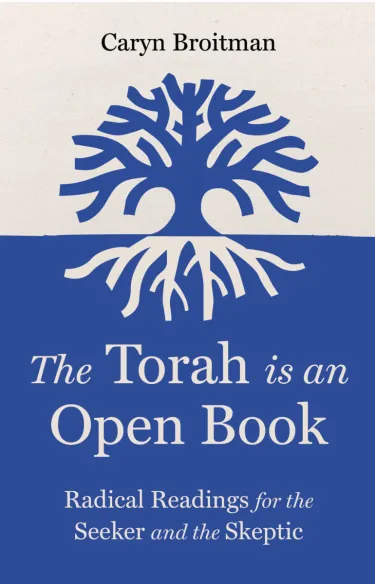
LOUISVILLE — Rabbi Caryn Broitman, whose “The Torah is an Open Book: Radical Readings for the Seeker and the Skeptic” was published last month, told the hosts of “A Matter of Faith: A Presby Podcast” that it’s important and productive for Jews — as it is for other people of other faiths — to study Scripture together.
“It’s actually an ancient thing in Judaism,” Broitman, the rabbi at Martha’s Vineyard Hebrew Center, told “A Matter of Faith” hosts the Rev. Lee Catoe and Simon Doong during a 53-minute conversation that can be heard here. “We study texts often in pairs, going back and forth and then bringing it before the larger community. In our community we study it during our Saturday morning service.”
“It feels like it unfolds in a different way when you have all those voices,” voices that are “often contradictory, and you can’t have them all be literally true,” she said. “But what they do is unearth a different truth and together you come to something deeper.”
Catoe asked Broitman about her lifting up the Midrash process in her book. Midrash, she explained, is the Hebrew root for “search” and “seek.”
“It’s creating imaginative stories that answer those in-between spaces,” she said. “It’s not answered for you in the text. It’s up to us to think it through in a way that will give meaning.”
“There’s this sense that our engaging in Torah study in a sacred way is part of the revealing of the sacred text,” she said.
For Doong, “the journey of the discovery and the individual and collective experience of wrestling with that is actually the point.”
In the Hebrew Bible, that happens in different ways, depending on what genre is used, according to Broitman. “For example, there could be laws in Leviticus or Deuteronomy that just aren’t laws we would want to have in our society today,” she said. “It’s like the way living law is in our society. We have laws on the books that are just wrong and unjust, and then you change them.”
In narratives such as Jonah being swallowed by a great fish (called a whale in some translations) and Noah’s Ark, “I just can’t see how taking that genre literally is helpful for meaning,” she said. “For me, to look at those stories metaphorically is actually more powerful.”
“For me, Jonah was fleeing the call of God,” she said. At one point he asks his shipmates to throw him overboard. “He almost had this death wish. He ends up in the whale’s belly, which is kind of like a tomb, and then it becomes a rebirth. It’s a womb where he’s reborn.”
“He hears God’s call, not perfectly, but is able to take the next step in his life to figure out what his path is,” she said. “To me, that’s much more sacred and meaningful than saying there was an actual whale, and you’d better believe that or else.”
“Taking a story literally doesn’t invite me into a spiritual experience,” Catoe said. “These stories were meant to be metaphoric, and that turns the mind in a different way.” Catoe asked for Broitman’s thoughts on the Genesis account of the three visitors being welcomed into the tent of Abraham and Sarahbefore heading to Sodom.
Broitman replied that in the Jewish tradition, it’s not God’s judgment about homosexuality. “If you look at the story and the context the story is in, it’s clearly about the way we treat the migrant, the stranger, the new person or the person who’s not like the dominant group,” she said. “The sin of Sodom and Gomorrah is that the law criminalized compassion for the poor and the vulnerable. It’s not only individual evil — it’s the social structure of evil.”
“You’ve showed us a way we can challenge assumptions,” Doong told her. “I wish we saw more of the Midrash approach in Christianity.”
Many in the Jewish community are turning to Buddhist forms of meditation, she said, and “I know a lot of people who love the African American Christian spirituality. That’s the great thing about being a multi-faith country. We really learn from each other.”
In her reading of the New Testament, Broitman said she’s “struck by how much Jesus is quoting both the Torah and the prophets,” especially Isaiah.
“If you say the New Testament is about love and the Torah is about law, that’s just not correct,” she said. “Jesus was about both love and law, and he was inspired by the texts of his tradition, which was Judaism.”
In the story of Jonah, “Ninevah was a real place that people felt ambivalent about at the time of the writing,” she said. “In that story, God is saying, ‘Jonah, go to the people you are frightened of whom you see as the enemy. Go and help them repent.’”
She called the Book of Job “a really radical book. I think it’s supposed to be unsettling.” It includes two “completely different genres — the folktales that frame it and the poem. They each have a role.”
“I think of the false comforters [among Job’s friends] and how easy it is for us to fall into that — to use a certain kind of piety, which according to the Book of Job is not really piety, to make everything as if it’s supposed to be that way.”
A friend who’s translated the Book of Job talks about Job and truth-telling, she said. “The comforters aren’t wanting Job to tell it the way he feels it, which [for Job] is ‘No, this is unjust. … I will tell it the way I see it. We did not deserve this.’ It’s a powerful interpretation to think about Job as a book of truth-telling. I also see the poetry of Lamentations as a truthful expression of pain and injustice. They are railing against God.”
She said she hopes her book will be “a way to bring people together — different religions, different political or faith or theological perspectives, secular or religious — to look at a text together that needs all of us to do it together.”
“One thing I haven’t said is that in the Jewish tradition, community reading and discussing is really important. You get so much out of being together and doing this.”
“This is a time we really need to come together over a shared text to try to understand each other and bring out our own experiences.”
“There is a moral economics in the Bible that I think is important for Americans to read,” she said. “The Bible has been used to justify large gaps in economic equality and the policy that facilitates that kind of gap. That’s not biblical.”
“Actually,” she said, “a literal reading of the Bible is much more of a collective responsibility to eradicate poverty.”
New editions of “A Matter of Faith: A Presby Podcast” drop every Thursday. Listen to previous episodes here.
You may freely reuse and distribute this article in its entirety for non-commercial purposes in any medium. Please include author attribution, photography credits, and a link to the original article. This work is licensed under a Creative Commons Attribution-NonCommercial-NoDeratives 4.0 International License.


