Respected church music scholars sit down with the hosts of Sounding Board
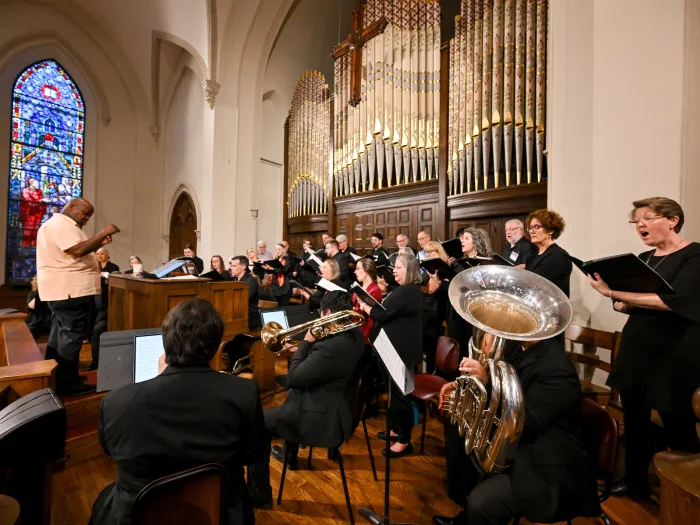
The episode is recorded at Convocation Hall at Montreat Conference Center during the Music & Worship Conference
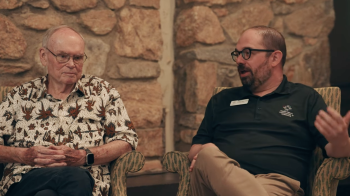
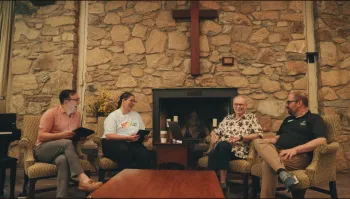
LOUISVILLE — During the Presbyterian Association of Musicians’ recent Worship & Music Conference, Sounding Board podcast hosts Jeremy Roberts and Sarah Abushakra took the opportunity to sit in Convocation Hall at the Montreat Conference Center to speak with two respected church music scholars, Dr. Michael Hawn and Dr. Joshua Taylor. Their 77-minute conversation can be seen here. The podcast can be heard here or here.
Hawn is the University Distinguished Professor Emeritus of Church Music at the Perkins School of Theology at Southern Methodist University, where he is still adjunct faculty in the doctoral program.
Taylor is the instructor in Sacred Music Studies at the College of Music at the University of North Texas and director of Worship & Music at First United Methodist Church of Denton, Texas. He’s the author of a recent article published by Call to Worship, “How Shall We Sing the Lord’s Song in This Land?”
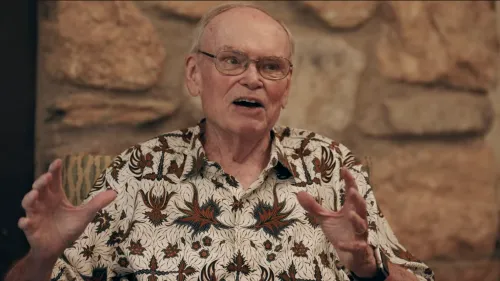
Hawn said that growing up, his first minister of music — “although he wouldn’t have used that name” — was a milkman.
“He understood the vocation and was very involving of everyone,” said Hawn, whose first church solo was at age 6, when he delivered a stanza of “Children of the Heavenly Father.”
His church in those days didn’t have a children’s or youth choir, “so I just started singing with the adult choir, whatever they sang,” Hawn told Abushakra and Roberts. “It was amazing how rich an experience that was. We would do these mini Baptist revivals on poor unsuspecting Lutheran and Catholic communities in someone’s house.”
These days, Hawn is a ruling elder and worships at Second Presbyterian Church in Richmond, Virginia.
Taylor grew up in Texas, “where I still live and serve,” he said. When he was a youngster, friends took him and his sister to church. As a teenager, “some things happened” in the church and his parents told him and his sister to find another church to attend.
“Most of my music teachers happened to be Presbyterian,” said Taylor, PAM’s incoming president. “They invited me to come to the Presbyterian church, where I got involved with the youth choir, and as the story goes, the rest is history. I found my home in the PC(USA) and spent my time there until Covid, and now serve at the First United Methodist Church [of Denton].”
At the Worship & Music Conference, “I got to sit back and watch and marvel at all the amazing things that my friends and colleagues do,” Taylor said, adding his delight for the direction the hosts have taken Sounding Board.
“PAM has been a formational organization for me personally, and I’m so excited for the future,” he said, adding that the “Sounding Board” name was his idea, “and so I’ll take a little bit of credit for that.”
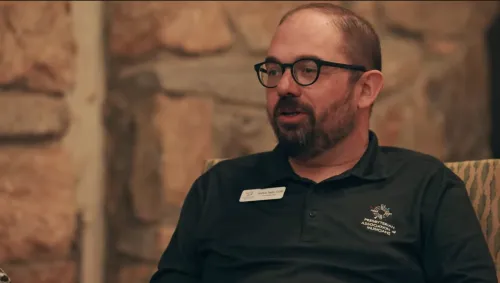
Taylor was a member of the second doctoral cohort that Hawn supervised. “I’m pleased to say that, like Josh, the people in the program have become movers and shakers in their denominational or ecclesial contexts in church music in a variety of ways,” Hawn said, including composition, leadership and publishing. “The idea was to give some space for people who wanted to stay in this vocation. My job was to create that space.”
“I’m not one to totally retire yet,” Hawn said, “because I really like being around these people.”
He said he’s “enjoying life on the lay side of the church as opposed to being on the staff.” Among the surprises he’s seen are that people in progressive churches “want to sing ‘I Come to the Garden Alone’ because they relate to it through a parent or a personal experience or their faith formation.”
“Who puts this song in our hearts? Whose testimony is it? Put a face on it,” Hawn suggested. “I find all those things make a big difference.”
Asked by Abushakra why he wrote the piece for Call to Worship, Taylor talked about wrestling with hymn selections around the Fourth of July weekend as well as Veterans Day and Memorial Day.
“Several years ago there was controversy around First Baptist Church of Dallas performing ‘Make America Great Again’ at a political rally. I bristled at that, and I think a lot of people were uncomfortable with it,” Taylor said. “Then I came to my current congregation, which has a long tradition of having the community band play on the Fourth of July weekend. That has typically been a patriotic celebration. There was a time when that was fully embraced, and now we’re trying to thread the needle a little bit on how we do that faithfully.”
“Sometimes you’re willing to tread on a tradition, and sometimes you know it’s a landmine you don’t want to step on,” he said. “What I was trying to wrestle with in the article was, is there a way to bring patriotic celebration faithfully to our worship?”
“I think it’s a contextual thing. We used to paint with broad strokes and think it was the same for all of us,” Taylor said. “I don’t think that’s the world we live in anymore. The question is more open-ended than it used to be.”
Part of the article seeks to “examine how we think about what we sing as formation, as Christian formation and cultural formation,” he said. “There’s a lot of research out there and it’s cited in the article about the role of Christian worship music as political actor, essentially. Hopefully every time we choose to put words in the mouths of our congregation, we’re thinking about what we’re asking them to embody. That’s political and theological, and for me it’s a huge responsibility.”
For Taylor, when he thinks of the generations of people who have sung “I Come to the Garden Alone” at baptisms and funerals and weddings, “or standing around the piano with loved ones singing a beloved hymn, all of a sudden the theological nuance and the reasons why you shouldn’t use that go out the window.”
The article speaks of patriotic music “and this period of time when we’re wrestling with Christian nationalism and American identity in our worship and what’s faithful or not. Hopefully, it opens it up for us to consider it much more broadly every time we pick something to have our congregation sing.”
Some churches get accused of being too political, Taylor noted. “That’s a fair judgment if the goal is partisanship. I believe Jesus was political — not partisan, but political. He had something to say about the land and the stewardship of the land and how we form community in this place.”
“If we believe that to be true,” he said, “then our songs better embody and encapsulate that reality.”
You may freely reuse and distribute this article in its entirety for non-commercial purposes in any medium. Please include author attribution, photography credits, and a link to the original article. This work is licensed under a Creative Commons Attribution-NonCommercial-NoDeratives 4.0 International License.