‘The work is hard, and the work is possible’
At Synod School, the Rev. Dr. William Yoo explores actions taken two centuries ago to stand alongside the Cherokee Nation
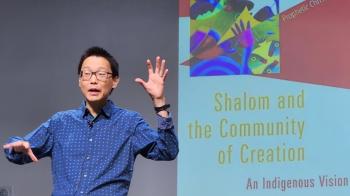
STORM LAKE, Iowa — At Synod School, Wednesday is a day for thinking about love in between the mundane and the dream. Convocation speaker the Rev. Dr. William Yoo shared with the 650 or so attendees sketches of members of the Cherokee Nation and their allies during the years leading up to the Cherokees’ forced removal from their land and the Trail of Tears that followed.
Yoo is Associate Professor of American Religious and Cultural History at Columbia Theological Seminary. Synod School is a ministry of the Synod of Lakes and Prairies.
Yoo opened with the story of Harriet Ruggles Gold, who married Elias Boudinot, a Cherokee man who was educated at the Foreign Mission School in Cornwall, Connecticut. They fell in love as teenagers. Boudinot concluded his studies in 1822, met his bride-to-be and corresponded with her for some years. “They must have been some letters, but they’re lost to history,” Yoo said.
His cousin, John Ridge, also married a white woman, Sarah Bird Northrup Ridge, in 1825. Not everyone celebrated the marriage. “To have her thus marry an Indian and taken into the wilderness among savages must indeed be a heart-rending pang which none can realize except those called to feel it,” wrote Isaiah Bunce, who blamed the school for enabling these marriages.
Ridge’s own brother burned pictures of the couple in the town square. The two married quietly, and the school closed soon after that. “It couldn’t continue after those two weddings,” Yoo said.
“How are the American people ever to atone for the injuries done the original inhabitants of this country?” Gold asked.
Boudinot, a writer and newspaper publisher, went on tour to raise money to purchase a printing press. He spoke at First Presbyterian Church in Philadelphia and later turned his talk into a pamphlet, “An Address to the Whites,” where he said white Christians had two choices: help Cherokees survive, or turn their backs and watch them perish.
Jeremiah Evarts, an early leader of the American Board of Commissioners for Foreign Missions, “understood that his religious work required political involvement,” Yoo said. He compared efforts to remove Cherokees from their land to the biblical story of Naboth’s vineyard.
“For him, it was a clear story of right and wrong,” Yoo said. “He said, ‘In this story, we are Ahab and Jezebel. Do we really want to imitate that ruler?’”
Yoo included the work of Catharine Beecher, whose activism marked the first political movement by white women in U.S. history. She noted Georgia’s efforts to remove the Cherokee by what she called “cruel and unjust methods.”
While on vacation she heard from Evarts “a most interesting narrative of the success of the Board of Missions … among these Indians, and of the distressing and disastrous consequences that would result from the cruel measures undertaken. He said that American women might save these poor, oppressed Natives, and asked me to devise some method of securing such intervention.”
Her answer was a pamphlet called “To the Benevolent Women of the United States.”
“She carved out distinctive space for women” despite their inability to vote, Yoo noted. Her message was straightforward: We have influence in our neighborhoods and in our churches.
Gold wrote a letter shortly before her death that included this vision: “I wish you could see us in our family, in our neighborhood, and our [Cherokee] Nation. You need not say that I possess that disposition of bragging so peculiar to the Gold family — perhaps I do — but I now mean — I wish you to see how Indians can live — how families, and how a nation of Indians can live.”
The stories may be mundane, but they’re also “a reminder of the human consequences of the colonial enterprise,” Yoo said. “This activism was inspiring.”
“It was messy and complicated. It was a struggle,” Yoo said, “one I hope we will continue today.”
“What is our call to friendship and allyship in this work?” Yoo asked. Native people “live among us today,” he said, and he displayed a map showing the concentration of Native populations.
“There is a call for each of us to determine how we wish to atone,” Yoo said. “I don’t think Christian ministries should be motivated by guilt and shame, but by responsibility and repair. God is stirring and disrupting us to get involved in the work of repair.”
“Let’s just ask, ‘How can we help?’” he suggested. “How can we support self-determination, dignity, flourishing and partnership?”
“It requires a collective resolve to say, ‘This is wrong, and I want to participate in making it right.’ That’s the first step,” Yoo said. “We want to lift up the original inhabitants of this nation. … It is our work to figure out how to arrive at mutual flourishing.”
“We want to do good,” Yoo said, and one way is to learn more about the PC(USA)’s Center for the Repair of Historic Harms. “All of us can be in the crowd of momentum.” Among the 650 people gathered, perhaps 10 or 20 or 30 or 40 will say, “I am committed to doing this and I am going to find people in the Church who know how to do the work,” such as the Restorative Actions movement in which the Synod of Lakes and Prairies is a partner.
“The work is hard, and the work is possible,” Yoo said. “I am excited we can do the work together.”
You may freely reuse and distribute this article in its entirety for non-commercial purposes in any medium. Please include author attribution, photography credits, and a link to the original article. This work is licensed under a Creative Commons Attribution-NonCommercial-NoDeratives 4.0 International License.