Discerning our working theology
The Rev. Dr. William Yoo helps Synod School attendees find the sweet spot between patriotism and faithfulness
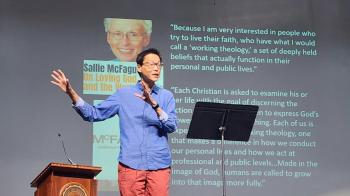
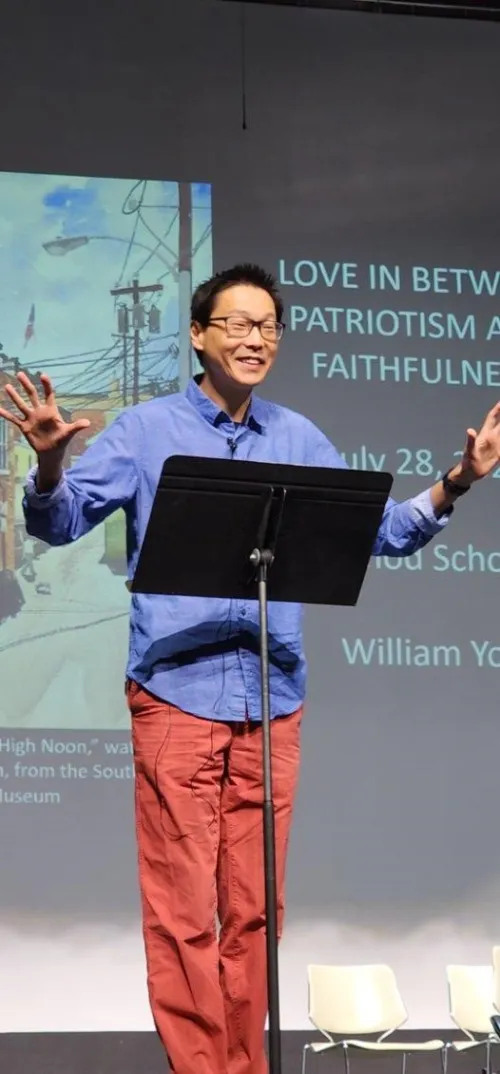
STORM LAKE, Iowa — Building on themes on patriotism and faithfulness that he explored during a talk this past spring at Montreat Conference Center, the Rev. Dr. William Yoo discussed on Tuesday the kind of “working theology” identified by Sallie McFague as “a set of deeply held beliefs that actually function in [people’s] personal and public lives.”
“Each of us is expected to have a working theology, one that makes a difference in how we conduct our personal lives and how we act at professional and public levels,” McFague wrote in her essay “On Loving God and the World.”
Yoo, Associate Professor of American Religious and Cultural History at Columbia Theological Seminary, is convocation speaker this week at the 72ndSynod School, a ministry of the Synod of Lakes and Prairies.
“We do this working theology because we are already Imago Dei, created in the image of God — not to be saved, but because we are saved,” Yoo said. “It is both deeply beautiful and deeply challenging.”
Sadly, our working theology is often different from our professed theology, Yoo said. “We want it not only in the Book of Order but we want it to be our working theology,” he said.
Prior to the spread of Christianity, there were no public hospitals in the Roman world, points out Bart D. Ehrman in “Love Thy Stranger,” “no government assistance to help those in need or private charities to minister to the poor, homeless and hungry. These are Christian innovations that evolved from Christian understandings of what it means to be a good person.”
When the Rev. Dr. Martin Luther King Jr. spoke at Montreat on Aug. 21, 1965, it was days after the Watts Rebellion. King said that day that the Church “has a real responsibility in the midst of this crisis because the problems involved are essentially moral issues. The Church being the moral guardian of the community cannot overlook its moral responsibility at this hour.”
In King’s sermon “Paul’s Letter to American Christians,” Yoo noted that King appeals to the notion of American Christians holding a “dual citizenry:” “You live both in time and in eternity, both in heaven and Earth.”
About 35 years ago, E.J. Dionne, Jr., published “Why Americans Hate Politics,” where he argued that “what Americans want, they’re not seeing in the politics of the day,” Yoo said.
Six years ago, Eitan Hersh published “Politics is for Power,” a book about why Americans love politics, Yoo said, despite their knowing that “a lot of the work is mundane and not glamorous.” The work is about making sure everyone’s needs are met, he said.
“Politics is difficult to wrestle with, even here at Synod School,” Yoo said. “We disagree about the principles and the policies of how to get there. But I think it’s appropriate to talk about this in church.”
On the topic of Christian nationalism, Yoo said that our Christianity “should shape our nationalism in terms of participation and commitment to thriving and justice.” He called Frederick Douglass’ most famous speech, “What to the Slave is the Fourth of July,” delivered July 5, 1852 in Rochester, New York, “a real appeal to a fuller and more faithful interpretation of national and Christian principles.” Douglass noted there is “a lot of good” in the U.S. Constitution, which deemed him 3/5ths of a person in terms of congressional representation.
“There’s still something here about liberty and freedom and dignity for all,” Yoo said, citing Douglass’ fealty to the Constitution. “Turning the world upside down is what it means to be a Christian, and what it means to be an American.”
Yoo also displayed a slide of Douglass’ reaction to the Dred Scott decision, in which the U.S. Supreme Court ruled that enslaved people were not citizens of the United States and, therefore, could not expect any protection from the federal government or the courts. Chief Justice Roger B. Taney read the decision publicly on March 6, 1857.
Yoo let Douglass have the final word on that heinous ruling from the High Court:
“The Supreme Court of the United States is not the only power in this world,” Douglass wrote. “It is very great, but the Supreme Court of the Almighty is greater.
“[Justice] Taney can do many things, but he cannot perform impossibilities. He cannot bail out the ocean, annihilate the firm old Earth, or pluck the silvery star of liberty from our Northern sky.
“He may decide, and decide again; but he cannot reverse the decision of the Most High. He cannot change the essential nature of things — making evil good, and good evil.”
Synod School attendees burst into applause.
“This is an appeal to Christianity and morality,” Yoo said, “and it’s a patriotic appeal.”
Synod School continues on the campus of Buena Vista University through Friday.
You may freely reuse and distribute this article in its entirety for non-commercial purposes in any medium. Please include author attribution, photography credits, and a link to the original article. This work is licensed under a Creative Commons Attribution-NonCommercial-NoDeratives 4.0 International License.