The church ‘cannot overlook its moral responsibility at this hour’
Just as the Rev. Dr. Martin Luther King Jr. did more than six decades ago, Dr. William Yoo delivers an inspiring talk at Montreat Conference Center

LOUISVILLE — In our modern time, the church cannot be silent. But what should it say?
That was the question for Dr. William Yoo, Associate Professor of American Religious and Cultural History at Columbia Theological Seminary, who spoke at Montreat Conference Center last week. View Yoo’s chock-full presentation and the question-and-answer session that followed here.
The title of Yoo’s talk is based on something the Rev. Dr. Martin Luther King Jr. said at Montreat amidst the civil rights movement, on Aug. 21, 1965: “When a crisis emerges … the Church has a specific and great responsibility. It has a real responsibility in the midst of this crisis because the problems involved are essentially moral issues. The Church being the moral guardian of the community cannot overlook its moral responsibility at this hour.”
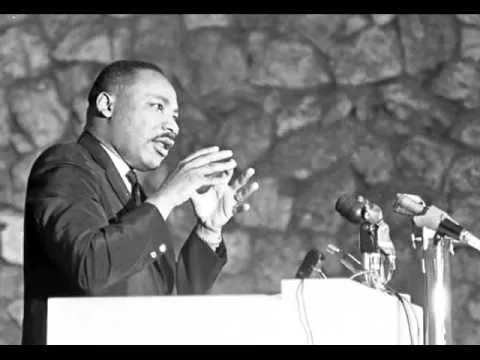
As a moral guardian, the church “is called to be an interpreter of politics rather than an agent of politics,” Yoo said.
Many people believe they are deeply engaged in politics, Eitan Hersh wrote in The Atlantic six years ago. But mostly, “they consume political information as a way of satisfying their own emotional and intellectual needs. These people are political hobbyists. What they are doing is no closer to engaging in politics than watching SportsCenter is to playing football,” Hersh wrote.
Hersh urged involvement more in keeping with a woman who taught special needs children in Boston who worked tirelessly to increase funding for her students. “Hersh was saying, ‘This woman was really engaging in the work of politics by building consensus, getting into the muck and mire and understanding how funding works and talking to the right people in power so more resources could be diverted and invested in her local community and in her students,” Yoo said.
When Yoo talks to churches, he asks them to fulfill the moral guardian role that King mentioned. “I would like churches to talk about maybe not partisan things, but political issues,” he said. “I would like for us to talk about how to do commonsense immigration enforcement. I think we need to talk about being a lawful nation so people don’t have to live in the shadows, so people are protected and have access and pathways to dignity and flourishing, and I think that belongs in the congregation.”
Faith communities “need to get into the harder work of thinking about politics in the form of morality and what it means to be a guardian” as well as “what it means to be an interpreter of messy politics for the gospel, for the sake of the common good and moral flourishing,” he said. But how do we do that “in these extremes of political polarization?”
In researching Christian nationalism, Yoo ran across Gerald L.K. Smith, a minister and would-be politician who had the idea at the outset of the Great Depression that elderly Americans ought to have a social safety net.
He later formed his own political party, which he initially called the America First Party. He moved from there to call it the Christian Nationalist Crusade, Yoo noted. Smith later told the House Un-American Activities Committee, “I am just an old-fashioned, Bible-believing, Christ-loving American.”
What Yoo takes away from the Theological Declaration of Barmen is “it is right for the church as moral guardian to think deeply about economic struggles and the decline of the American Dream. But authoritarianism and Christian Nationalist parties are not the right prescription for this diagnosis.”
During his speech at Montreat, King, speaking at the time of the Watts Rebellion, noted that “at the bottom of many of the conflicts taking place today in many of our cities is the lack of economic opportunity.”
“Now the church, again the moral guardian of the community, must see this,” King said. “The church must speak to the power structure of the nation.”
It is the lack of opportunity and the decline of the American Dream that we’re witnessing today, Yoo said. Gene Ludwig, the 27th comptroller of the currency and a business and civic leader, called the American Dream “the desire that most parents hold: that with hard work and gumption, their children will be able to do a little better than the generation that came before them. The presumption of upward mobility has long distinguished American life.”
For Yoo, the dream is less about upward mobility “and more about freedom of opportunity to choose a vocation that maybe won’t lead to extravagant wealth, but to a decent wage and flourishing.”
Material goods are not necessarily inherently evil. “Recall that Jesus provided extra wine at the feast at Cana,” wrote Daniel Finn in “Christian Economic Ethics,” as quoted by Yoo. “The understanding of the material world as good and as a gift to be cherished arises from, and only makes sense within, the fundamental relationship with God. Even more importantly, the commitment to the widow, the orphan and the resident alien — the poor in the ancient world — is also noted in this covenantal relationship.”
As the National Association of Evangelicals put it in 2004: “God wants people to have access to productive resources so they can care for their economic needs and contribute to their community.”
King and Black abolitionists including Frederick Douglass “noted that with more equal opportunities will come more equal outcomes,” Yoo said. “It’s not going to happen overnight, Douglass and others argued, but give us access to opportunity and our success rates will be similar to what we see in our white population.”
Yoo said that while it may be an oversimplification, “I do think the decline of the American Dram is connected to the rise of Christian nationalism and white Christian nationalism.”
How do we get to the goal of shared economic prosperity? Ludwig and others are “more concerned about the floor than the ceiling,” Yoo said. “We think about the parable of the workers in the vineyard. They all got the same pay, whether they were hired in the 11th hour or the first hour.”
Progressive-leaning folks will say, “you increase the floor by taking from the ceiling,” according to Yoo. “What Ludwig would say is that the floor needs to get a lot higher. The government provides a social safety net so people don’t fall into utter despair,” a service that churches are increasingly called to do in the community as well. “Churches can and should do this work well,” Yoo said.
But it will require more than charity, he said. “It requires a faithful and just economic and political system,” Yoo said, “and this is where churches can get involved.”
“As a Christian and a Presbyterian, I care deeply about dignity and I care deeply about wanting in this country a good floor, a quality of opportunity where people who work hard and play by the rules can make it in this country” and feel like they have a shot at living out the American Dream, Yoo said.
Preachers aren’t talking about this enough, Yoo said. “We can disagree faithfully on the solutions, but I do think we can get some mutual understanding that these are problems God wants us to use our minds and hearts and bodies to think about, to pray about, talk about and work to enact.”
In “Real World Faith,” Walter Brueggemann says his intent is “to support the rich and varied ways in which our faith impinges on our common public life.”
Issues including money, power, weapons, policies, treaties, taxes and trade agreements “are the proper agenda of our faith because our faith consists of trust in the One who governs our bodily life in the world,” Brueggemann wrote. “Our interpretive work is to try to articulate the ways — albeit hidden ways — in which the agency and character of God makes effective contact with our world.”
The church cannot be silent, Yoo said, and here’s some of what it should be saying:
- Christians are called to love God and love neighbor within the existing economic order. But Christians are not simply to accept the inequities and inequalities of the day.
- The church as moral guardian must speak against white Christian nationalism, but the church must also speak for an American Dram with a theological vision that substantively repairs economic problems and social injustices.
- The Bible offers clear principles, but not specific policies, for our contemporary age, and we discern as a community of faith how to live as good Christians and good citizens. We also seek to minimize the risk of dependency and fraud as well as exploitation and restrained greed because these components undermine the common good and flourishing of all God’s Creation.
“Our principles are clear, but we acknowledge that policy-making is messy,” Yoo said. Reinhold Niebuhr put it this way: “The sad duty of politics is to establish justice in a sinful world.”
“God’s desire for all of us to have access to resources and equality of opportunity is abundant enough,” Yoo said. “But we’ve got to figure out how we can be the channels of God’s blessings so that this fruit of the Spirit may abound, even in the messy and sinful world of the United States and our capitalist system in 2026.”
“So church, we can’t be silent,” Yoo said. “There are things we can and should say.”
During the question-and-answer session following his talk, Yoo said he knows Presbyterians and others are concerned about “the aging and the numerical decline in some of our congregations.”
Churches that speak out for justice can also participate in the civic life of their community, he said.
“I would love for churches, when thinking about law enforcement, to faithfully partner with local police departments so that the only interaction for mainline churches isn’t when something goes wrong,” although “we need to speak out when something goes wrong,” Yoo said.
“Policing is a dangerous job, and [officers] have a lot of authority with the weapons they carry, and so we want it to be done safely and right,” Yoo said. “I want to support them year-round, and I want churches to, also. I want to say ‘thank you’ and ‘I’m praying for you’ and ‘I’m here to support you,’ and perhaps the church can say, ‘here is a meal for you, just to thank you.’”
Police officers may not know that their local First Presbyterian Church used to have 300 members and now has 30, Yoo said. “But they do know First Presbyterian Church has been around for a long time and they’re supporting the dangerous, hard work that we do. They are going to hold us accountable when something goes wrong, but they are very thankful for the many things we do right. That’s the work that congregations who are called by God can do.”
You may freely reuse and distribute this article in its entirety for non-commercial purposes in any medium. Please include author attribution, photography credits, and a link to the original article. This work is licensed under a Creative Commons Attribution-NonCommercial-NoDeratives 4.0 International License.