'Bravery under fire': Veterans Day through a lens
Images from the PHS archives highlight veterans and chaplains throughout history
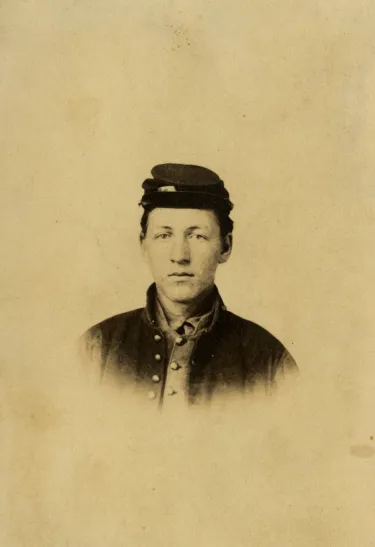
On the 11th hour of the 11th day of the 11th month of the year 1918, an armistice between the Allied nations and Germany went into effect. Fighting ceased.
The official end of "The Great War," or World War I as we now know it, came when the Treaty of Versailles was signed on June 28, 1919. Five months later, President Woodrow Wilson proclaimed Nov. 11 as the first commemoration of Armistice Day — that day in 1918 when a temporary cessation of hostilities was agreed to months before the peace treaty was authorized. "To us in America, the reflections of Armistice Day will be filled with solemn pride in the heroism of those who died in the country's service," the president said. On June 4, 1926, Congress passed a resolution recognizing Nov. 11, 1918, as the end of World War I and a day set aside for remembering. An act approved in 1938 made Nov. 11 a legal holiday, known as "Armistice Day," to be dedicated to the cause of world peace and to honor veterans of "The Great War."
It was in 1954 that Nov. 11 was redesignated as "Veterans Day." The title change came at the urging of various veterans service organizations, which pointed to World War II and the Korean War as evidence of the need for a broader field of recognition. And so, the Act of 1938 was amended by striking out "Armistice" and replacing it with "Veterans." With the approval of this amendment in June 1954, Nov. 11 became a day to honor all American veterans, and on Oct. 8, President Dwight D. Eisenhower issued the first Veterans Day Proclamation.
Eisenhower was a veteran himself. A renowned World War II soldier, he attained the five-star rank of General of the Army in 1944. As president of the United States, an office he held from 1953 to 1961, he was able to institute a national holiday in recognition of those who served, in whatever capacity, in whatever conflict.
In 1946, way before his election as president, General of Army Dwight D. Eisenhower attended a luncheon hosted by the General Commission on Army and Navy Chaplains. He was photographed enjoying a joke with Bishop Henry K. Sherill, chairman of the General Commission on Army and Navy Chaplains. To the far right stands Fleet Admiral Chester W. Nimitz.
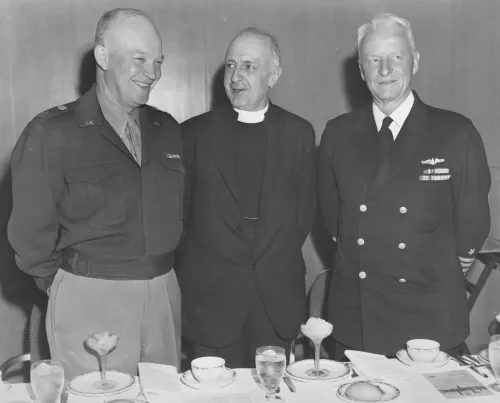
Simultaneously, the annual meeting of the Associated Church Press was going on in D.C. ACP editors were invited to attend the luncheon, where they heard General Eisenhower warn the audience that "we’ll all disappear in the dust of an atomic explosion" unless there is "a moral regeneration throughout the world."
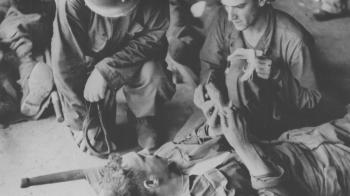
During the luncheon’s remarks, both General Eisenhower and Admiral Nimitz praised the work of chaplains during the war — like the chaplains pictured in the image above, who comfort a wounded soldier, their helmets emblazoned with simple white crosses.
A press release was published in correlation with the image of Chaplain Carol R. Hudson of Green Bay, Alabama (left), and Cpl. Forrest W. Dougherty of Akron, Ohio, comforting a patient at a forward aid station in South Korea. The press release opened with a story of another chaplain, Captain Arthur E. Mills of Santa Ana, California, who "jumped in a jeep" and headed toward "a group of wounded Americans …cut off by enemy troops in an isolated area … Details of his one-man expedition have not yet been received … but it is known that he arrived back hours later with his jeep loaded with wounded. He is one of the several score U.S. Army chaplains now with American Forces in Korea who are helping observe traditions of the Corps of Chaplains on its 175th Anniversary by providing the wounded with spiritual comfort and aid." A handful of other chaplains are honored with stories shared of their bravery and service.
The press release ends with a call-back to a much earlier battle: "During the Revolutionary War local clergymen accompanied their village boys and men when they went off to join the American Militia. In the years since then the phrase 'Bravery under fire' has become a part of the history of U.S. Chaplains."
The Religious News Service Photograph Collection at the Presbyterian Historical Society is a goldmine. Millions of past moments immortalized through a lenspiece, which researchers and casual browsers can sift through at their fancy thanks to PHS's digital repository, Pearl. This is the magic of the archive. These images are just a small sample of the photos related to chaplaincy, military service, and veterans that live in the RNS Collection.
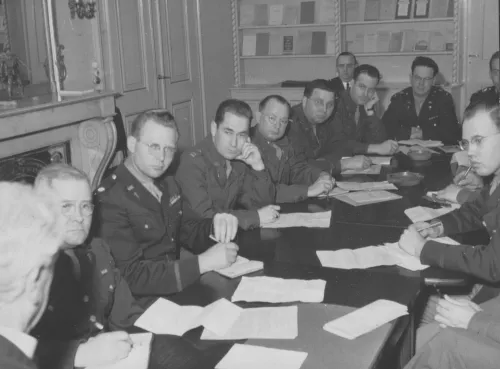
In 1946, U.S. Army chaplains from the Mediterranean Theater gathered together in conference at the headquarters of the World Council of Churches in Geneva, Switzerland. This was the first of a series of two-day meetings to be held under the auspices of the World Council for chaplains in Europe.
The "Mediterranean Theater" was a branch of the United States Army that supervised all U.S. forces fighting in North Africa and Italy during World War II. U.S. Army operations in this theater began in November 1942, when Allied forces landed on the beaches of northwest Africa, and concluded in early May 1945 when the German forces surrendered in Italy. The "Mediterranean Theater” was created in February 1943 as the "North African Theater of Operations." The name changed in October 1944.
In 1937, representatives from more than 100 churches voted in favor of founding a World Council of Churches, but the organization’s actual beginning was delayed following the outbreak of World War II. When the World Council of Churches finally came into being at its first assembly in 1948, there were 147 member churches involved. Fast forward to the end of 2013, and 345 churches listed themselves as members of the World Council.
In 1963, another group of chaplains was gathering together — not for a conference, but for a collection.
Chaplain (Lt. Col.) James R. Barnett, the division chaplain at Fort Carson, Colorado, is seen at the far left "turning in offerings" to Chaplain (Capt.) D.E. Lee, the custodian of the post chaplain's fund. All together, the group was able to forward a check for $602.82 to Tagajo Christian Church in northern Japan.
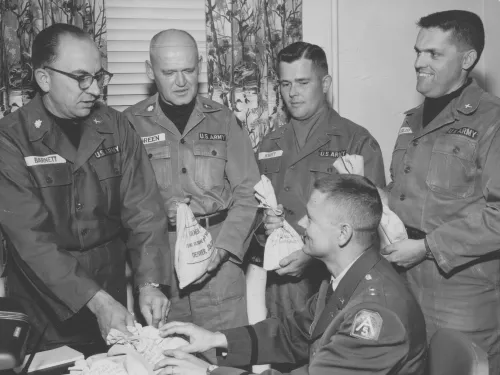
"The check should arrive in time for the church's 10th anniversary celebration," the caption reads. The Tagajo Christian Church had been founded Feb. 14, 1954, by the Protestant Women's Group located nearby, which consisted of women whose husbands were stationed at Camp Schimmelpfennig.
The $600 raised by the Fort Carson chaplains would be added to $800 "collected during a dedicated offering at Fort Carson chapels Nov. 3 and augmented by interested Army personnel from coast to coast." The total amount being sent in support of the church reached $1,402.96. According to the Bureau of Labor Statistics' CPI Inflation Calculator, $1,400 in 1963 equates to around $15,000 in today's economy.
The money collected by the Fort Carson chaplains and other donors will be "earmarked to repay a crushing $970 lien to a bank for the purchase of kindergarten playground land to meet a new requirement of the Japanese government. The balance will go toward a reconstruction program ..."
Chaplains turning in offerings here are, left to right; Lt. Col. James R. Barnett, a Baptist from Texas; Lt. Col. W.H. Green, a Baptist from Florida; Capt. Geoffrey D. Knott, a Baptist from North Carolina, and Capt. P.B. Bliss, a Presbyterian from Connecticut.
As we commemorate Veterans Day, the PC(USA) extends its heartfelt gratitude to all who have served, in whatever capacity.
You may freely reuse and distribute this article in its entirety for non-commercial purposes in any medium. Please include author attribution, photography credits, and a link to the original article. This work is licensed under a Creative Commons Attribution-NonCommercial-NoDeratives 4.0 International License.