When loving your neighbor means protecting asylum-seekers
Despite a hostile political climate, Pastor Sharon Kutz-Mellem continues her immigrant support efforts
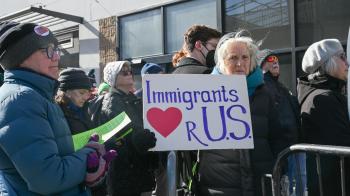
With the current administration’s stated “crackdown on immigration,” many churches and Christian individuals are asking how they can love and care for their migrant, refugee, and asylum-seeker neighbors. For Pastor Sharon Kutz-Mellem, the answer has been to continue helping people seek asylum as she has for decades, with the added responsibility of protection in an increasingly hostile process.
Kutz-Mellem is parish associate for immigrant advocacy at Springdale Presbyterian Church in Louisville, Kentucky, but her ministry to immigrants and asylum-seekers has been the work of a lifetime. For 40 years, she has done volunteer work helping resettle refugees who come through Kentucky with Church World Service. For most of that time, the work has been around helping individuals and families move through the formal asylum process. They arrived in Kentucky with visas, and Kutz-Mellem would work with other volunteers to set up housing, drive refugees to meetings, and help with ESL classes.
“When Trump came on the scene, all of that stopped,” Kutz-Mellem said.
Immigration has been a major focus of President Donald J. Trump during both of his terms. During his first term, he prioritized the construction of a wall along the southern border of the United States, established travel bans, and enforced a “zero tolerance” policy for unauthorized immigrant adults that led to many children being separated from their families. On the first day back in office during his second term, Trump declared a national state of emergency in regard to immigration, and has since enacted significantly broadened deportation efforts and removed protections on sensitive locations like churches, schools, and hospitals. The administration has also attempted to overturn birthright citizenship and reduce temporary protective status for some nationalities.

During the first Trump term, Kutz-Mellem traveled to the border with a group of women and saw child separation efforts in action. They also witnessed people being “dumped out of detention” with nothing but the clothes on their backs. Their group worked with the Archdiocese of Rio Grande and a woman named Sister Norma, who runs the Humanitarian Respite Center. When they asked Sister Norma what they could do to help her efforts, she told them to go home.
“Go back to your communities, go to the bus stations and have baby formula and diapers and help these people make their way,” Kutz-Mellem recalls her saying. And so they did.
Kutz-Mellem was part of a broad network that stretched all the way from the border to Maine and saw thousands of migrants each year. Then Covid shut their efforts down. Still Kutz-Mellem pursued her calling, turning her attention to refugees in her local area.
Much of her work now is shaped by Trump’s targeted efforts to prevent people from being granted asylum. One move, referred to as a “turnback” policy, disallows asylum- seekers from entering the United States, where they would be given protections. Though this “metering” practice began during the Obama administration, it was expanded and formalized during Trump’s first term. It was rescinded in 2021 during the Biden administration, but Trump later called for the Supreme Court of the United States to reconsider the case.
The Rev. Jihyun Oh in her capacity as Stated Clerk of the General Assembly of the PC(USA) joined other faith leaders in signing an amicus brief in support of the claimant — an immigrant services organization called Al Otro Lado — and PC(USA) staff participated in an interfaith vigil outside of the Supreme Court building in Washington, D.C., while arguments in the case were being heard in March of this year. Ultimately, the Supreme Court ruled the turnback policy constitutional by a voted of 6-3. Justices Sotomayor and Jackson both published dissenting arguments.

As that case and other policy debates unfolded in the national halls of power, Kutz-Mellem was sheltering families who were directly and devastatingly impacted. For three years, she sheltered a woman, T, and her young son. T had gone through the legal process to pursue asylum, but found when her turn came that asylum was no longer a qualifying condition for entry to the United States. She and her then-four-year-old child were marked for immediate removal.
Kutz-Mellem said she and others helped crowdsource funding so T could file an asylum claim, noting that such a claim costs a minimum of $10,000. You cannot get a work permit until after your claim is filed. T eventually did get her permit, and worked nights at Amazon, which enabled her and her son to move into their own place. However, this past December, ICE performed a data sweep at Amazon, and T was picked up along with others who had pending asylum claims. She was released with an ankle bracelet, but she and her son were court-ordered to go to Memphis. While Kutz-Mellem and others helped T get her case moved back to Louisville, T’s son—who is now 12—still has his case located in Memphis. Because he is a minor, keeping his case in a separate state from his guardian is illegal, but they’ve had to crowdsource again to cover the costs of attorneys to fight the issue.
Meanwhile, once T and her son were able to move out of Kutz-Mellem's house, one of her contacts who helped transport asylum-seekers sought her out with another ask. It was July 4th weekend several years ago, Kutz-Mellem recalled, and this Venezuelan woman, M, and her three children were released from detention with no belongings and no way forward. M had intended to take a bus to Atlanta but boarded the wrong one and ended up in Louisville by mistake.
Over the course of two months, M and her children had walked from Venezuela, through the Darien Gap, and ultimately swam across the river at the US-Mexico border to pursue asylum. M’s husband had been a political enemy of the government in Venezuela and had come to the US ahead of his family. He worked without a permit for a year to send money to pay for his family’s safe passage. They were finally reunited in the US after the family was released from detention, and Kutz-Mellem and her network worked with them to fund and process their asylum case.
Their court hearing was canceled three times during the Biden administration, and when their final court date arrived shortly after Trump returned to the presidency, their asylum claim was denied without a hearing or any consideration. They are working to appeal the ruling, but for now they remain stuck in a legal limbo which could go on for years.
Kutz-Mellem said that because she has such strong connections across the country, she has become a resource person as the government continues to enact anti-immigrant policies. In addition to helping people like T and M move through the process, she spends a lot of time educating churches and individuals about how to avoid ICE. She is part of a defense network with a 24-hour bilingual hotline. The work now looks “radically different from working with a group where refugees were welcome.”
She has had some surprising and encouraging moments, fostering relationships and understanding between the families she accompanies and people in her community who might be inclined to pre-judge or dismiss them. Still, she wonders about all the people she helped move through the network as the sought refuge in the US.
“I wonder about all those people that came through our bus station. Where are they now? How are they making it in this environment?” she asks, adding, “Our whole function was to welcome them, to show them the real face of the United States. And now they’re seeking something that’s totally different.”
Despite these hard questions, Kutz-Mellem finds hope in the families she walks alongside. T’s son has become “everybody’s kid” and even has “his own fan club.” He still stays with Kutz-Mellem and her husband a few nights a week and is currently going through confirmation at church. M and her children, meanwhile, blow her away with their faith in God.
“M tells her ‘God has gotten me this far, and I know that God will look after us and get us where we need to go.’”
Kutz-Mellem remains committed to helping M’s faith proclamation prove true. Though politics and policies change, and the work looks different, the gospel doesn’t change, and neither does her calling to follow it by welcoming the stranger, helping the outcast and loving your neighbor — whatever it takes.
You may freely reuse and distribute this article in its entirety for non-commercial purposes in any medium. Please include author attribution, photography credits, and a link to the original article. This work is licensed under a Creative Commons Attribution-NonCommercial-NoDeratives 4.0 International License.