Berea Presbyterian Church and the Second American Revolution
The Rev. Carl Safford Dudley and his church's witness for justice in the 1960s and 70s

Did you partake in the Second American Revolution? The Rev. Carl Safford Dudley did. That’s how he referred to the 1960s in a letter written to his grandchildren in 2007, two years before his death. "You asked about civil rights and the 1960’s," he wrote. "It was a second revolution when the world was turned up-side-down."
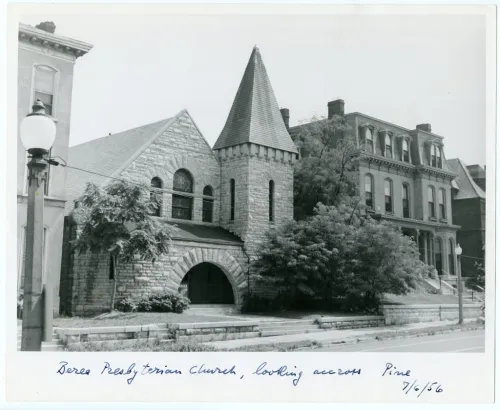
And Dudley saw it happen, and helped make it happen, front and center, "through the Window of Berea Church." During his ministry, he became known for his work in helping small congregations mobilize for community ministries. He served as the first white pastor to a historically Black congregation at the height of the civil rights movement. He was a conscientious objector to the Korean War, marched in Selma, Alabama, alongside the Rev. Paul Smith and the Rev. Dr. Martin Luther King, and lent his church building to the local Black Panthers chapter to host their meetings.
Carl Safford Dudley (1932-2009) was a graduate of Cornell University, Union Theological Seminary in New York, and McCormick Theological Seminary, and was ordained by the Presbyterian Church in 1959. At that time, he and his wife Shirley moved to Buffalo, New York, where he served as an assistant pastor at First Presbyterian Church for four years. In 1962 the elders at Berea Presbyterian in St. Louis made history when they called Dudley to its pulpit. He heeded the call and spent 11 years at Berea, where he helped cultivate a community that felt more like family than anything else.
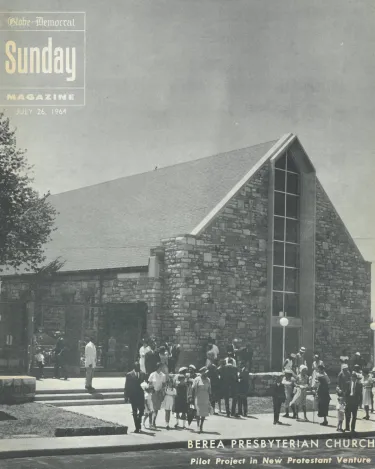
But it was no easy sailing. Right from the start, Berea was surrounded by a cloud of skepticism and disdain. "Controversy surrounded our church because we survived in that location," Dudley wrote. In the late 1950s, Mill Creek Valley, the historic St. Louis neighborhood where Berea was located, became the focus of an urban renewal plan. With the intention of creating a profitable commercial and residential area, the state and federal government razed most of Mill Creek Valley. "When urban renewal leveled 458 acres in St. Louis’ Mill Creek Valley area, forty-two churches relocated, merged, or closed their doors," the St. Louise Globe-Democrat reported in its July 26, 1964, edition.

After Mill Creek Valley was razed, LaClede Town was built. A public housing development like no other, LaClede Town first opened its doors to residents in 1965. The developers’ goal was to create a neighborhood attractive enough to entice middle-income —and white — people to settle there. The construction was to be federally funded, but the developers wanted to ensure that LaClede Town wasn’t just a copy-paste of other previously built public housing projects. In their design, they strayed from the look of the high-rise, multi-building complexes that were popping up elsewhere, opting to create a more village-oriented structure — one with a public square where events could be held, for example.
From its opening in 1965 and stretching into the 1970s, LaClede Town received national attention. Newspapers reported it as a success after visiting the new neighborhood; residents gushed over the design and affordability. LaClede Town was chock full of musicians, artists, students, and working families. This would not last. By the 1980s, LaClede Town had been condemned.
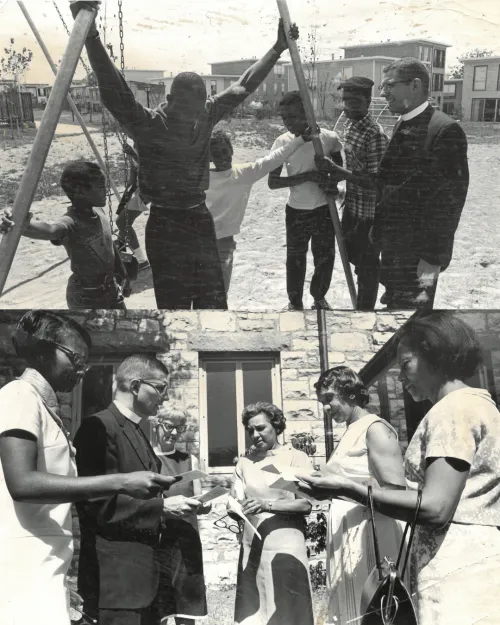
By 1970, much of Berea Church’s membership had moved out of the area, a result of the razing and construction occurring in the city — and yet Berea remained an anchor of the new community.
As the first Black Presbyterian congregation west of the Mississippi River, the Berea congregation traced its roots to 1887, when Mary Jane Townsend began educating the local children in the basement of a St. Louis church, teaching them to read and write and recite verses from Scripture. Townsend’s small class grew into a mission church, continuing to grow and blossom until it was recognized in 1898 by the Presbytery of St. Louis as a formal congregation. The congregation’s first full-time pastor, the Rev. Selden Parr, moved the church to a new building on a different street and christened it with the name of Berea Presbyterian Church. Located at 3027 Olive, Berea Church celebrated its 65th anniversary in 1963, Dudley’s first full year in the pulpit.
Dudley was committed to maintaining the church’s presence in St. Louis, and growing the church in its new community, despite the displacement of much of his congregation. The renovated building became a meeting space for a new nursery school, civil rights activists, Vietnam draft resisters, and the local Black Panther chapter. Church and community members alike spent ample amounts of time studying, discussing, and organizing action for peace, fair housing, and antipoverty.
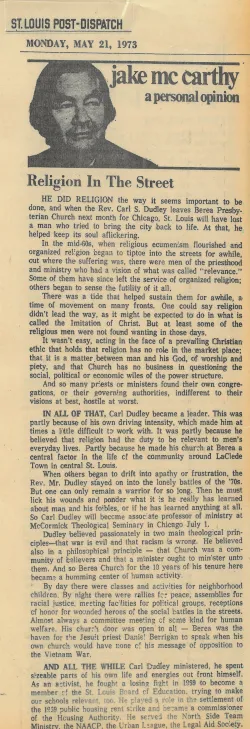
"By 1964 the shock troops for Berea were about 50 volunteers called CATs — Christian Action Team," Dudley recalled. "We demonstrated against (racist) policies of the Board of Education and shared in pickets that challenged the segregated employment practices of some St. Louis industries … We also registered several hundred new voters, so that one precinct voting machine was conveniently in our church building." This engagement with residents and community members was very successful, leading Berea Presbyterian Church to become a "central factor in the life of the community around LaClede Town," Jake McCarthy reported in the May 21, 1973, edition of the St. Louis Post-Dispatch.
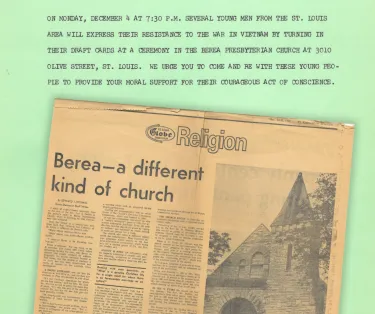
In 1967, in collaboration with other leaders in the St. Louis community, Berea Church chose to observe a Day of Non-Cooperation, hosted in the sanctuary of the church, during which a Commitment to Resistance service would commence. The service was scheduled for December 4, 1967, at 7:30 p.m. In response to outspoken concerns over utilizing a church building to host such an event, the session of Berea Presbyterian Church stated: "Sustained by the love of God, we pray with, counsel and seek to support each of our brethren, whether he be in military service or conscientious objector … We invite all men in conscience and commitment to join with us in response to the love of God, made real in Jesus Christ our Lord."
When reflecting on this draft resistance event, Dudley shared that it was the result of hours of discussion and debate. "The officers of Berea Church had to address the war question when nine young men in St. Louis asked to use our community building for a forum to send their draft cards back to the government,” he wrote to his grandchildren. "After four hours of debate, our board said that the young men should not use the community building but must make their witness in our sanctuary since this was an act of conscience, face-to-face with God."
In 1973, Dudley and his family moved to Chicago, as he joined the faculty of McCormick Theological Seminary. For 20 years, as Professor of Church and Community, he worked as teacher and consultant to ministers, priests, rabbis and imams in congregations that were working to engage with their communities. At McCormick, he founded the Center for Church and Community Ministries.
The congregation's witness for justice persisted throughout Dudley’s service there as pastor, and beyond. For example, in 1978, Berea welcomed the Rev. Lawrence N. Barron to its pulpit. Barron had been born and raised in St. Louis. In 1973, he completed his studies at Princeton Theological Seminary and headed west for Iowa. He served various Presbyterian parishes in the Hawkeye state for five years before heading back home to St. Louis to heed Berea’s call. Barron immediately enveloped himself in the work of the congregation, becoming active in advocacy work for low-income integrated housing and the desegregation of local public schools.
Barron took his work a step further as he started conducting research focused on housing inequality and shortages in the community. The project spanned a handful of years, his notes beginning in 1979 and the final product being published in 1984 by the Synod of Mid-America. The multi-media curriculum that resulted from Barron’s studies, interviews, and research is titled "A Roof Over Every Head: Why and How the Church in the Synod of Mid-America is Responding to the Severe Shortage of Safe and Sanitary Housing for Low-Income Peoples and How Newly Interested Congregations Can Become Involved." The Lawrence N. Barron Papers, which include 35mm slides and audio cassette interviews, live in Washington University’s Special Collections, where they were donated in November 2023.
Dudley was also a writer and researcher, serving as author or editor of 16 books during his lifetime, including perhaps his most important work on small congregations, "Making the Small Church Effective" (Abingdon 1978). Here’s the publisher’s description of the book: "Is your church’s future frozen in memories of the past? Is the congregation caught in a 'collision of cultures' or struggling to survive its dwindling membership? Here’s encouragement and guidance to help your members find new possibilities within the community and develop the church’s potential for faithful Christian witness."
Dudley also directed a large-scale church and community action research project which led to publication of "Basic Steps in Community Ministry" (Alban Institute 1991) and "Energizing the Congregation" (with Sally A. Johnson, Westminster 1993). He moved to Hartford Seminary in 1993, where he taught and conducted important congregational studies research until well after his retirement. In 1997, he was elected President of the Religious Research Association. Dudley died in 2009 at the age of 76.
The Berea congregation merged with Curby Presbyterian Church in 2019 to create BereaCurby Presbyterian, an active and vibrant congregation that continues his legacy through their commitment to the St. Louis community.
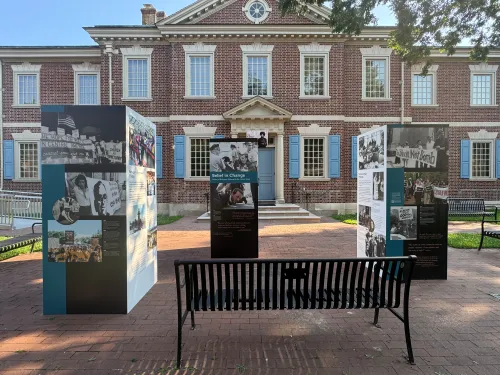
Berea Church and the Rev. Carl Dudley believed in change. Since the country’s beginnings, faith has inspired many Americans to speak out and act against injustice and inequality. Religious people —clergy and congregants alike— have protested, marched, and prayed to make their voices heard on controversial and divisive topics. Then and now, their beliefs compel them to move beyond the pulpit and pews. Their actions, intended to address urgent problems, have roots in the past and look towards a better future.
PHS has recently installed a new outdoor exhibit titled Belief in Change. This exhibit features stories of individuals across time and space who have advocated for social change from deeply held religious beliefs — like Dudley. Learn more and stop by the next time you are strolling through Old City, Philadelphia.
Further reading
Flory, Julie and Sean Gunsten, “LaClede Town: The Rise and Fall of a ‘Bohemian Utopia,’” Decoding the City, decodingstl.org.
Looker, Benjamin, “Neighborhood exceptionalism and racial liberalism in the Great Society city: integration as civil showpiece at St Louis’ LaClede Town,” Urban History (2022) Volume 49, 401-434, Cambridge University Press.
St. Louis Churches: Past and Present, PHS blog.
You may freely reuse and distribute this article in its entirety for non-commercial purposes in any medium. Please include author attribution, photography credits, and a link to the original article. This work is licensed under a Creative Commons Attribution-NonCommercial-NoDeratives 4.0 International License.