Celebrating 60 years of the Jinishian Memorial Program
For more than half a century, Armenian vision and Presbyterian commitment has proven to be a remarkable combination

MILWAUKEE — Where there was a will, there has surely been a way.
A way paved by Vartan H. Jinishian, a man of great faith and wealth, whose $9.2 million bequest in 1966 established the Jinishian Memorial Program (JMP), which for six decades has provided economic, social and spiritual assistance to millions of Armenians in Syria, Lebanon, Istanbul, Armenia, Jerusalem and Georgia.
Founded in memory of Jinishian’s parents, the Rev. Haroutune and Catherine Jinishian, and administered by the PC(USA), JMP helps people transition from poverty and despair to self-sufficiency and hope while serving as an excellent model of sustainable, impactful development in places of deep need.
As JMP’s executive director, Eliza Minasyan, graciously welcomed guests to a festive reception at the 227th General Assembly (2026) — including inviting them to enjoy Armenian sweets in colorful gift bags — she began her brief remarks by reflecting on “the remarkable wisdom and vision” contained in Jinishian’s original will.
“After more than two decades of serving this mission, I have come to believe that many of the reasons for our success today can be traced directly to the principles established 60 years ago,” Minasyan said. “Long before terms such as inclusion, ecumenical partnership, local leadership, sustainability and innovation became common in the development world, Vartan Jinishian envisioned a mission that would transcend denominational boundaries, serve people without discrimination and empower local communities to shape their own future.”
The Rev. Michael Wallace, a commissioner from Muskingum Valley Presbytery, came to the event “excited to learn all about what the national church is doing in order to translate it” to his local congregation.
“I have always had a heart for mission,” said Wallace, who serves as pastor of Christ Presbyterian Church in Canton, Ohio. “Since I had never heard of the Jinishian Memorial Program, I came to find out what our denomination is doing in international mission.”
And what JMP has been doing faithfully for 60 years is maintain continuous operations, “adapting to changing circumstances while remaining faithful to its mission,” according to Minasyan.
“We are not afraid to innovate,” she said. “We are willing to take risks when necessary. We understand that not every new initiative will succeed, but we never allow fear of failure to prevent us from trying something that may transform lives.”
The anniversary reception also served the dual purpose of celebrating — and introducing — two of Minasyan’s predecessors, the Rev. David Nelson and the Rev. Dan Rift, whose leadership, she said, helped shape JMP during important periods of its history. Minasyan also thanked the current board members in attendance, including the Rev. Rebecca Barnes and Barry Creech of Presbyterian Life & Witness.
Nelson, who retired from JMP in 2006 after serving for 7½ years, spoke to the gathering about one of the program’s many innovative shifts.
“The initial vision of Jinishian — and it was a vision — was relief oriented,” said Nelson, an ordained minister in the Evangelical Lutheran Church in America living in Dixon, Illinois. “But when we saw the opportunity to do both relief and development work, we convinced the local advisory committees in these countries that they could move beyond social services.”
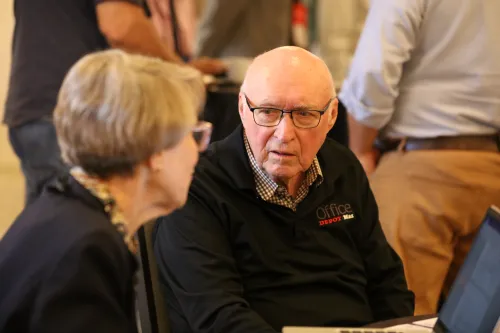
As participants continued to engage in spirited conversation over coffee and cookies following the more formal aspects of the reception, the Rev. Greg Allen-Pickett, a commissioner from the Presbytery of Central Nebraska, emphasized the significance of the strategic move cited by Nelson.
Allen-Pickett, who worked in sustainable development primarily in Guatemala and southern Mexico before graduating from seminary in his early 30s, thought he was being called to pastoral ministry but instead became general manager of what was then Presbyterian World Mission.
“Because of my background in sustainable development and my seminary education, I was asked to serve on JMP,” said Allen-Pickett. “The shift from relief to development work was huge. I loved going to the meetings and getting reports from Eliza. It was a highlight of my service in Louisville.”
Nelson, who had earlier said he knew little about Armenia before starting his position, delivered some humor to the festivities by sharing an anecdote from the years of the shift.
As the relief side of Jinishian continued into development in the early '90s, Nelson introduced Earl Mummert, a Lutheran layman and businessman from Harrisburg, Pennsylvania, to the chairperson of the Armenian advisory committee of JMP, the supreme leader, or catholicos, of the Armenian Apostolic Church.
“His holiness said, ‘I’ve never met an earl before,’ to which Mummert replied, ‘I’ve never met a catholicos before,’” Nelson related to great laughter.
Many in the room whose interest in Armenia was sparked by the event eagerly picked up postcards advertising JMP’s upcoming study tour. The Discover Armenia Mission Tour will take place Oct. 1-10, and will be hosted by JMP staff.
“Participants will not only experience Armenia through its history, culture and landscapes but also gain a deeper understanding of six decades of compassionate service, development work and human connections that have impacted countless lives,” Minasyan said.
July 30 is the deadline to apply for the tour, which begins in Armenia’s capital city, Yerevan. Because each year’s tour group is kept small by intention, interested participants are also encouraged to consider the same dates, Oct. 1-10, in 2027.
Minasyan left the gathering with the assurance that JMP has always been careful with its resources, an approach that has proven invaluable during times of crisis.
“Because we avoid unnecessary administrative costs and prioritize long-term sustainability, we have never had to abandon our core programs when difficult times arrived,” she said. “We also place tremendous value on local leadership. We rely on local expertise, local partnerships and local decision-making.”
But, in the end, it’s the people, she said, who have blessed JMP’s mission most of all.
“Many of our staff, board members, volunteers, donors and partners view their involvement not simply as a job or responsibility, but as a calling,” said Minasyan. “As we celebrate 60 years, we give thanks for those who came before us, for those who serve today, and for those who will carry this mission in the future. The story of JMP is ultimately a story of faith, vision, courage and service. And by God's grace, that story continues.”
You may freely reuse and distribute this article in its entirety for non-commercial purposes in any medium. Please include author attribution, photography credits, and a link to the original article. This work is licensed under a Creative Commons Attribution-NonCommercial-NoDeratives 4.0 International License.