Humanizing those who are experiencing homelessness
A talk at New York Avenue Presbyterian Church explores one way congregations can help: getting to know their unhoused neighbors
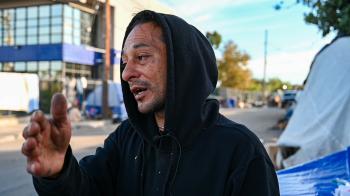
LOUISVILLE — One of the best ways to humanize people experiencing homelessness is also one of the simplest: learn their names.
“Everything changed in our work and in our confidence that we were on the right path when we realized communities had to know everyone experiencing homelessness [in that community],” said Rosanne Haggerty, president and CEO of Community Solutions and the speaker Saturday during a McClendon Scholar Program at New York Avenue Presbyterian Church in Washington, D.C. “This is such a solvable and avoidable tragedy.”
Watch Haggerty’s talk here. She’s introduced at the 30:12 mark. A question-and-answer session hosted by the Rev. Glenna J. Huber of Church of the Epiphany, around the corner from New York Avenue Presbyterian Church, begins at 67:35.
“How do we fail to grasp the risk to our communities,” Haggerty asked, “allowing the ill and the vulnerable to struggle in plain sight while not even knowing their names and dismissing the impact of hearing their experiences and honoring their agency?”
“There are no good guys and bad guys here,” she said. “This is a challenge that has been politicized to everyone’s disadvantage.”
Community Solutions is working with 170 communities through its Built for Zero movement. Since 2015, 211,000 individuals have been housed in Built for Zero communities. Sixty-two communities have verified reductions in their homeless populations.
“If we can harness the resources in the community” — resources including business, faith-based communities and city hall — “that’s when things begin to move,” Haggerty said.
Haggerty noted that a common tenet among people of faith and others is that we serve the common good — “and that actually needs some infrastructure,” she said.
“We have figured this out before, during wartime and the Depression,” Haggerty said, but “we have not successfully figured out how to tell that story.”
If the goal is to make homelessness “rare and brief,” Haggerty has dozens of examples from across the nation. In Atlanta, which Community Solutions has been working with for years, 467 people who had been unsheltered downtown have been housed in the last four months. In Denver, 1,600 people used to live in tents downtown. Now 2,500 are living in hotels that have been released for housing.
“It is a story of political will,” Haggerty said, but “homeless service organizations cannot get the job done without joining with mayors, congregations and the business community.”
A dozen states have “active pro-housing movements that are putting together bipartisan collations to change the game in terms of what [kind of housing] can be built,” she said. In the last year, at least 16 states have changed zoning laws to build more affordable housing, including accessory dwelling units. Such statewide policies “takes the free-for-all debate” out of meetings of the local zoning commission or city council, she said.
Community Solutions’ work to reduce homelessness has surfaced five priority policy recommendations, Haggerty said:
- Implement a federal, interagency goal and measurement network for ending homelessness
- Require quality real-time data on homelessness and make data accessible
- Finish the job of ending veteran homelessness
- Act on homelessness as a public health crisis
- End homelessness in rural America.
Haggerty concluded her talk with a Community Solutions video of people discussing their lived experience:
During her question-and-answer time with Huber, Haggerty recalled helping to develop a registry of volunteers who were preparing to interact with people who were unsheltered. “People would come back and say, ‘I just spoke to a 25-year-old woman living under a bridge. That’s the same age as my daughter.’”
When that happens, “it’s not an issue anymore; it’s neighbors,” Haggerty said. “We need to create more of those experiences.”
In the coming days, leaders from 13 cities are gathering to learn more about what’s working in Atlanta, Denver and other places. “People are looking for good news, so we show them and put them in communication with each other,” Haggerty said. “We have worked with folks in Atlanta for 20 years. There were a lot of valleys before this peak. Everyone needs to be housed. Everybody needs access to education. We need to hardwire these values into how we’re governed.”
Haggerty said she has “a lot of sympathy for elected officials trying to do the right thing. There are a lot of voices in their ear.” In some cases, people “who show up for affordable housing don’t want it in their neighborhood. How can we help elected officials implement policy? Too often, we are not attentive to the competing pressures.”
After Saturday’s presentation, those in attendance had lunch together before engaging in an afternoon workshop on working to house even more unsheltered people in the nation’s capital.
“I am hopeful that people of faith who have been working on this issue and know what’s at stake can show what we’re capable of,” Haggerty said. “What if all our goals and policy intentions, as important as they are, had to be supported by what we can do with what we have, to put our resources and our will in a new, forceful way?”
“I think the congregations of our country, showing that kind of disruptive, transforming energy, is what can offer examples people stepping into relationships and using resources in new ways.” That, she said, “will help us turn the corner.”
You may freely reuse and distribute this article in its entirety for non-commercial purposes in any medium. Please include author attribution, photography credits, and a link to the original article. This work is licensed under a Creative Commons Attribution-NonCommercial-NoDeratives 4.0 International License.