'May you hear the words, thank you'
Global Ecumenical Partnership model centers gratitude and global collaboration

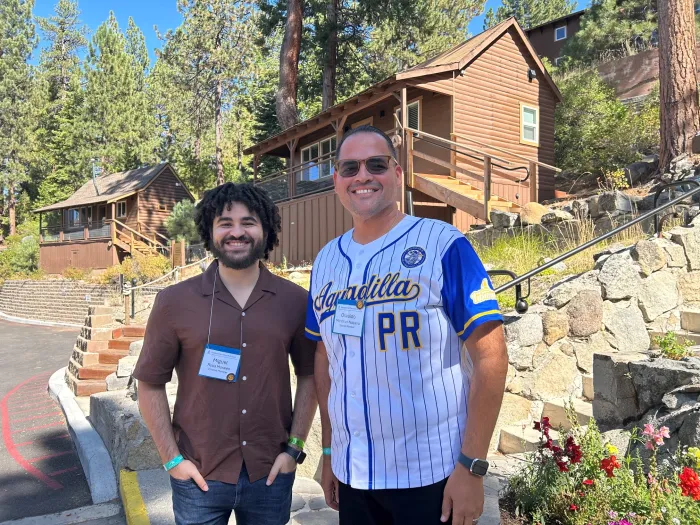
Global Ecumenical Liaisons (GELs) the Rev. Jed Koball and Cindy Corell met virtually with members of Baltimore’s Brown Memorial Park Avenue Presbyterian Church on Sunday, March 15, offering what Koball called the most important message of their presentation: “If you hear nothing else today from us, may you hear the words, ‘thank you.’”

Koball and Corell — two of the GELs serving in the Presbyterian Church (U.S.A.)’s new office of Global Ecumenical Partnerships (GEP) — outlined a reimagined model of global engagement created in the wake of the closure of the PC(USA)’s World Mission in March 2025. That painful closure, Koball explained, came after “significant staff reductions” were announced in November 2024. “The money was no longer there to sustain this model of mission," he said, noting that the denomination acted when it did “in order to be able to provide those severance packages for mission co-workers.”
“We needed to begin imagining a new model of how we’re going to engage the world and be in partnership,” Koball said. While acknowledging the pain caused by that transition and the gratitude for all who served under the previous model, Koball played a short video introducing Global Ecumenical Partnerships before Koball and Corell shared examples of the work of global ecumenical liaisons (GELs) and how this work is rooted in partnerships.
Corell, a U.S.-facing GEL, described the new office — part of the denomination’s Presbyterian Life & Witness — as staffed by 20 liaisons: 10 international-facing and 10 U.S.-facing. “All that we do continues to be rooted in partnerships,” she said, adding that Presbyterians pursue mission “with congregations, presbyteries, synods, ecumenical networks, NGOs and community-based movements.” Of the U.S.-facing GELs, several work closely with the 16 synods of the PC(USA) to connect mid councils, congregations and mission networks to the partnerships and resources of Global Ecumenical Partnerships, while others support churches and leaders within African, Middle Eastern, Latino/a/é, Native American/Indigenous, African American, Korean and Asian churches within the PC(USA). Four international-based Young Adult Volunteers, including Koball's wife, Jenny Valles, are closely aligned with the work of global partnerships.
Early in the meeting, Brown Memorial church members shared their commitments to El Salvador, Cameroon, Cuba, the Lakota people, and local ministries that aligned closely with the priorities of the GEP program. “It’s incredibly encouraging and inspiring,” Koball told the congregation. “Very helpful for us, too, as we consider how we might grow our relationship with you.”
Among several examples of global partnership, Koball highlighted work in the Andes Mountains of Peru, where PC(USA) offices collaborated to support Indigenous communities affected by climate change. He described a shared visit to the Andes with presbytery leaders and a General Assembly Co-Moderator and staff from Presbyterian Disaster Assistance,, the Presbyterian Hunger Program and the office of Ecumenical and Interreligious Relations.
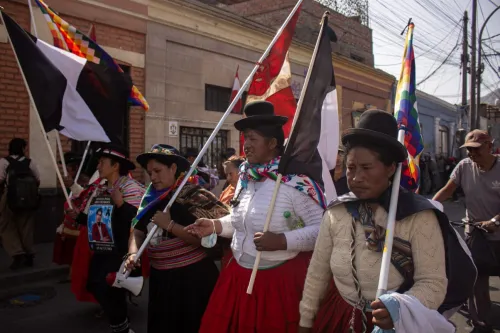
The group traveled to “learn from indigenous peoples, particularly how climate change is impacting them and how they are responding,” Koball said. The work reflects the denomination’s goal of centering “historically marginalized voices to generate solidarity,” but it also demonstrated the collaborative way that what is now PL&W is coming together in global partnerships.
Corell lifted up work along the U.S.–Mexico border with immigrants. Joseph Russ, a U.S.-facing GEL, is one of several staff members who tell the stories of migration and advocate on immigration issues. Corell also described the work of former Intercultural Congregational Associates who now work as GELs in the U.S. She pointed to the ministry of the Rev. Irvin Porter, who serves Indigenous Presbyterian churches. “He serves in these communities … to bring the support that the Presbyterian Church can offer, but also to be there in connection and in solidarity,” she said.
Koball lifted up collaboration with the Rev. Jermaine Ross-Allam and the Center for the Repair of Historic Harms. Among other initiatives, the PC(USA) is helping build a Pan-African network by connecting Afro-Peruvian, Afro-Brazilian, Afro-Caribbean and African American leaders demanding reparative justice. In Peru, the Center supported a conference for Afro-descendant women from across Latin America. “Our office and the Center for the Repair for Historic Harms helped make that happen,” he said.
Hearing Brown Memorial’s long-standing commitment to El Salvador moved both liaisons. “Jed and I were both so pleased to hear of your relationship with folks in El Salvador,” Corell said. In March 2024, Corell visited El Salvador with the Presbyterian Hunger Program. She described a mural depicting mostly young men striving to escape gang violence. “Why would they do that? What are the causes behind it?” she asked, explaining that the Mesoamerica Migration Network, facilitated by Russ, seeks to answer these questions for U.S. congregations.
Since the office of Global Ecumenical Partnerships was officially created, its managers, the Rev. Cheryl Barnes and the Rev. Ellen Sherby and its director, the Rev. Carlton Johnson, have been traveling widely. Most recently, Barnes and Sherby met with the Global Mission Network in National Capital Presbytery in January and to present to representatives of five presbyteries at the All Georgia Presbyteries event in February. Johnson, along with Barnes, Sherby and 10 other staff within Presbyterian Life & Witness, participated in a gathering of more than 40 mid council and academic leaders at Union Presbyterian Seminary in March. Johnson, Barnes and Sherby said they are “excited to support the global ecumenical liaisons as they continue existing connections or make new ones with churches and mid councils around the PC(USA).”
Congregations, mission networks, and mid councils seeking to invite a global ecumenical liaison for partnership or discernment may contact the office of Global Ecumenical Partnerships.
“We are eager to hear your questions and find out ways that we can serve in God’s world,” Corell said as she wrapped up the presentation. And with gratitude, Koball added: “Thank you for what I hope is the beginning of a relationship.”
You may freely reuse and distribute this article in its entirety for non-commercial purposes in any medium. Please include author attribution, photography credits, and a link to the original article. This work is licensed under a Creative Commons Attribution-NonCommercial-NoDeratives 4.0 International License.