
Interfaith learning opportunities address Islamophobia
Denominational leaders discuss opportunities for immersive learning, virtual dialogue and peacemaking
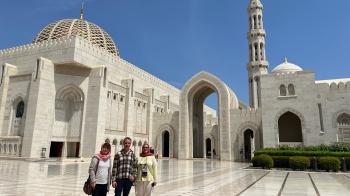
Staff from the Presbyterian Church (U.S.A.)’s Office of Global Ecumenical Partnerships (GEP) and the Office of Public Witness met on March 4 with the Rev. Justin Meyers, executive director of the Al Amana Centre in Oman, a country on the southeastern coast of the Arabian Peninsula, to discuss expanding educational and interfaith opportunities for U.S. congregations. Meyers highlighted the center’s long history with Reformed churches, its unique setting in the Middle East, and its readiness to support Presbyterians seeking deeper understanding of Islam, interfaith dialogue and peacemaking.
The meeting also reflected the collaboration among several offices in the Interim Unified Agency of the PC(USA) in the past few weeks as they accompanied partners in the Middle East through the war in the region. “The newly Unified Agency encourages more fluid connections between program areas to respond efficiently in cases like this one,” said the Rev. Carlton Johnson, director of the new GEP office. “A key element of Global Ecumenical Partnerships is building trustworthy relationships through intentional listening, then making the best possible connections with external partners as well as other internal program areas."
Luciano Kovacs, the international Global Ecumenical Liaison (GEL) who organized the meeting, explained how it and other correspondence with partners in Syria and Lebanon between Kovacs and staff from the Presbyterian Disaster Assistance are an expression to the General Assembly mandate INT-01, which commits “to including in our discussions our global ecumenical partners and a broad range of Christian and other faith perspectives, as well as people from marginalized communities in the U.S. and from frontline communities in parts of the world affected by U.S. policy.”
On its website, Al Amana Centre describes its work as fostering “safe, immersive, interfaith experiences” designed to build peace through person-to-person connection. Its location in Oman offers “the safety, accessibility and invitation required for meaningful connections between diverse groups.” The center’s history stretches back more than 130 years through Christian-Muslim cooperation in the sultanate, making it one of the oldest continuously operating Christian-led initiatives in the region dedicated to interfaith peacebuilding.
The PC(USA) affirmed that partnership in 2023 with a visit to the center and in 2024 with a $6,000 grant in support of Al Amana Centre programming. That relationship also continues through Presbyterian representation in its governance. The Rev. Dr. Elmarie Parker recently joined the center’s board, and Jeff Japinga, retired executive presbyter of the Presbytery of Minneapolis, also serves as a board member.
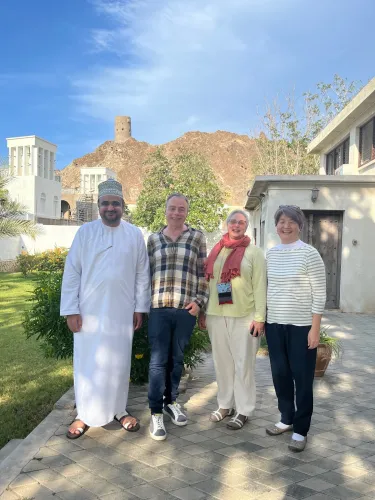
Meyers, who has served in Oman for 13 years, told staff that the center’s credibility stems from long-term relationships. The trust built with the Omani government enables the center to apply for the appropriate visas to host students, clergy and community leaders from around the world for immersive programs.
He depicted Oman as a nation deeply committed to regional peace. Despite hosting peace negotiations that made significant progress, Oman had been the target of several missile strikes on March 1, 2, 3, 11 and 13, but Meyers expressed Oman’s desire to protect itself through the interception of drones and missiles, but to stay out of the war.
“They truly have a genuine desire to build peace,” he said. The center’s role, he explained, emerges from that context. “I don’t think there’s a more neutral space to have religious dialogue in the world than the Al Amana Centre in Oman. … It’s no one’s home turf.”
Meyers described how firsthand encounters dispel stereotypes. “Some of [our visitors] came wanting just to be safe and [are] very skeptical of Islam,” he said. “They left hugging Muslims on their way out the door, saying their lives were changed.”
During the conversation, Catherine Gordon, representative for international issues in the PC(USA)’s Office of Public Witness, raised a challenge familiar in Presbyterian congregations: widespread misconceptions about women in Islam and the hijab. She noted that public discourse in the U.S., especially surrounding events in Iran or rhetoric about groups like Hamas, often reinforces Islamophobic assumptions. Pointing to online reactions to events such as New York City’s observance of World Hijab Day, the group discussed what can often be seen as “a blanket impression that women are oppressed.”
Her observations prompted Meyers to explain how such stereotypes break down when Presbyterians meet Omani women. He shared that many Omani women choose hijab freely, lead in government roles and outnumber men in university settings. “When you talk to them, you find out in Oman that they’re not oppressed. It’s their choice,” he said.
Gordon also emphasized the importance of learning Presbyterian history in Iran as one way to combat U.S. distortions of Islam and Middle Eastern cultures. She mentioned “America and Iran,” a book that explores the role of Presbyterian educational institutions and mission history there, noting that “some of the major schools in Iran were established by Presbyterian ministers.”
The discussion underscored how the center’s offerings align with the work of the PC(USA)’s GEP, which “connects, equips, and accompanies people in shared work and witness” rooted in mutuality and relationship building. GEP supports congregations, mid councils and networks seeking resources for global engagement, including interfaith learning, and emphasizes partnerships guided by local wisdom.
U.S.-based GELs Joseph Russ and Rachel Anderson asked how Presbyterians might gain tools for interfaith dialogue in their own contexts. Anderson noted her desire for training — not only for congregations but also for staff — and asked what internal teaching or training might be helpful. Like other U.S.-based global ecumenical liaisons, Russ and Anderson connect with congregations wanting to understand and expand global ecumenical partnerships through the synod. International GEL Luciano Kovacs, who convened the meeting, fosters relationships between the PC(USA) and partners in Europe and the Middle East.
In the spirit of partnering for learning, Meyers outlined two primary avenues for Presbyterian engagement: virtual Interfaith engagement and immersive educational trips to Oman. Meyers offered to connect congregations directly with Omani Muslim colleagues for open conversations about Islam and Christian-Muslim relations. “We’d be happy to come on together,” he said, noting that his colleague Ahmed leads an “Ask Ahmed Anything” session for visiting groups. The center is prepared to hold those same sessions via Zoom for churches or mid councils.
The center regularly hosts groups for weeklong programs emphasizing proximity, shared meals and direct encounters with Omani communities. These visits, Meyers said, have the power to reshape ministry. “How do we bring churches and church groups here to experience Islam and Arabs in a new way? We know [it] changes their ministry and their lives.”
The Al Amana Centre emphasizes experiential learning as a path from tolerance toward deeper understanding, empathy and reconciliation — a progression central to its approach to interfaith dialogue.
Anderson and Russ, who connect the work of GEP with congregations and mid councils through the Synod of the Covenant, Synod of Lakes and Prairies, Synod of Lincoln Trails, Synod of Living Waters, Synod of the Pacific, Synod of the Rocky Mountains, Synod of Southern California and Hawaii, and Synod of the Southwest, expressed interest in ways to connect with the center’s efforts to counter Christian nationalism, Christian Zionism and Islamophobia. Meyers welcomed the opportunity, saying, “Let us know — I’ll show up. You get me there, I’ll be there.”
As GEP continues its work to equip Presbyterians for relationship- based global engagement, leaders noted that partnerships like the one with Al Amana Centre offer PC(USA) congregations access to trusted, experienced guides in interfaith understanding.
You may freely reuse and distribute this article in its entirety for non-commercial purposes in any medium. Please include author attribution, photography credits, and a link to the original article. This work is licensed under a Creative Commons Attribution-NonCommercial-NoDeratives 4.0 International License.


