This month in Presbyterian history
Letters of protest, a Thanksgiving hymn, and a survey of Lane Theological Seminary's land
In November 1844, a land surveyor visited the campus of Lane Theological Seminary near Cincinnati, Ohio.
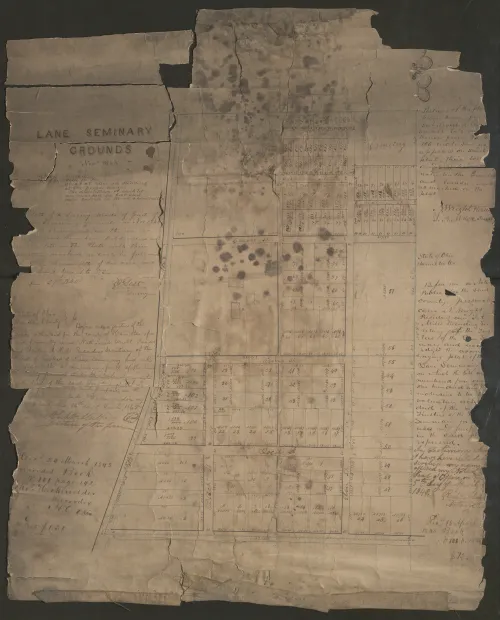
Lane Theological Seminary was the result of an idea had in 1828 by a Baptist lay person named Ebenezer. That year, he and his brother, William Lane, pledged to put the profits made from their New Orleans businesses toward the creation of a seminary somewhere near Cincinnati. When the Baptists were unable to carry the project through, the Presbyterians assumed it. The inaugural Board of Trustees, known as the "Ohio Board of Education," was organized in 1829, and Lane Seminary became a chartered institution. Elnathan Kemper and his brothers donated 60 acres of land in Walnut Hills to the newly gathered Board.
Those 60 acres from the Kempers were being surveyed and assessed in 1844. The Presbyterian Historical Society holds in its collection the fragmented drawn record of the visit. It is a large sheath of paper, 20 inches in length, and 16 inches wide, with a title written in pencil near the top left: "Platt of a survey made of ... grounds in Nov 1844."
This document was visited repeatedly in the months that followed, with various notes bordering both sides of the sketch. On the left is an update from March 18, 1845, the beginning of which reads, "Before me, a justice of the peace, within and for the county of Hamilton afore said, personally came Nathaniel Wright President and Thornton A Mills Recording Secretary of the Board of Trustees of Lane Seminary, and acknowledged the accompanying plat of the Lane Seminary grounds to be the solitary act and deed ..." Below that, a note that on March 24 of the same year, the surveyor received $1.50 payment for his work.
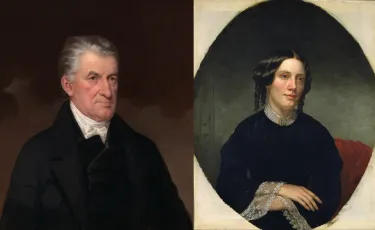
In its early years, Lane Seminary was organized into Preparatory, Literary, and Theological Departments. The Rev. Lyman Beecher served as the first president of the seminary, relocating from Boston, Massachusetts. The president's house, the structure of which still stands, is known today as the Harriet Beecher Stowe House, named after Beecher's daughter and the author of "Uncle Tom's Cabin."
The Walnut Hills School — a structure that had already existed on the property when it was gifted by the Kemper brothers — was run as a preparatory academy from 1829 until 1834. The seminary was at first functioned via the "manual labor plan" popular at the time, requiring the students to perform daily farm work — this was abandoned sometime after 1844. In 1932, Lane Seminary joined McCormick Theological Seminary in Chicago. The Lane board of trustees continued into the 2000s, administering funds held in the name of the former Seminary.
Access the guide to the Lane Theological Seminary Records
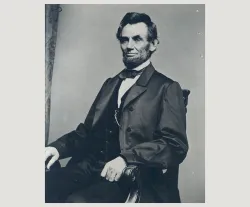
George Washington was the U.S. president who initially established Thanksgiving as a national holiday. He did so on October 3, 1789, when he declared that the national government would be celebrating Thanksgiving Day on the 26th day of the following month. John Adams and James Madison echoed Washington's declaration. It didn't entirely stick at that point in the nation's history — but decades later, when President Lincoln made a similar declaration, Americans heeded his call to action.
It was on October 3, 1863, at the height of the Civil War, that Lincoln issued his own Thanksgiving Proclamation. "It has seemed to me fit and proper that [the gracious gifts of the Most High God] be solemnly, reverently, and gratefully acknowledged as with one heart and one voice by the whole American people," Lincoln's Secretary of State William Seward wrote (Lincoln issued the proclamation; he did not author it). "I do, therefore, invite my fellow-citizens in every part of the United States, and also those who are at sea and those who are sojourning in foreign lands, to set apart and observe the last Thursday of November next as a Day of Thanksgiving and Praise to our beneficent Father who dwelleth in the heavens." This was just one of nine proclamations issued by Lincoln throughout the duration of the Civil War, each of similar content. This time, unlike Washington's attempt, it stuck — Thanksgiving has been celebrated each year since Lincoln's proclamation of 1863.
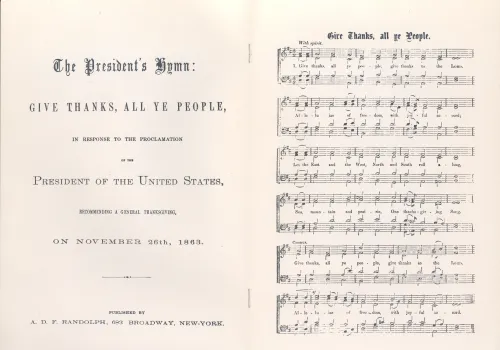
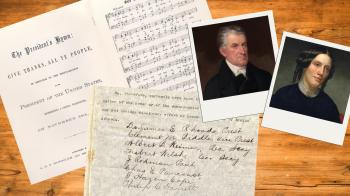
In response to Lincoln's Thanksgiving Proclamation, Anson Davis Fitz Randolph published "The President's Hymn: Give Thanks All Ye People." Randolph was the founder and owner of A.D.F. Randolph and Company, a printing business that he established in New York in 1851. Prior to the opening of his own store at 669 Broadway, Anson had worked for two decades as an errand boy in the American Sunday School Union.
The note at the top left of the sheet music tells the musician and vocalists to perform the song "with spirit." The lyrics of the chorus are as follows: "Give thanks, all ye people, give thanks to the Lord, Alleluias of freedom, with joyful accord."
A.D.F. Randolph and Company printed mostly religious books, pamphlets and sermons. In 1864, the year after he printed "The President's Hymn," Randolph moved his shop to 770 Broadway and Ninth Street, where he remained for 12 years. In 1884, his son, Arthur D. F. Randolph, became a partner within the business. The firm dissolved in 1896 after the death of Anson and the bankruptcy of the company.
Read the full text of Lincoln's proclamation
On the morning of November 11, 1887, Herbert Welsh sat down at his desk at 1316 Filbert Street, Philadelphia, where the offices of the Indian Rights Association were housed, and swiftly put pen to paper. "Dear Dr. Ellenwood," Welsh's letter began. "I enclose a copy of a protest signed by the most active members of our Committee, and which in time will, I presume, have the signatures of all," he wrote to the Rev. F.F. Ellenwood. Welsh also mailed Ellenwood a "copy of a letter written by me + the Evening Telegraph of this city."
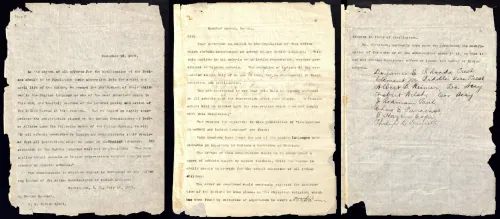
The list of signatures forwarded to Ellenwood was gathered in protest of a newly announced requirement by the Board of Missions, that is conveniently quoted in the body of the text: " ... we regard as highly inexpedient the construction placed by the Acting Commissioner of Indian Affairs upon the following order of the Indian Bureau, to wit: 'In all schools conducted by missionary organizations it is required that all instruction shall be given in the English language. Instruction in the Dakota language will not be permitted. The rule applies to all schools on Indian reservations whether they be government or mission schools.'" No mission schools would be allowed that did not comply with this new regulation.
The committee members then outline their reasons for "objecting to this prohibition of 'instruction in school any Indian language.'" What of the scores of already established schools taught by Native teachers? "The order so construed," the committee stated, "would seriously restrict the instruction of the Indians in some places in the Christian religion ... We, therefore, earnestly urge upon the Government the modification of the order or of the construction given to is, so that it may not abridge missionary effort or lessen the number of Indian schools." The letter was then signed by the President of the Indian Rights Association, Dr. James E. Rhoads, as well as the Vice President Clement M. Biddle, Herbert Welsh, who forwarded their protests to Rev. Ellenwood, and five other members of the committee.
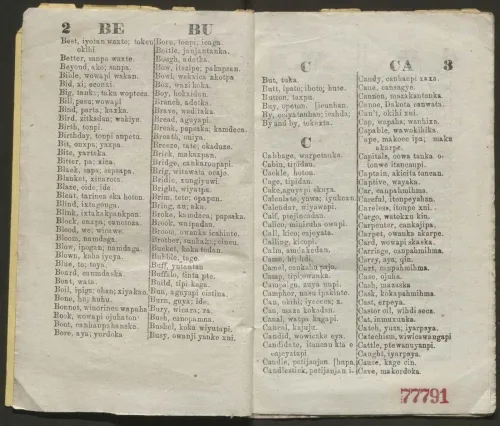
Perhaps Ellenwood served on the staff of the Board of Foreign Missions, an organization formed in 1837. In the next 55 years, the BFM, in addition to the Indian Territory missions, established missions among the Chippewa (Ojibwa), Ottawa, Dakota, and Sioux in the North; among the Iowa, Omaha, Otoe, Sac, and Fox tribes in the Midwest; among the Nez Percé, Sioux, and Spokane in the Northwest; and among the Navajo, Apache, Pueblo, and Pima in the far Southwest. Beginning in 1884, the BFM began switching its work among Native Americans to the Board of Home Missions, completing the process by 1893.
These letters live in RG224, American Indian Correspondence: Collection of Missionaries' Letters, 1833-1893, 1949-1950. They illustrate the irony inherent in the history of mission work amongst the Indigenous tribal peoples of the United States. The men who signed the letter of protest were not Native American; they were white clergymen speaking on behalf of the indigenous North American communities that the missionaries were endeavoring to assimilate. They did not truly speak for the Native American people — they spoke instead on the side of those working towards "the instruction of the Indians ... in the Christian religion ... which has been found by centuries of experience to exert a powerful influence in favor of civilization." The complexities of their protest remain. The effort toward ensuring that native tribal language be a consistent characteristic of schools intended for the instruction of native children could be seen as a positive endeavor — however, it's one that appears rather dull when placed in context with the larger goal of forced assimilation.
Access the guide to the American Indian Correspondence Collection of Missionaries' Letters
Browse the Indigenous peoples of North America digital collection in Pearl
Read Rev. Dr. Cecil Corbett's 1985 article "The Indian Culture Has Something To Say" in Pearl
Enjoy these glimpses into Presbyterian history in years past? Donate to the PHS Annual Fund, which supports the efforts of the Presbyterian Historical Society to collect, preserve, and share the past in order to transform your current perspective on church history.
You may freely reuse and distribute this article in its entirety for non-commercial purposes in any medium. Please include author attribution, photography credits, and a link to the original article. This work is licensed under a Creative Commons Attribution-NonCommercial-NoDeratives 4.0 International License.