October is for archives
The Presbyterian Historical Society participates in Archives Month Philly for the second year in a row

The Presbyterian Historical Society believes that archives are for everyone.
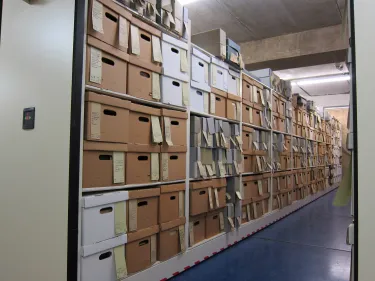
Whether you're a seasoned researcher or an amateur historian, an independent scholar or a professor working on a thesis, you are welcome at PHS. In fact, you're more than welcome — we often help folks get to the Reading Room by way of travel grants, awarded through our Research Fellowship Program, that's more than 20 years old.
Just as the archives are for everyone, so is Archives Month Philly. "Local Archives Month efforts were first initiated in Philadelphia during the 1990s as a week-long celebration known as Archives Week. In 2013, members of the Delaware Valley Archivists Group (DVAG) decided to revitalize this once popular but long defunct celebration, and Archives Month Philly (AMP) was born." This is an excerpt from an article all about the newly revitalized initiative in the May/June 2016 edition of Archival Outlook. "Now heading into its fourth year," the Archival Outlook reported, "the month-long festival in October is made up of independent events celebrating all things archives, libraries and special collections."
It’s been a decade since that article was published, and Archives Month Philly remains a popular annual celebration — one that the Presbyterian Historical Society was glad to be a part of for the second year in a row.
One of the staple events of AMP is the Archives Fair, held at the Parkway Central Library. Last year, PHS Outreach Specialist Olivia Cacchione tabled at the event, and brought with her the story of the Witherspoon Building and the 16 larger-than-life statues that were once attached to its exterior façade.
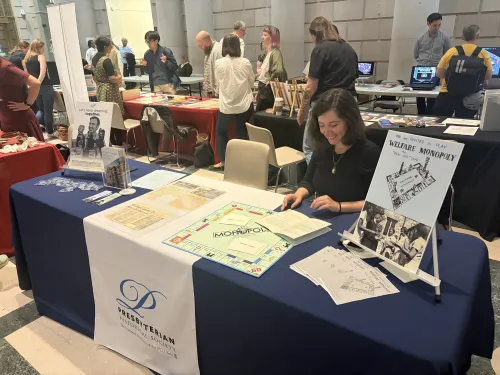
This year, the theme for the fair was "GAME ON! In the Archives." Just a few weeks before the theme was announced, Communications Associate McKenna Britton was familiarizing herself with the Rev. Carl Dudley, pastor of Berea Presbyterian Church in St. Louis, Missouri, when she discovered a folder full of materials relating to something called "Welfare Monopoly." It turned out to be the perfect find to bring along to the Archives Fair.
In late 1969, the Christian Conscience Committee at Berea Presbyterian Church sent out invitations to more than 100 families, asking them if they'd participate in a new game they'd developed. The game was set to last for an entire week. 120 families signed up to play what Berea was calling "Welfare Monopoly: The Real Life Game."
"Did you go to bed hungry last night? Did you wake up hungry this morning? And worse, are you forced to watch your children remain under-nourished because you cannot afford to provide them with adequate food, much less a nutritional diet? All of you can answer no to these questions, but for thousands right here in St. Louis, the answer would be a resounding yes." This was the players' introduction to "Welfare Monopoly."
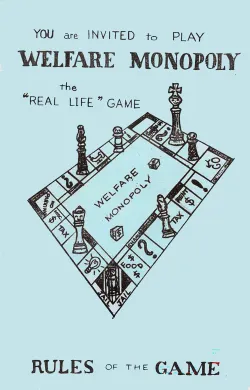
"It is true that welfare budgets include food, but do you know how much allowance is given for food??" asked the instruction pamphlet. "Prepare for a shock — the food allowance in Missouri averages 11 cents a meal!!!" This was the goal of the game: to exist on a welfare food budget for one entire week. The creators designed WELFARE CHANCE and COMMUNITY CHEST cards that presented common crises that occur to people while on welfare, though they acknowledged that "nevertheless, there is no way you can really know...So play — but understand the irony of a plentiful nation where some have to 'play' to understand the misery of others!!!!"
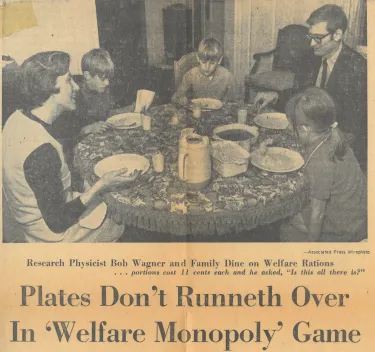
Bookended by two "welfare banquets," game-play officially began on Sunday, November 30, 1969, when the participants gathered to share a meal and receive the rules and materials necessary to play. The second banquet was held a week later, on Sunday, December 7, to which several officials had been invited "who have some direct connection politically with welfare programs in order for you to report your reactions firsthand to them."
The creators and members of the Christian Conscience Committee encouraged participants, and those reading about the game at home via their local paper, to develop and offer up "suggestions and proposals ... to help alter and improve the Welfare Programs of nation, state and city. Not just sensitivity, but action is our goal."
At the Archives Fair, Britton and Cacchione shared the story of Berea, Dudley, and "Welfare Monopoly," and encouraged passersby to interact with facsimiles of the CHANCE and COMMUNITY CHEST cards that they had displayed next to a traditional Monopoly board. They also provided facsimiles of the rule book for interested folks to take home.
To wrap up the month, AMP is hosting the annual Philly Archives Film Fest, where they'll be screening "seldom-seen weird and wonderful short films from Philadelphia archives and museums," including a special submission from the PHS archives. This free, in-person event will be held at PhilaMOCA on Wednesday, Oct. 28. Last year, PHS brought "Sunday on the children’s corner," a rare recording of Fred Rogers’ surreal predecessor to "Mister Rogers’ Neighborhood" which you can watch on Pearl. This year, PHS has submitted clips from a 16mm home movie made by a group of six young boys from West Philadelphia during the summer of 1966.
Barry Griffin, James Lucas, Ronald Mapp, Luerell Mapp, Michael Watters, and Howard White called themselves the Tabernacle Film Club; together, the Film Club conceived, shot, edited, and narrated a film about their lives, which they titled, “Not Much To Do.” They then proceeded to hold a public screening of their short autobiographical film.
In 1966, Robert D. Stoddard, a recent graduate of Princeton Theological Seminary and assistant pastor at Tabernacle Presbyterian Church in West Philadelphia, developed a film club for the local children who attended Tabernacle's Christian education class. Stoddard's initial notion was to have the children film adaptations of Bible stories, but a professor at the University of Pennsylvania's Annenberg School of Communication, Sol Worth, advised him to let the children simply roam with the camera.
The project had obtained most of its funding through a grant from the Board of Christian Education, though it was the efforts of the Tabernacle congregation that made the project possible at all. The film became a centerpiece for the congregation’s outreach efforts to their west Philadelphia community during a time of turbulence and transition.
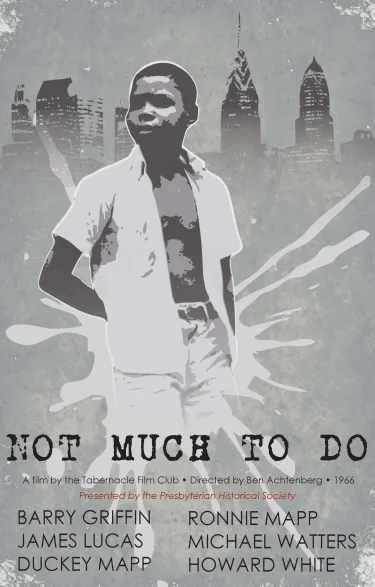
Edited in the library at Tabernacle and set to a jazz organ soundtrack, a plotless film coalesced around a guiding theme: there is not much to do in Philadelphia. The irony of the film's title of course is that the group finds plenty to do — they swim in the fountains in front of the Philadelphia Museum of Art, slap-box on the roof of an abandoned firehouse, roll down hills in Fairmount Park, roam free.
The boys continually talk about getting caught — while climbing around in the abandoned firehouse, while scrambling down the banks of the Schuylkill River, while sneaking into the Wistar Institute. But the city itself appears largely deserted, and the only figures around to assert any authority are rumpled-looking beat cops. Coming in the wake of Philadelphia's 1964 Columbia Avenue riots, the film treats the police department's reputation for brutality as the stuff of fairy tales. (For four days in August 1964, race riots erupted in North Philadelphia after escalating tension between the Philadelphia Police Department and the Black community that left over 300 people injured and seven hundred arrested.)
The story behind the film “Not Much to Do” transcends both time and space, bringing together a Presbyterian minister serving an inner-city parish; a university professor; a young graduate student; six Philadelphia boys ages 11-15; and last but not least, an archivist who discovered their story.
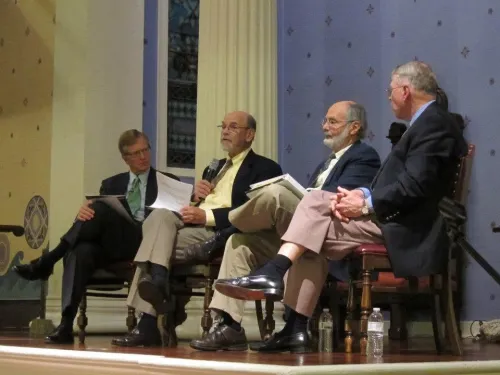
In 2011, PHS Records Archivist David Staniunas "discovered" the film along with some newspaper clippings in a collection donated by the Rev. Robert Stoddard. Staniunas and other PHS staff realized the film’s importance and decided to contact both Stoddard and Achtenberg about their interest in a public screening at PHS, perhaps followed by a panel discussion. Both Stoddard, now retired, and Achtenberg, a successful documentary filmmaker, were thrilled with the idea and agreed to be part of our efforts to share the film and its history with a wider audience. This panel and film screening was held in October 2012 — a year before Archives Month Philly was reborn— in the sanctuary of Old Pine Street Church.
"Not Much To Do" premiered at the Annenberg School on November 14, 1966, with six copies of the film being made for distribution to schools and church groups. Two of those copies are held at PHS, along with clippings collected by Stoddard. With assistance from NFL Films, PHS has transferred the film to DVD-video and MPEG-4 formats. PHS staff are excited to share this piece of history with other archive-lovers on October 28 at PhilaMOCA, and are excited to see what they might unearth for Archives Month 2027!
Did you enjoy this Archives Month update? Donate to the PHS Annual Fund, which supports the efforts of the Presbyterian Historical Society to collect, preserve, and share the past in order to transform your current perspective on church history.
You may freely reuse and distribute this article in its entirety for non-commercial purposes in any medium. Please include author attribution, photography credits, and a link to the original article. This work is licensed under a Creative Commons Attribution-NonCommercial-NoDeratives 4.0 International License.