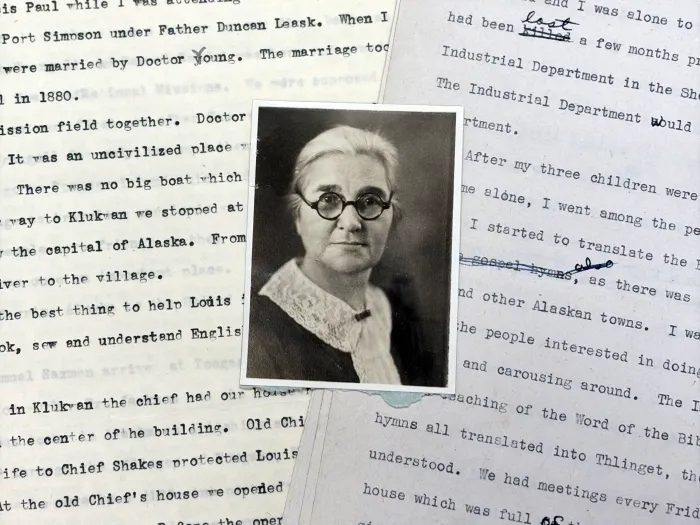
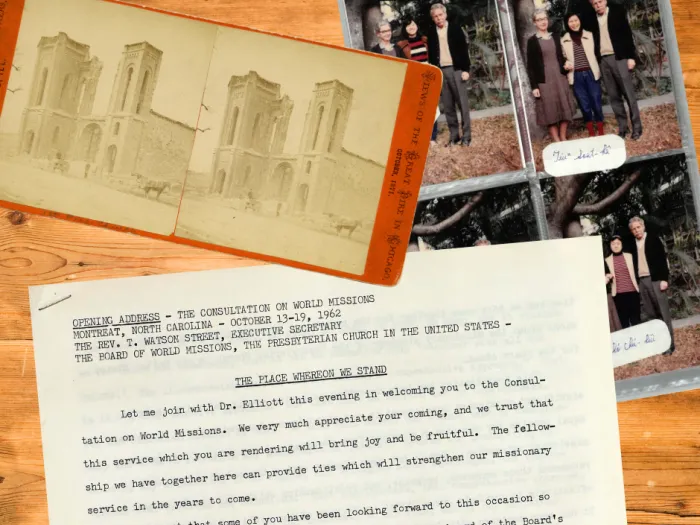
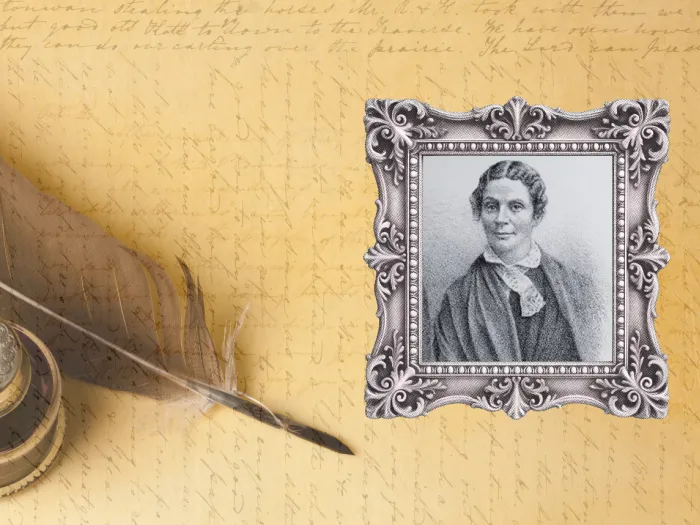
Presbyterian Heritage: history embedded
A preview from the fall 2026 edition of Presbyterian Heritage, available now
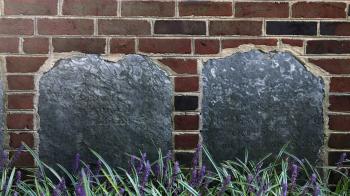
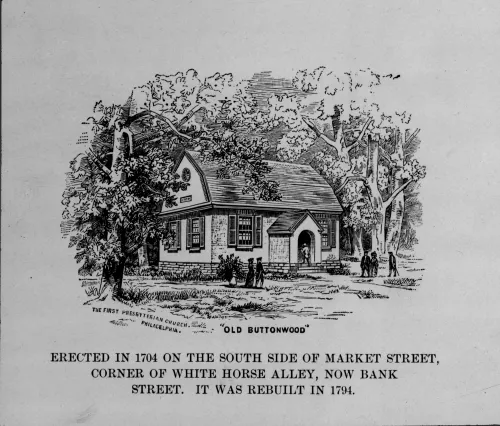
Organized in 1698, the First Presbyterian Church in Philadelphia's original home, known as "Old Buttonwood," was located on Market and Bank streets. Few artifacts exist today relating to this first location, and the Presbyterian Historical Society is honored to be the steward of a few of them: namely, 30 tombstones embedded in the exterior northern wall of our building.
Until 1820, First Presbyterian worshipped at Old Buttonwood and maintained a burial ground there and at a second site near Third Presbyterian Church on Pine Street.
Old Pine Street Presbyterian Church, the structure still stands at 412 Pine Street. The congregation was led by the Rev. George Duffield, Revolutionary War and Continental Congress chaplain, and by Dr. Archibald Alexander, founder and first professor of Princeton Theological Seminary.
Old Pine Street Presbyterian Church was the site of the first General Assembly of the Presbyterian Church in the U.S.A. in 1789, and is the only pre-Revolutionary War Presbyterian edifice in Philadelphia.
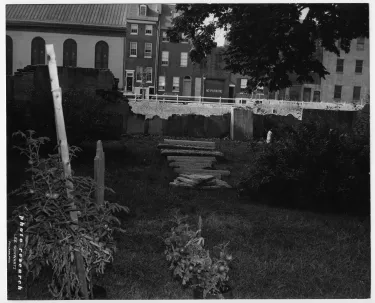
In the 1840s, when First Presbyterian Church was getting ready to sell the lot at Market and Bank Streets, the church thus had a burial ground to think of. Social customs said that the churchyard remains ought to be removed and reinterred elsewhere.
And so, between 1847 and 1848, the remains of 1,500 people were removed and reinterred to Laurel Hill Cemetery in West Philadelphia, which had opened in 1836. Simultaneously, the remains of 900 people were reinterred to First Presbyterian Church's Pine Street cemetery.
Families that opted to have their ancestors reinterred at Laurel Hill were not allowed to bring headstones, which was simply unacceptable to a handful of the descendants, who removed theirs, carried them from Bank Street to Pine, and set them against the cemetery's south wall.
The walls had, at one time, been made of wood.
A wooden fence encircled the Pine Street burial ground for years but had been torn apart by poor city residents who’d steal the planks to burn for heat during the cold winter months. After decades of this thievery, with their fence in shambles, First and Third Presbyterian churches collaborated to build a tall brick wall around the lot on Pine Street, to ward off miscreants and protect the graves. To the south of the wall ran a small alley named Tenor Street.
In the early 1960s, as part of the city's redevelopment efforts, the row houses that stretched along Tenor and Lombard Street were razed. The United Presbyterian Church in the U.S.A. then purchased the cleared land along Lombard as a future site for the Presbyterian Historical Society. As construction began on the new building, the south cemetery wall was torn down.
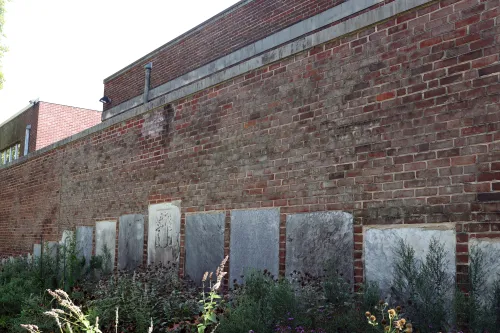
To preserve the 43 tombstones that had been leaning against that south wall for so very long — each of them now more than 200 years old — the architects decided to embed thirty of them in the northern wall of the PHS building.
The remaining 13 were propped against the western wall of the Old Pine Street cemetery, where they remain to this day.
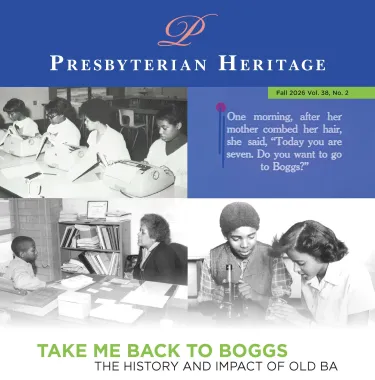
This article was written for Volume 38, Number 2 of Presbyterian Heritage, the biannual newsletter of the Presbyterian Historical Society.
Head over to pcusa.org/ph to read the other articles, including a feature on the history of Boggs Academy, a Presbyterian-run boarding school for Black children and youth in Keystone, Georgia.
Other highlights of this edition include an announcement regarding the upcoming edition of Waymarks, a preview of the Reformation Sunday bulletin, and a peek at our new outdoor exhibit Belief in Change.
You may freely reuse and distribute this article in its entirety for non-commercial purposes in any medium. Please include author attribution, photography credits, and a link to the original article. This work is licensed under a Creative Commons Attribution-NonCommercial-NoDeratives 4.0 International License.