
Israeli guide shows PC(USA) delegation a pocket of Palestinian neighborhoods in East Jerusalem
Yahav Zohar calls the neighborhoods ‘mixed in interesting ways’
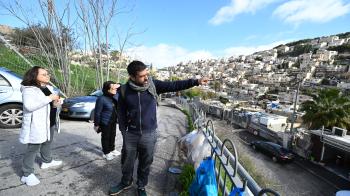
JERUSALEM — Yahav Zohar, an Israeli guide with more than 20 years of experience showing people some of Jerusalem’s most impacted neighborhoods, explained some of the sites in East Jerusalem to a delegation from the Presbyterian Church (U.S.A.) last week, calling the neighborhoods “mixed in interesting ways.”
Zohar, a former journalist who grew up in Jerusalem and has lived there all his life, develops itineraries that combine the historical and religious sites with the social and political realities of the present day.
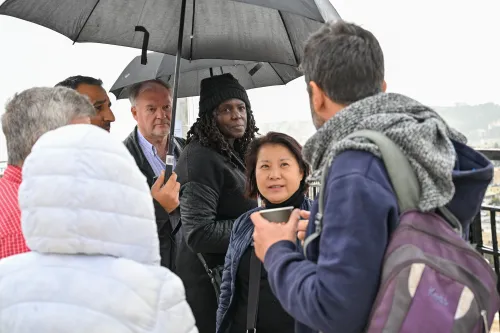
He started with an orienting view from behind a fence at a United Nations compound. “If it was more clear, you might see the Dead Sea,” he told the six-member delegation. “But you can see Jerusalem, which matters most to us now.”
From the elevated site, the group, which was led by the Rev. Jihyun Oh, Stated Clerk of the General Assembly and Executive Director of the Unified Agency, viewed the al-Bustan neighborhood in the Silwan District, where they took in West Bank land conquered by Israel during the Six-Day War in 1967. The Israeli government soon determined it didn’t want to make the West Bank part of Israel, Zohar said. “They made the decision not to decide, to just hold it under the military,” labeling it held territory rather than occupied territory. “The decision was made for 99% of the West Bank, but not Jerusalem.” With Bethlehem five miles to the south and Ramallah eight miles north, “you could argue they are part of Jerusalem too.”
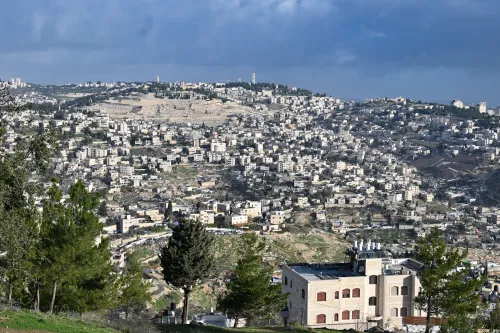
People living in the West Bank fall into one of at least three legal categories, he said. Some are full citizens of Israel. Some live under military governance and have few to no rights, while others “are legally and physically in between.”
Palestinian populations there have grown by almost sixfold since 1967, from about 70,000 people to around 400,000. A separation wall was constructed in 2003-04. “For more than three decades, it was just a line on the map,” he said. One result was the suburbs are much more dense than in the Old City. The construction permit process in the suburbs allows for that, he said.
People have become used to building their unpermitted homes quickly. “You know almost certainly you will be caught, but you hope it’s after construction is complete and someone is living inside,” he said. A demolition order in that case can be appealed, “and it takes many years. You are fined the estimated cost of the building, which is a very large fine,” he said.
A demolition order gives the owner two choices: demolish your home yourself, “which most people don’t,” Zohar said, or possibly suffer demolition by the authorities.
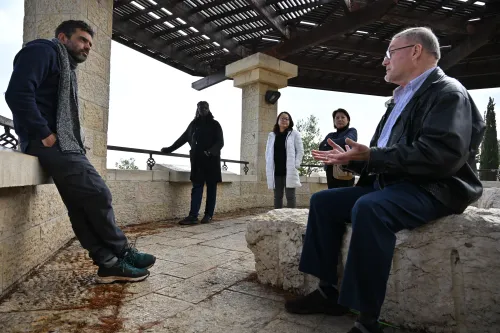
From the high ground, the delegation could see more parks and streetlights and better roads in Jewish neighborhoods than in those where Palestinians live. Zohar has studied the funding discrepancy and said that over the past 60 years, spending in Palestinian neighborhoods by municipal authorities is about one-fourth what is spent in Jewish neighborhoods. “It’s not that they do nothing in these neighborhoods,” he said, “but much less.”
“We live in a very segregated city — separate neighborhoods, separate schools, separate transportation systems,” Zohar said. “I grew up in a Jewish neighborhood near here. For the first 20 years of my life, I was never or almost never in these neighborhoods.” Palestinians might know East Jerusalem because they drive cabs or go shopping there. “A vast majority of Israeli Jews don’t go into Palestinian regions,” he said. “Many Israelis have a fear of being attacked there. I once was afraid, too.”
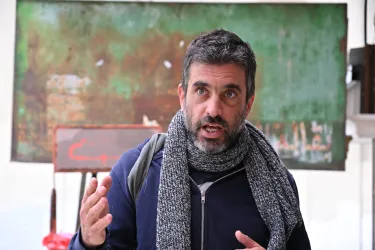
“Few do what we are about to do — drive through the [Palestinian] neighborhoods to look at how they are managed today,” he said, and the delegation proceeded to the Bustan neighborhood in the Silwan region, named for the biblical pool of Siloam. Zohar said 30 of 110 homes in Bustan have been demolished since Hamas attacked Israel on Oct. 7, 2023. He took the delegation to the debris of one such home, where appliances were left in piles.
“They want to keep people afraid their house may be next,” he said. “Gaza is there to show people in the West Bank how hard things can be for them.”
At a stop, Zohar asked aloud who the separation wall is stopping. “Regular commuters,” he said, answering his own question. “Who is it not stopping? Determined bombers.”
“Most Israelis don’t want to know how their sausage is made,” he said. “The system is working for us, and so we don’t want to know the details.” Work permits enabling some travel are good for 12 hours each day, from 7 a.m. through 7 p.m. “You pay to apply, and there’s some corruption in the system to get your permit issued faster,” he said.
Zohar called a stop later on in the day, the Mount of Olives Jewish Cemetery, the “best place in the world to be a dead Jew.” About 150,000 Jewish tombs are there, with “many more below.” In Jerusalem alone, 394 holy places had been counted by the mid-1990s, he noted.
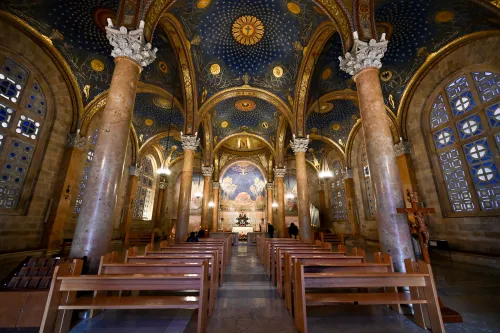
The Church of Gethsemane, which includes the Church of All Nations, is on the Mount of Olives next to the Garden of Gethsemane. The church was consecrated in 1924 on the foundations of two earlier ones, a fourth-century Byzantine basilica destroyed by an earthquake in 746, and a 12th-century Crusader chapel abandoned in 1345.
The floor copies Byzantine mosaics more than 1,500 years old. A rock is at the spot where tradition says Jesus was praying when he was arrested.
Some of the olive trees standing today are 800 years old, Zohar noted.
Read previous reporting by Presbyterian News Service on the visit PC(USA) delegation here, here, here, here, here and here.
You may freely reuse and distribute this article in its entirety for non-commercial purposes in any medium. Please include author attribution, photography credits, and a link to the original article. This work is licensed under a Creative Commons Attribution-NonCommercial-NoDeratives 4.0 International License.


