Pastoral care in the age of AI
New ecumenical resource helps pastors respond to griefbots, voice-cloning scams and AI companions while inviting ongoing discernment
NASHVILLE, Tennessee — A grieving parent relies on a chatbot built from a deceased child's digital footprint and suffers renewed trauma when a software update alters the bot's responses. An elderly parishioner becomes the target of a voice-cloning scam. A church leader who recently lost a spouse develops an attachment to a chatbot.
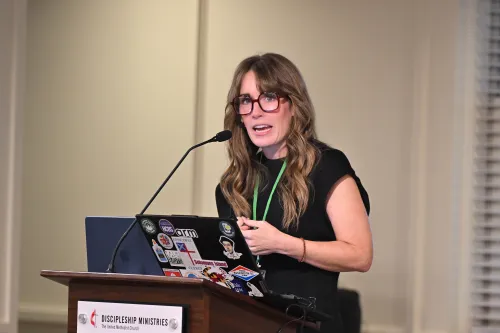
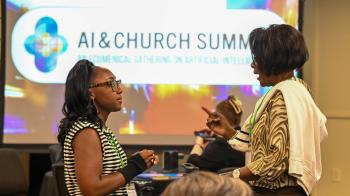
These are just some of the scenarios an ecumenical team of ministry practitioners, chaplains, theologians and technology specialists considered while designing the newly released toolkit, which was unveiled during the third day of the AI & Church Summit in Nashville, Tennessee, from Aug 24-28.
The 2026 summit, themed “The Agency of the People of God in the Age of AI,” brought together leaders from the Presbyterian Church (U.S.A.), Episcopal Church, Evangelical Lutheran Church in America, and United Methodist Church to explore both opportunities and concerns surrounding artificial intelligence. Earlier sessions examined topics ranging from technology ethics and human agency to AI infrastructure, labor concerns and the social consequences of emerging technologies.
The Church AI Toolkit was developed during a five-day design sprint convened in July by the TryTank Research Institute at Virginia Theological Seminary. According to organizers, 17 participants representing four Protestant traditions were asked to create practical resources for ministry leaders confronting AI-related questions in congregational life.
“This church AI toolkit is a free vetted collection of resources built to help congregations and pastors do the work of faithful ministry with, we hope, less guesswork and more capacity,” said the Rev. Olivia Lane at the launch. Lane, a teaching elder in the PC(USA), said the project emerged from conversations among pastors, chaplains, denominational leaders and technology practitioners who were already encountering questions about AI in their ministries. “We need tools that are not merely theoretical. We need help and modeling around engaging artificial intelligence, and I think most importantly we need each other to do that work with integrity,” she said.
According to the design sprint white paper, participants initially expected to spend much of their time discussing clergy use of AI for sermons, newsletters and administrative tasks. The group's focus shifted after reviewing ministry case studies and considering what situations were most likely to arrive in pastors' offices and congregations. The white paper cites examples including AI-generated grief companions, voice-cloning scams, deepfake extortion, adolescent attachment to AI companions and job displacement caused by automation.
During the launch presentation, speakers repeatedly emphasized that many of these situations are not primarily technology problems but pastoral-care challenges that churches already have experience addressing through ministries of listening, accompaniment, discernment and community support. The goal, presenters said, was not to create new forms of ministry so much as to help pastors apply existing pastoral skills in unfamiliar contexts.,
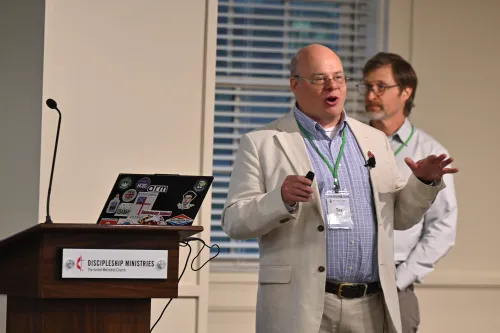
The Rev. Tay Moss, an Episcopal priest, member of the Anglican Church of Canada and software developer, illustrated the point with the example involving a church leader who became attached to a chatbot after losing a spouse. “That’s a grief issue,” Moss said.
According to the toolkit website, Moss was among several participants chosen for expertise bridging ministry and technology. During the sprint, he helped develop the website infrastructure that transformed the group's work into a publicly accessible resource.
The toolkit includes pastoral triage guides, governance templates, clergy formation materials, theological reflections, case studies and liturgical resources. According to the development team, the site is intended to function as a living resource that can be revised as technology and ministry needs evolve.
Throughout the presentation, speakers acknowledged concerns about bias, representation and whose perspectives are reflected in both artificial intelligence systems and church responses to them. “The church has patterns of deciding whose voices count and whose don't, and we need to be aware of that as we create new tools that have the ability to perpetuate these same verdicts,” Lane said.
Lane also challenged church leaders to think creatively about how AI might be used in ministry, particularly in resource-constrained settings. “Imagination is often our limiting factor,” she said, noting that artificial intelligence made possible work that would have taken much longer in previous years. At the same time, Lane warned against allowing technology to replace pastoral discernment. Design participants wrestled with what she described as “the temptation to let the tool do our discernment for us instead of alongside us” and with the risk of prioritizing convenience over vocation. She argued that “the whole vocation of pastoral ministry resists optimization” because some of the church’s most important work happens through embodied presence, relationships and accompaniment rather than efficiency.
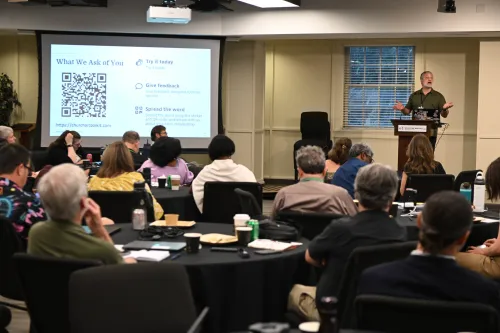
Questions about representation and peer review surfaced during the discussion that followed the presentation. The Rev. Carmelo Santos, an ELCA pastor and theologian, welcomed the effort but questioned whether broader review by pastoral-care experts and leaders from more culturally diverse communities should occur before the resource gains wider adoption. “I feel excitement. I also feel a lot of warning signs going up,” Santos said. “What worked with my Anglo parishioners was not the same that what worked with my Latino communities.”
Similar concerns appeared elsewhere during the summit. In the conference chat, one online participant questioned whether churches should embrace AI resources at all given ethical concerns about labor, exploitation and data practices that had been discussed during earlier sessions.
The toolkit's creators said such critiques are part of the ongoing development process. The design sprint white paper recommends field testing, theological and clinical review, accessibility improvements and an ecumenical stewardship model to oversee future revisions.
The Rev. Dr. Lorenzo Lebrija, executive director of TryTank Research Institute, urged attendees to view the toolkit as a beta release rather than a finished product. “We want you to play around with it. We want you to try to break it. We want you to tell us what works, what doesn't work, so that it can continue to be better,” Lebrija said.
For now, the Church AI Toolkit represents an attempt to equip pastors for conversations that organizers believe will become increasingly common in congregational life while leaving space for ongoing debate about the ethical, theological and human implications of artificial intelligence.
You may freely reuse and distribute this article in its entirety for non-commercial purposes in any medium. Please include author attribution, photography credits, and a link to the original article. This work is licensed under a Creative Commons Attribution-NonCommercial-NoDeratives 4.0 International License.