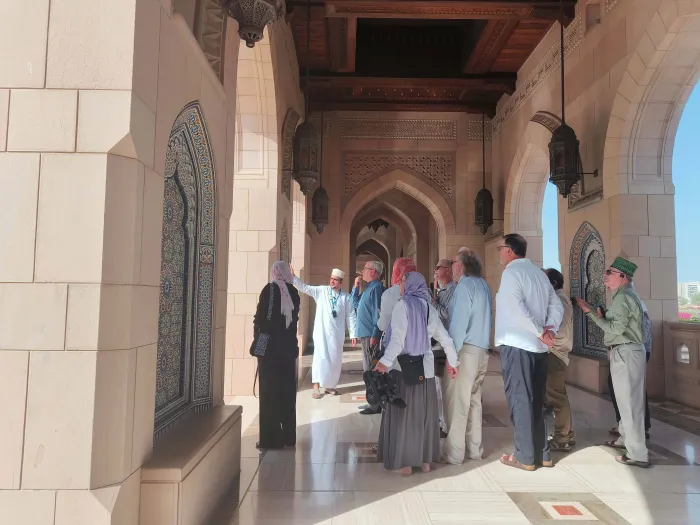
Seeing others as Jesus sees them
World Communion Offering supports expansion of interfaith experiences and education through the Al Amana Centre in Oman
LOUISVILLE — For the Rev. Justin Meyers, interfaith understanding isn’t just an abstract concept; it’s his lived experience.
During his 10 years in parish ministry, Meyers regularly engaged in a wide range of interfaith initiatives, from pulpit exchanges to interfaith Thanksgiving services to interfaith justice and social initiatives.
But his immersive, firsthand education and commitment to interfaith dialogue weren’t limited to the congregations and communities he served.
“I have a family history with my father’s sister marrying a Lebanese Muslim immigrant and having cousins who were all raised in the Muslim faith tradition,” Meyers said. “I was drawn to the work of interfaith relations since it was not only a piece of my personal history but also a part of pastoral ministry that I valued highly.”
Even so, the idea of taking a position with the Al Amana Centre in Oman, a country on the southeastern coast of the Arabian Peninsula — was perhaps the farthest thing from his mind.
“I never saw myself becoming a mission worker; I was recruited,” said Meyers, an ordained minister in the Reformed Church in America who became the Al Amana Centre’s associate director in 2013 and is now its executive director. “And although I never thought my wife would agree to go, she said yes. Oman also offered the opportunity for my sons, who were 4 and 7 years old at the time, to experience something most kids never would have the opportunity to have in their lifetimes.”
With its roots in the Reformed Church of America, the Al Amana Centre’s work is based on more than 130 years of collaboration between Christians and Muslims in the Sultanate of Oman. It is one of the few Christian-led organizations in the Muslim-majority world working toward sustainable peace.
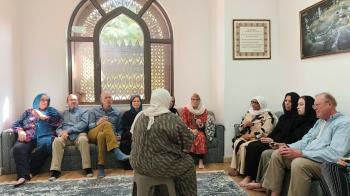
The staff and Al Amana’s eight-member board seek to foster peace and reconciliation through safe, immersive interfaith experiences, offering training sessions and relational encounters that build capacity to work across differences, religious and political.
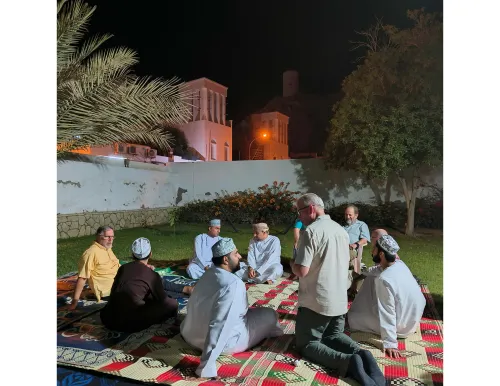
Through genuine and open exchanges, the Centre’s facilitated discussions bridge the gap between people of different beliefs and help participants gain deeper insights into themselves. One of the Centre’s priorities is to lift up the role of religion so that people can connect, reconcile and build peace within their own context.
“Interfaith opportunities increase dialogue and knowledge,” said Luciano Kovacs, Global Ecumenical Liaison, Middle East and Europe, with Global Ecumenical Partnerships of the Presbyterian Church (U.S.A.).
Within the structure of Presbyterian Life & Witness (PL&W), the Global Ecumenical Liaisons (GELs) serve as bridges between the PC(USA) and its international/U.S. partners, mid councils, new worshiping communities, diaspora communities, ethnic caucuses, ecumenical partners and mission networks.
“Interfaith experiences break prejudices, show the ‘other’ as a fellow human being rather than someone belonging to a different religion, without attempting to level diversity,” Kovacs said. “They foster solidarity based on common human needs rather than opposition in beliefs. Personal encounters make religious doctrine secondary to getting to know one another as people.”
Meyers said that many of the people in the region, especially in places such as Palestine and Africa, who need training in interfaith relations and peacebuilding, don’t have the financial resources to spend on the trainings that Al Amana offers, nor do they have the luxury of travel outside of the region.
“Supporting the Al Amana Centre through the PC(USA) allows us to deepen partnerships, offer needed training and retreats to people in conflict zones, and allows us to help people in the U.S. meet and understand people of different religions and cultures in the Gulf, Levant, and the wider MENA [Middle East and North Africa] region,” said Meyers.
Although board members like the Rev. Dr. Elmarie Parker, a PC(USA) minister and former regional liaison for PL&W, were in the process of engaging several U.S. congregations with Al Amana’s work by scheduling learning trips, any such visits to the region are necessarily on hold in the light of the continuing crisis in the MENA region.
“Once this war is over,” added Kovacs, “I would like to see PC(USA) constituents plan trips to Oman to experience directly how the Al Amana Centre conducts interfaith dialogue.”
In the meantime, Al Amana’s ongoing programming continues to advance its critically important mission in the region and beyond.
“Learning peace-building skills from partners like the Al Amana Centre is deeply relevant to the challenges facing congregations in today’s United States,” said Parker. “Increasing our capacity to work effectively across differences of all kinds directly contributes to embodying the invitation of Micah 6:8.”
In fact, the prophet’s threefold call is at the heart of all three of the PC(USA)’s Special Offerings, with Micah’s charge to “love kindness” shining a light on the newest of the three, the World Communion Offering.
Received by many congregations on World Communion Sunday, which falls this year on Sunday, Oct. 4, this new Offering can be celebrated at any time of the year.
With its singular focus on reconciling God’s people around the sacrament of the Lord’s Supper, it supports the PC(USA)’s initiatives in racial justice, gender justice, peacemaking, global witness, and ecumenical and interfaith relations, as embodied by the work of the Al Amana Centre.
“The World Communion Offering at its core invites us to something different — to act on a commitment we say has its root and its core expression at the table,” said the Rev. Dr. Jeffrey Japinga, a Presbyterian transitional minister serving a congregation near Chicago who chairs the board of the Al Amana Centre. “It’s a commitment that belongs not to one church, nor just to the Presbyterian Church, but the whole church, the whole world. That the barriers we too often build — cultural, political, personal — that keep us from seeing others as Jesus sees them are set aside here. But if those are only words, uttered only for a few moments on a Sunday morning, they ring hollow. This offering is a way to act: to stand alongside people and organizations breaking down the very barriers set aside at Christ’s table.”
The Rev. Ellen Sherby, PL&W’s manager for International GELs, said that just as reconciliation takes place around Christ’s table of grace, “the ministry of Global Ecumenical Partnerships aspires to bring people together for work rooted in strong relationships and local discernment that brings fullness of life to all.”
“Just as the World Communion Offering seeks the wholeness of all peoples from all nations of the globe, the Presbyterian Church (U.S.A.) works with others to connect, equip and accompany people in shared work and witness for God’s work in the world,” said Sherby. “Feast joyfully, give generously. The table is set, and all are invited!”
You may freely reuse and distribute this article in its entirety for non-commercial purposes in any medium. Please include author attribution, photography credits, and a link to the original article. This work is licensed under a Creative Commons Attribution-NonCommercial-NoDeratives 4.0 International License.