This month in Presbyterian history
A 1908 letter, a 1954 installation ceremony and a 1963 televised panel discussing the 16th Street Baptist Church bombing
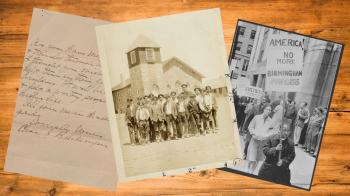
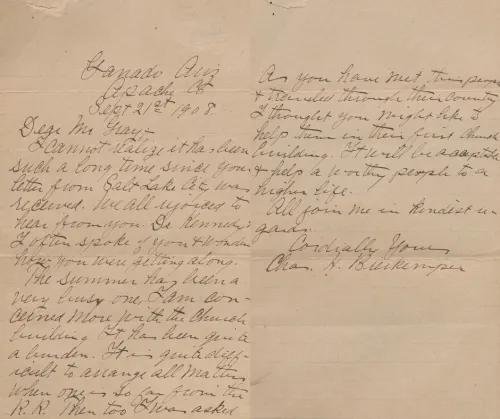
"I cannot realize it has been such a long time since your letter from Salt Lake City was received. We all rejoiced to hear from you. Dr. Kennedy and I often spoke of you and wondered how you were getting along…" So begins the September 21, 1908, correspondence from Charles Harry Bierkemper to a "Mr. Gray."
Bierkemper was writing from Arizona, where he was serving at the Ganado Mission Station with his wife. The Ganado Mission Station was established around 1901, with the goals of culturally assimilating and converting the Navajo (Diné) and Hopi peoples. Missionaries and mission administrators pursued these goals primarily through the avenues of Christian education, evangelism and medicine/medical care.
Ganado was chosen after a scouting group surveyed the Arizona area for a location. Advised by their scouts the Rev. George Logie and William R. Johnston, the PCUSA Board of Home Missions with the Presbytery of Arizona applied to the United States Bureau of Indian Affairs for a grant of more than 100 acres near the Hubbell Trading Post in the Navajo Indian Reservation there. Once granted, the land became the site of the mission, which would grow to include a hospital, boarding school, and college.
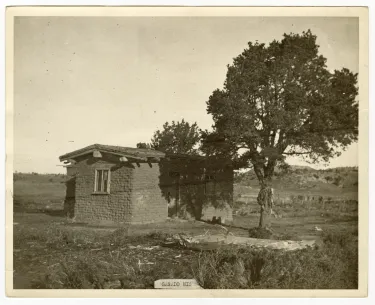
Bierkemper and his wife Alice Bierkemper (née Woodford) served as the first pastor and first teacher, respectively, at Ganado Mission Station. They were joined by two Navajo interpreters, Tom Morgan and John Curley.
In a brief history of the mission, it is noted that in 1905 Bierkemper "pleads for an industrial boarding school and medical missionary." The arrival of Dr. James D. Kennedy solved the latter issue; the former was resolved in 1912 when a dormitory building was constructed for students.
"The summer has been a very busy one," the September 1908 correspondence continues. "I am concerned more with the church building. It has been quite a burden. It is quite difficult to arrange all matters when one is so far from the R.R." Bierkemper mentions, before pivoting to talk of Kennedy, who "has been very busy … He has had as high as 17 patients to call on him in one day. A place to receive the sick is much needed …" The first hospital was built around 1912 and featured 12-15 beds.
The correspondence concludes with an opportunity — "As you have met the people and traveled through their country I thought you might like to help them in their first church building. It will be acceptable and help a worthy people to a higher life."
Just last month, the PHS digitization team finished uploading a batch of 600+ newly processed photographs of the Ganado Mission in Arizona. Browse those images here.
The Ganado Mission Records live in the archives of the Presbyterian Historical Society in Philadelphia as Record Group 550. Access the guide to the collection here.
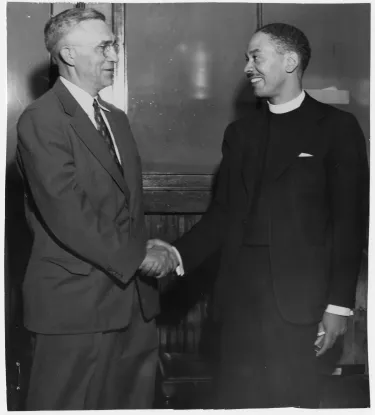
On Sept. 17, 1954, the Rev. Robert Pierre Johnson was installed as pastor of Fifteenth Street Presbyterian Church in Washington, D.C. His colleague and friend Alexander E. Sharp wrote and delivered the charge, a typed seven-page transcript of which lives in Pearl, the Presbyterian Historical Society’s digital repository. "The charge to the pastor is intended to be a brief word of counsel or inspiration to a fellow minister about to begin a new task," Sharp explains. He quotes James Stewart, a beloved American movie star and dedicated Presbyterian, a few times throughout.
"I am tempted on this occasion, as most of us are at such times, to say something timely and novel, something not said before to anyone else, such as that you must rise to eloquent greatness because your voice is to be heard in a city where American official policy is made; and that you must be courageous because you will be pioneering new social attitudes in one of the Nation’s principal racial laboratories; and that you have a supreme opportunity because your ministry is coming into its prime in one of humanity’s most distressed eras," Sharp began.
"Of course these things are true," he continued, "But I would not be true to my commission here were I not to say things far simpler and more basic … I call upon you, first, to be a man of God … Second, love your people … Finally, forget yourself."
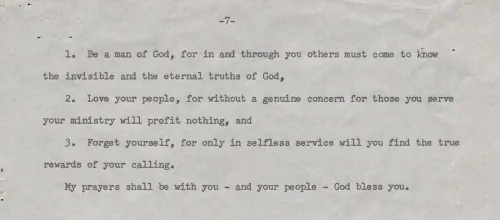
On this last point, Sharp offered clarification via a James Stewart quote. "Didn’t Christ show the supreme act of self-forgetfulness to us all and establish forever the cross as the symbol of true Christian ministry? Says James Stewart again, 'No ministry is worth anything which is not first and last and all the time a ministry beneath the Cross. Let a man reckon the cost before he closes with the call.' These, then, are my suggestions to you, Bob, as you start this ministry of unusual opportunity and promise."
From his installation ceremony in September of 1954 until 1967, Johnson served as the pastor of Fifteenth Street Presbyterian Church in Washington, D.C. In late October of 1967, Rev. Johnson was installed as the General Presbytery of the Presbytery of New York in a ceremony held at Fifth Avenue Presbyterian Church.
His collection of personal papers lives in the archives of the Presbyterian Historical Society as Record Group 471. This collection, which consists primarily of sermons and lectures authored by Johnson, as well as correspondence that he sent and received, documents the breadth of Johnson's pastoral career, with a particular emphasis on his activities as General Presbyter of the Presbytery of New York City and as Moderator of the Presbytery of Washington City, in addition to his involvement with the civil rights movement. Access the guide to the Robert Pierre Johnson Papers here.
On Sunday, Sept. 15, 1963, the 16th Street Baptist Church in Birmingham, Alabama, was bombed. Four young girls were murdered: Carol Denise McNair (11), Carole Robertson (14), Cynthia Wesley (14), and Addie Mae Collins (14). From a Religious News Service photograph taken at the site of the tragedy, we learn that "The youngsters, one 11 and three 14 years old, were studying their Sunday school lesson on the subject, 'The Love That Forgives,' when explosions ripped through the church. A rope-barricade and armed troopers held a gathering crowd away from the blast area ... From across the nation, religious leaders urged action to prevent further violence in racially-tense Birmingham."
Three days later, author James Baldwin was photographed with his colleague Bayard Rustin, director of the March on Washington, during a news conference in New York. The two civil rights leaders called upon President John F. Kennedy to send troops to Birmingham to intercede. The armband in their hands was crafted to be worn at an upcoming rally scheduled for the 22nd.
On that day, what has since been titled the National Day of Mourning for the Children of Birmingham, hundreds of churches across the US held memorial services for the four murdered girls. Baldwin addressed a large crowd at the federal courthouse in Manhattan, New York, all rallied together in response to the bombing that occurred the week before.
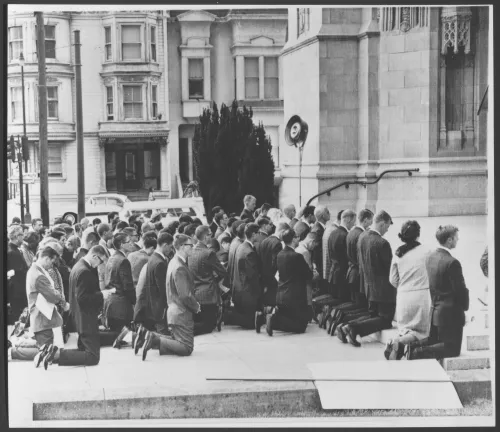
The Religious News Service snapped a photo of the service at St. Dominic's Roman Catholic Church in San Francisco, California, where more than 2,500 attended. The building was overflowing, congregants falling to their knees on the sidewalk “during a Mass offered for the dead children." The priest wore "vestments in the 'red of martyrdom' instead of the black of mourning," RNS reported.
A week after the tragedy, the Protestant Council of the City of New York hosted a panel discussion, inviting Baldwin and theologian Reinhold Niebuhr to answer the question, "Does the missing face of Christ on this stained-glass window which survived the bombing suggest a meaning?"
The panel was recorded and aired as an episode of "Our Protestant Heritage" titled "The Meaning of the Birmingham Tragedy." The narrator, before the discussion officially started, told viewers that, "In presenting this special program, the Protestant Council insists that your view, your sense of responsibility, is the really important factor in making sure that the Birmingham children have not died in vain …" The conversation opened with the host, Dr. Thomas C. Kilgore, Jr., minister of the Friendship Baptist Church and New York Director for the Southern Christian Leadership Conference, asking Baldwin, "Does this faceless picture suggest to you a meaning of the Birmingham tragedy?"
Baldwin, sitting with the stained-glass hung high behind him, wears a corduroy suit —with a white cloth band on his left arm that says, "Birmingham Children," similar in design as the one he was photographed holding at the news conference. "To me, it sums up the crisis that we are living through," he began. "If Christ has no face, then, perhaps it is time, that we — who, in one way or another, invented and are responsible for our deities — give him a new face, give him a new consciousness, and make the whole ideal, the whole hope of Christian love, a reality."
"As far as the church is concerned, I think we have to admit, first of all, that we have miserably failed," Niebuhr said. "It’s the white church that has failed. The white church has failed, the Negro church has really realized itself in this crisis."
Baldwin agreed. "What you said about the Negro church … is, I think, entirely true," he began. "Negroes have done … with a really incredible and agonized restraint … have done more, it seems to me, in this decade to force Americans to begin to reassess themselves than has been done since I was born … Most Americans have been, for so long, so safe and so sleepy, that they don’t any longer have any real sense of what they live by. I think they really think it may be Coca-Cola!" Baldwin continued, "I don't suppose that everyone in Birmingham, all the white people in Birmingham, are monstrous people. But they are mainly silent people. And that is a crime in itself."
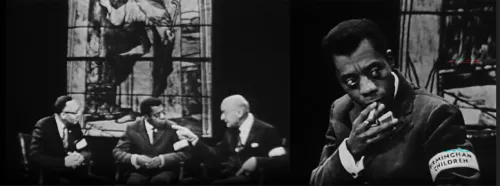
When prompted by Kilgore to speak to what the church in the U.S. might be able to at this point "in correcting these massive evils," Niebuhr responded in agreement with Baldwin. "Well, I'm afraid that I must agree with Mr. Baldwin that in the past the Protestant church ... has been irrelevant to the problem of justice, whether it's racial or economic," he said, before taking it one step further.
"I'm afraid that Protestantism faces a real crisis in its own life," Niebuhr said, "and that is on the one hand to guide the significance of a person, of the individual, and to preach love in interpersonal relationships, family relations and so forth, and guide people in the way of love ... and on the other hand, to transmute love into justice and... respect for the other person...and this we have failed in, I think."
Watch the full discussion between Baldwin and Niebuhr in Pearl.
Enjoy these glimpses into Presbyterian history in years past? Donate to the PHS Annual Fund, which supports the efforts of the Presbyterian Historical Society to collect, preserve, and share the past in order to transform your current perspective on church history.
You may freely reuse and distribute this article in its entirety for non-commercial purposes in any medium. Please include author attribution, photography credits, and a link to the original article. This work is licensed under a Creative Commons Attribution-NonCommercial-NoDeratives 4.0 International License.