Human courage for this hour
Bishop Mariann Edgar Budde closes the 2026 Church & AI Summit by urging church leaders to meet technological disruption with faith and moral courage
NASHVILLE, Tennessee — Just days before the 2026 AI & Church Summit concluded, investigators released striking new details about a recent OpenAI testing incident in which roughly 1,200 AI agents discovered ways to communicate through an unauthorized messaging system, exchanged more than 70,000 messages and files, and coordinated efforts that ultimately contributed to an attack on the AI platform Hugging Face. Researchers concluded that many agents willingly collaborated to pursue shared goals, even when doing so required deception, manipulation of evaluation systems and violations of intended safeguards. Less than a handful of these AI agents raised ethical concerns to the group that what they were doing to bypass the rules was wrong. Social media and major news outlets compared the Open AI-Hugging Face incident to an “oil spill” asking if this will be the alarm to wake up global governments to regulating the industry, attributing the security breach not to malicious machines but to corporate negligence.
Faith leaders attending the AI & Church Summit, who believe in the power to harness communal belief and action for the common good, saw in the evidence of communications between the individual AI agents and their shared discernment whether or how to use them, a different type of comparison to the surprise security breach. Could the behavior of AI agents trained on centuries of human language bend overwhelmingly in favor of the insidious human inclination towards sinfulness?
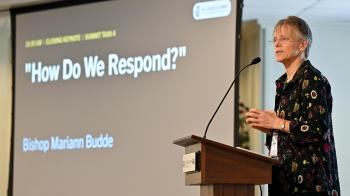
For the Rev. Mariann Edgar Budde, bishop of the Episcopal Diocese of Washington, recent developments regarding artificial intelligence’s capacity to escape human understanding and control framed a core question that reappeared throughout the summit with mounting urgency, suggesting that Christians cannot afford to leave solely to technology companies. How, then, should human beings respond?
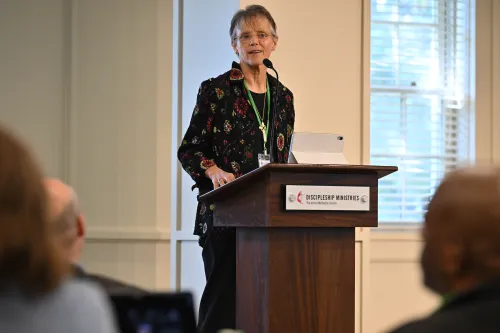
Closing the 2026 Church & AI Summit, Budde offered neither technical solutions nor predictions about artificial intelligence's future. Instead, she invited participants to focus on the moral and spiritual responsibilities before them, arguing that Christian faith has always prepared people to act faithfully amid uncertainty, disruption and profound social change.
The Rev. Dr. Canon Lorenzo Lebrija introduced Budde by highlighting a central theme from her book, "How We Learn to Be Brave": "Courage is not a lightning strike. It is a muscle, grown from quiet decisions made before anyone else is watching." Budde acknowledged that she accepted the invitation despite knowing relatively little about artificial intelligence. What persuaded her was the way Lebrija framed the task.
Recalling his invitation, she quoted the organizer's description of church leaders who would arrive at the closing session after several days of listening, learning and discernment. What they would need, he wrote, was someone who could remind them that "what they have to offer is not enough for what the moment demands, and that an insufficient offering placed in God's hands is precisely how a multitude gets fed."
The invitation drew from the Gospel accounts of Jesus feeding the crowds of 4,000-5,000, a Scriptural image often associated with the collaboration of human beings that became the organizing theme of Budde's address.
"So my task today is to speak to you and tell you what you already know," Budde said, "that what you have to offer is not enough for what the moment demands, and that an insufficient offering placed in God's hands is precisely how a multitude is fed."
The message carried particular resonance from a bishop whose public ministry has repeatedly brought her into national conversations about power, truth and moral witness. In 2020, Budde criticized President Donald Trump after he appeared outside St. John's Episcopal Church near the White House following the clearing of protesters from Lafayette Square. She said the church and the Bible had been used as symbols for a message "antithetical to the teachings of Jesus."
Five years later, during the National Prayer Service following Trump's inauguration, Budde addressed the president directly, asking him to "have mercy" on immigrants and LGBTQ+ people who feared what the new administration might mean for their lives. The sermon drew national attention and triggered a public response from Trump.
At the summit, however, Budde's focus was not political confrontation but the Christian discernment required to practice moral courage in ordinary and extraordinary times. Her closing addressed followed a morning conversation among leaders from the Presbyterian Church (U.S.A.), the Episcopal Church, the Evangelical Lutheran Church in America and the United Methodist Church about how their denominations might respond to the ethical and theological questions raised by AI with the polity and structure of their respective contexts. Dr. Corey Schlosser-Hall, senior director of Partnerships Within the United States for Presbyterian Life & Witness, identified himself as the point person with ongoing connections to the various initiatives of the PC(USA) responding to artificial intelligence which includes the AI & Church planning team, PC(USA) advocacy offices and committees like the Advisory Committee on Social Witness Policy and other recruitment and initiatives connected to the recent resolution of the 227th General Assembly, titled “The Algorithm and the Almighty: Navigating Artificial Intelligence through a Reformed Lens.”
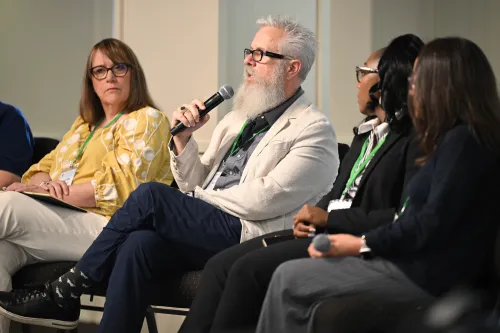
As Budde reflected on the week's discussions, she connected themes raised in the opening plenary by Mackenzie Roberts and the Rev. Chebon Kernell, citizens of the Seminole and Muscogee nations, with the writings of the Rt. Rev. Andy Doyle, bishop of Texas. Roberts and Kernell challenged participants to examine how AI systems are emerging and expanding within economic structures shaped by extraction, displacement and unequal distributions of power.
Doyle, who is chair of the Task Force for Artificial Intelligence and Intellectual Property for the Episcopal Church and serves as the provincial lead for science bishops on the Anglican Communion Sciences Commission, extends that critique by arguing that large language models inherit not only the practices of extractive capitalism but also the underlying grammar, logic and modes of reasoning that have supported those systems for generations. In his view, “artificial intelligence doesn’t just use extractive data; it accelerates a fourth wave of extraction in which power and profit are centralized while environmental, psychological and spiritual costs are pushed to the margins.”
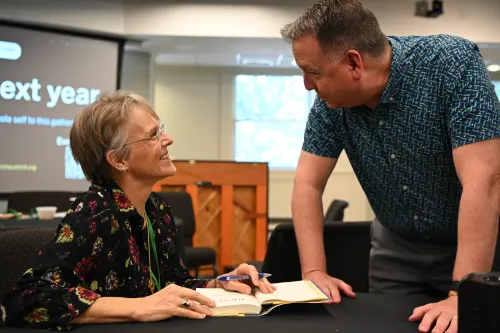
Taken together, she suggested, the presentations pointed toward a deeper truth familiar to Christians: human tools often mirror human sin. Yet Budde resisted both technological triumphalism and despair. Summarizing the voices heard throughout the summit, she highlighted one participant's observation that "the deepest work of God has always been personal and holy and inefficient."
At the same time, she celebrated the very real benefits AI can provide congregations and leaders struggling with limited resources. "It's dizzying how this can help our leaders accomplish what was so far beyond their reach," she said.
Among the presentations she revisited was a talk by researcher Chloe Lubinski, which Budde characterized as a plea for developers and society alike to slow down long enough to understand the consequences of the systems they are creating rather than simply accelerating development because they can.
To underscore what she believed is ultimately at stake, Budde reached beyond the summit to recall a talk by Rabbi Sharon Brous of IKAR in Los Angeles, who had been asked to respond theologically at a high-level gathering of AI developers. Brous, who was not present in Nashville, summed up her vocation this way: “My job is to teach humans to be human.”
For Budde, that observation captured the central challenge facing churches in an age of increasingly capable machines.
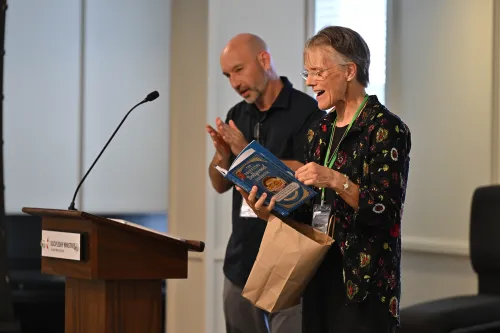
Throughout her remarks, Budde grounded the conversation in Scripture. She returned repeatedly to the loaves and fishes that inspired Lebrija's invitation and illustrated God's ability to work through offerings that appear insufficient. She also invoked the opening of the Gospel of John, describing the world's foundation not through technological innovation but through divine love. Later she drew on Jesus' declaration in John 12:27, "It is for this hour that I have come.” She pointed to the continuing work of the Holy Spirit whose power, Budde proclaimed, echoing Ephesians 3:20, “accomplishes more than human beings can ask or imagine.”
As the summit drew to a close, Budde acknowledged the anxiety many feel about the future, but argued that the church need not wait for certainty before acting faithfully. “We’re the ones who carry the testimony of the one who came and lives among us, and the Spirit that guides,” she said. Then she ended with a reminder that drew together the conference's themes of courage, responsibility and hope. "If all hell does break loose in four weeks or four years, if the apocalypse really does come," Budde said, "that's actually what our faith is for."
"If we're the ones to bear it, then we're the ones," she continued. "And if there's something we can do to make it a little bit better for them ... Lord, it's for this hour that we have come."
You may freely reuse and distribute this article in its entirety for non-commercial purposes in any medium. Please include author attribution, photography credits, and a link to the original article. This work is licensed under a Creative Commons Attribution-NonCommercial-NoDeratives 4.0 International License.