Faithful leadership in an age of artificial intelligence
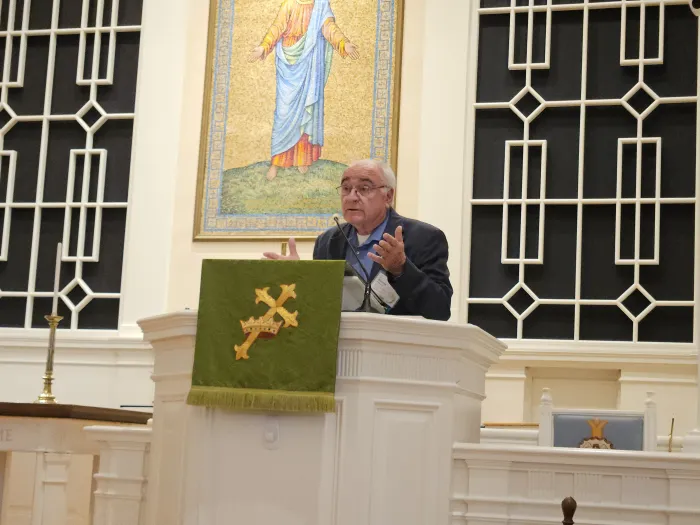
The Rev. Dr. Andy Morgan of First Presbyterian Church in Knoxville, Tennessee, delivers a thoughtful keynote to POAMN conference attendees

LOUISVILLE — The Rev. Dr. Andy Morgan, who keynoted last week’s “Rooted in Hope” conference for the Presbyterian Older Adult Ministries Network, was uniquely qualified to address those gathered.

Morgan, a recognized leader in artificial intelligence fluency and ethics within the church, is Director of Faith Formation at the host church for the conference, First Presbyterian Church in Knoxville, Tennessee. For the past 18 months or so, he’s also worked for a Massachusetts-based company “doing things like this,” looking at the intersection of faith and AI. Morgan developed the AI Fluency section for the Church AI Toolkit, as reported by Presbyterian News Service here.
“I’m in both the tech world and the church world,” Morgan told the POAMN gathering. “That perspective has given me lots of opportunities to talk in both spaces.”
He described his job as “helping people understand what AI is and how it works and honing the questions a person of faith might want to be asking. We have lots of questions,” Morgan said. “We know there aren’t always answers, but there are better questions.”
“This is serious discernment,” Morgan said, “and it’s the work of the church.” The 227th General Assembly took an important step this summer, Morgan noted, by approving a paper offered by the Advisory Committee on Social Witness Policy, “The Algorithm and the Almighty: Navigating Artificial Intelligence through a Reformed Lens.”
The discernai.church tool created for those attending the POAMN conference is another way to learn more, Morgan said.
Older adults have a lot to lose if they fall victim to AI-generated scams, Morgan said. Americans over age 60 lost nearly $5 billion to fraud in 2024, up 43% from the previous year. “Older adults are at risk because they’re so dad-gummed sweet,” he said, and because many have amassed significant financial resources. The problem for older adults is that only about 20% can spot AI-related red flags, while younger adults are aware of about 80% of those warning signs.
Many people are thinking about the ecological and economic impacts of AI, especially the data centers needed to power the technology. It can summon feelings of “runamokness,” he said, defined as “when things feel out of control and we feel we have little agency or stability.”
God’s people have seen this before, of course. Morgan cited Isaiah 2:1-5, especially the prophet’s vision of nations beating their swords into plowshares and their spears into pruning hooks. “This is a classic example of God’s people in the midst of runamokness hacking the technology at hand,” he said.
Faced with runamokness, we have three options: flee it, fight it, or “picture something in the middle that nobody has seen yet … and then walk toward it,” he said. That third option is hope. “Hope means that in the midst of dire circumstances, God’s people have seen and worked toward a more constructive end for humanity.”
Morgan said he works with lots of mainline churches. “What I really like is they are able to see and work toward nuanced conversations,” Morgan said. “There’s a lot of gray space. If [people of faith] don’t talk about [AI], who will?”
There’s both strong and weak AI, he said. Strong AI is self-aware and sentient, like Rosie the Robot on “The Jetsons.” “It’s the version Hollywood sells,” Morgan said. “It does not exist.”
Weak or narrow AI “is everywhere. It’s narrow, task-specific software,” he said, and includes both predictive and generative categories — Large Language Models such as ChatGPT.
They’re designed to provide users with the very next word. For example, if Morgan said “May the” to a church crowd, he might hear “peace of Christ” in response. If he said the same thing at a comic book convention, he might well hear “force be with you” as the response.
“It’s just probability. It’s sorting. It’s math — no thinking, no intelligence, no soul,” Morgan said. “Just probability.”
AI isn’t sentient, it’s not spiritually aware and it’s not neutral, he said. “It’s trained on our language, and shaped by our biases and blind spots.”
“The Cloud” is just a figure of speech, he noted. “Somewhere, there is a building” to support AI offerings. “It has a power bill, a water bill, and neighbors down the road.”
Or, as “The Algorithm and the Almighty” put it, “Even the most seemingly immaterial of our tools is composed of physical things, of wires and circuits and flowing electrons.”
The 227th General Assembly asked Presbyterians to advocate for AI-related environmental and ecosystem safeguards to ensure the flourishing of Creation.
That suggests “using AI sparingly and in pursuit of limited, particular purposes, due to its impact on the environment,” Morgan said.
In a section of his talk that focused on voice training and the rise of familiar scams, Morgan said scammers “want you to be urgent in your response.” Instead, employ a PATCH strategy, he suggested:
- Pause when the feeling spikes
- Agree on a family safe word
- Trace the source. Ask, “Can I call you back?”
- Cross-check for any online verification
- Hang up and call back on a number you find yourself.
Completing the exercises on the discernai.church website takes about an hour. Morgan suggested finding a partner to get started.
You may freely reuse and distribute this article in its entirety for non-commercial purposes in any medium. Please include author attribution, photography credits, and a link to the original article. This work is licensed under a Creative Commons Attribution-NonCommercial-NoDeratives 4.0 International License.