Z Holler, 9/11, and Jesus’ ‘Impossible’ Possibility
Sermon by a PC(USA) pastor delivered on the Sunday after the attacks has applications for today
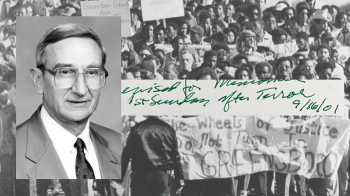
Zeb North Holler, Jr., known as Z, was a Presbyterian minister and activist from Greensboro, North Carolina. Born on Aug. 2, 1928, Z grew up in the Presbyterian Church of the Covenant. He graduated from Davidson College in 1949, and from 1950 to 1955 served as a U.S. Navy aviator. He returned to his studies afterward, culminating at Union Theological Seminary in Richmond, Virginia, in 1958. Z accepted a call from Young Memorial Associate Reformed Presbyterian Church in Anderson, South Carolina, where he served as pastor of the congregation from 1960 to 1964. During that time, Z was also a faculty member at the Anderson School of Theology for Laymen. In 1967, he completed a doctorate in Biblical Criticism at the University of Aberdeen. Z was pastor at Central Presbyterian Church in Atlanta from 1966 to 1968, and at Fort Hill Presbyterian Church in Clemson, South Carolina, until 1979, when he took the pastorate at his home church, Church of the Covenant in Greensboro.
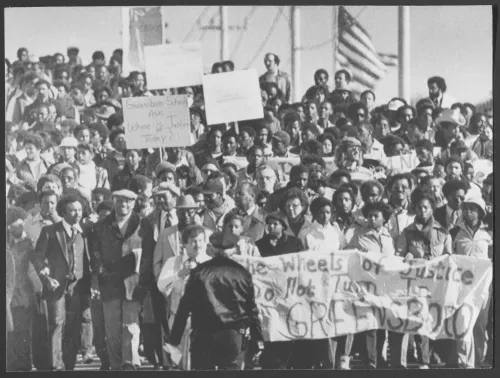
Two months after Z returned to Greensboro in 1979, a confrontation between labor activists against Ku Klux Klan members ended with five dead and 12 wounded. The Rev. Nelson Johnson, a member of the Communist Workers Party, was among the injured. The CWP had organized some anti-Klan actions, as well as a march, which was set for Nov. 3 in Greensboro. Unbeknownst to the organizers, members of the local police department had provided a copy of the planned march route to the antagonists, who planned an assault. On Nov. 3, more than 40 Neo-Nazis violently attacked the marchers, killing four CWP members and one additional individual and wounding 12 others, including Nelson and two news crew members. This event became known nationally as the Greensboro Massacre.
In the wake of this violence, Z ministered to Greensboro’s Black community, promoting inter-racial "truth speaking.” Nelson continued his schooling and returned to Greensboro, where he served as an assistant pastor until founding Faith Community Church in 1991. Later that year, he co-founded the Beloved Community Center and served as its founding director.
Upon his retirement from Covenant in 1993, Z joined with the Rev. Nelson Johnson in his work at the Beloved Community Center, a non-profit devoted to racial and economic justice that is still active today.
In 2001, Z co-chaired the Greensboro Truth and Reconciliation Commission Project alongside Nelson, which culminated in the formation of commission to address the effects of the 1979 massacre. In due time, this process uncovered the Klan and Nazi relationship with GPD and its role in blunting police response to the 1979 attack. The Greensboro City Council initially refused to apologize for its role in the massacre, instead issuing a “statement of regret” in 2009. It finally apologized in 2018 — two years after Z’s death. The final report of the commission is available in full on the community center’s website.
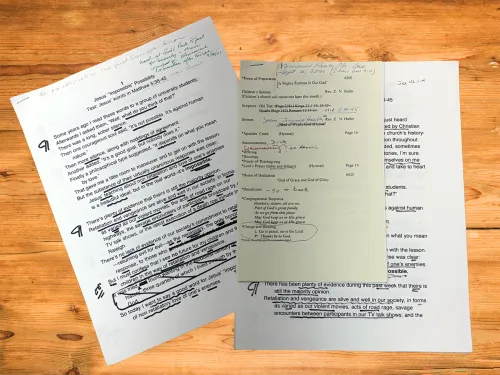
The Z Holler Papers live in the Presbyterian Historical Society archive; the collection consists of eight boxes, most of which are filled to the brim with sermons, essays, research and seminar notes. There are sermons that deal with interpreting specific books of the Bible, sermons that touch on familial relationships and matters, and sermons that speak to current events ranging from the 1980s through the 2000s.
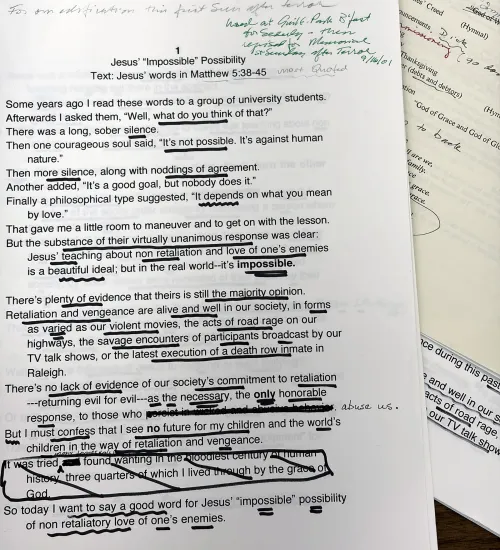
Included in the latter addresses is a sermon titled “Jesus’ ‘Impossible’ Possibility.” There are two copies, both marked up by Z’s hand — one has a note penned in green in the top right corner that offers the provenance of the sermon. "Used at Guilt Park B’fast for Elderly – then revised for Memorial 1st Sunday after Terror 9/16/01."
He opened his sermon by reading from Matthew 5:38-45: “You have heard that it was said, ‘Eye for eye, and tooth for tooth.’ But I tell you, do not resist an evil person …” and shared with those in worship that the passage includes “the words of Jesus that were most quoted by Christian writers during the first 300 years of the church’s history … Of all the words of Jesus, these finally impressed themselves on me late last night as the ones we most need to hear and take to heart this first Sunday after the terror.”
Z continued with a story. He’d read this passage to a group of college students, and “the substance of their virtually unanimous response was clear: Jesus’ teaching about non-retaliation and love of one’s enemies is a beautiful ideal; but in the real world — it’s impossible. There has been plenty of evidence during this past week that theirs is still the majority opinion,” noted Z. He pointed to violent movies and television, road rage, and the “speeches of our president and other leaders, religious and political, since last Tuesday’s atrocities,” as evidence of retaliation and vengeance being “alive and well in our society” in various forms.
Z spoke of the American society’s “commitment to … returning evil for evil … as the necessary, the only honorable response, to those who abuse us,” and then pointed out a potential third option, brought forth by Jesus in the book of Matthew.
“He proposes neither passive acceptance nor aggressive retaliation,” Z explained. “Instead, he would have the victim stand there in the oppressor’s face, unmoved, and deliberately turn the other cheek … Do you see that ‘turning the other cheek’ is both self-respecting and respectful of this arrogant ‘enemy’?” Z asked his congregation.
He explained that Jesus’ suggestions and the three stories he tells to illustrate the intention of his teaching “picture non-violent, imaginative, disarming resistance to oppressive, bullying behavior … He is proposing responses to evil that have the potential of uniting victim and victimizer at the level of their common humanity. And I’m sure his original hearers found his teaching at least as shocking and ‘impossible’ as we do,” Z concluded.
“It is way past time, friends,” Rev. Zeb Holler said on that first Sunday after the Terror of 9/11, “for Christians to get serious about Jesus’ way: no more public or private vengeance; no more violence undertaken to stamp out violence … This is not a time to answer hurt and hate and fanatical despair with massive, angry retaliation that can only lead to greater hurt and hate and senseless evil … So the crucial question for us today is, How might Jesus’ way relate to our present situation, under attack from international terrorism? At the very least we followers of Jesus can begin trying to think of the terrorists who hate us as neighbors on this planet Earth, whom we are somehow to love as ourselves.”
Twenty-five years after the attack on the World Trade Center — and 47 years after the Greensboro Massacre — his words still carry power. As we continue, all these years later, to remember, may we “never forget” that crucial teaching of Jesus: to love our enemies, and to turn the other cheek.
If you have sermons from September 16, 2001, in audio, video, or text, or prayer vigils on video from the week of September 11, please contact David Staniunas at PHS: [email protected].
You may freely reuse and distribute this article in its entirety for non-commercial purposes in any medium. Please include author attribution, photography credits, and a link to the original article. This work is licensed under a Creative Commons Attribution-NonCommercial-NoDeratives 4.0 International License.