
A brief statement of faith in the midst of loss
In life and in death, the Rev. Dr. Joanna Moseley Adams helped people confess and live their faith
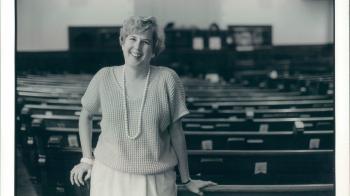
ATLANTA — Even in death, the Rev. Dr. Joanna Moseley Adams was still teaching the church what it means to believe.

At the memorial service she carefully planned before her death from a stroke on Aug. 7 at age 81, worshipers were invited not first to remember her accomplishments, but to confess the faith that shapes them.
The service began with the opening question of the Heidelberg Catechism and ended with the congregation reciting the A Brief Statement of Faith, the contemporary confession Adams helped write during the Presbyterian reunion that formed the Presbyterian Church (U.S.A.). The development of new confessions can take years and span across General Assemblies. Adams was in her 30s and beginning her ministry when she served for four years on the original committee of 21 that wrote the first draft of what is popularly known as the “Brief Statement.”
For Presbyterians, confessions are a collective witness of a tradition that lives through and beyond its historical testimonies — equal chapters in an ongoing story of God’s presence in the life of the church and its members.
During the Sept. 4 celebration of her life and witness to the resurrection, the Heidelberg and the Brief Statement framed a life spent helping others discover what they believe and how to live it. The worship service at Trinity Presbyterian Church in Atlanta opened with worshipers reciting together, “That I am not my own, but belong, body and soul, in life and in death, to my faithful Savior Jesus Christ.” The congregation later rose again to recite the opening of the Brief Statement, “In life and in death we belong to God.”
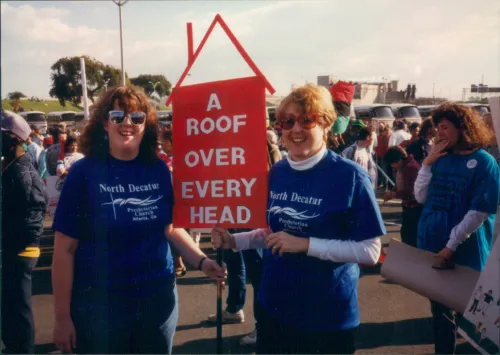
In between, a congregation of family members, former colleagues and friends celebrated the life and witness of a trailblazing pastor, gifted preacher, bridge-builder and advocate whose ministry left a lasting mark on Atlanta and the wider church. Adams became the first woman called to a full-time installed pastoral position in the Presbytery of Greater Atlanta in 1979 and went on to serve local congregations including Central Presbyterian Church, North Decatur Presbyterian Church, Trinity Presbyterian Church, First Presbyterian Church of Atlanta and Morningside Presbyterian Church.
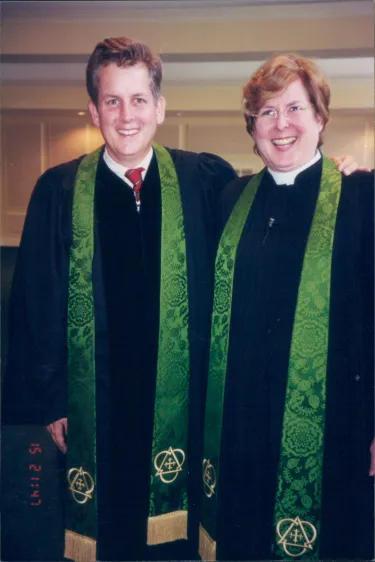
The Rev. Rebekah LeMon, senior pastor of Trinity Presbyterian Church, welcomed mourners by describing Adams as “a devoted and loving wife and mother and sister, a Southern woman to her core, a compassionate and inspiring pastor, a mentor and teacher, an advocate for justice, and to so many people, a friend.” Friendship and inclusion became a recurring theme throughout the service.
The Rev. Dr. Sam Adams recalled accompanying his mother to the shelter ministry she launched after a man experiencing homelessness died on a cold night near the Georgia Capitol. What began at Central Presbyterian Church eventually grew into what is now Intown Cares. As a child, he accompanied her some nights. “I went with her some nights,” he remembered, “and watched her greet strangers, calling them her guests as they entered and telling them gratefully that they were her brothers and sisters in Christ.”
“The city of Atlanta is a more welcoming and inclusive place because of her ministry on behalf of the unhoused,” he said.
He also reflected on Adams’ role in drafting A Brief Statement of Faith. “She didn’t just help write the important affirmations from the Brief Statement, but she sought to live that out in her ministry,” he said. “My mom devoted her life to ‘justice, freedom, and peace,’ and she was tireless in her advocacy on behalf of those who were struggling, especially in Atlanta.”
Turning to her gift for preaching, he described a multi-year collaboration with his mother on a forthcoming collection of her sermons as “the most meaningful time I ever had with her.” He pointed especially to the final sermon in the volume, “A Matter of Time,” as a window into her theological depth, noting how, even in 2002, she was challenging fantasies of radically extended life and insisting that only by accepting human limits and “inherent frailty compared to God’s eternity” can people learn to live well in each moment.
His remembrances also revealed a lighter side of Adams: she was a devoted Atlanta Falcons fan, a host of elaborate luaus for grandchildren Virginia and Charlie, and a Southern cook whose fried chicken and mincemeat pie achieved legendary status in the family.
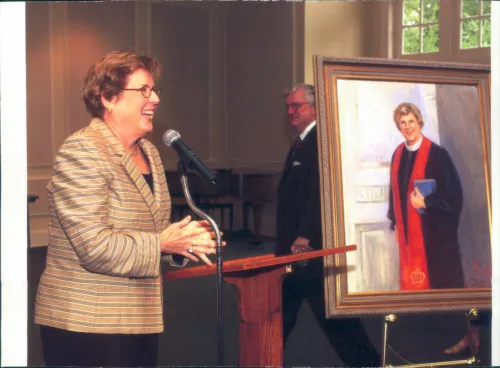
Dr. Elizabeth Adams offered another glimpse into her mother's gift for human connection. During a trip to Scotland, the two found themselves seated beside a distraught young woman whose engagement had just ended. “Within moments, she was receiving excellent pastoral care,” Elizabeth said. When the woman asked how she knew exactly what to say, Adams replied: “I'm a pastor from Atlanta, Georgia.” Reflecting on mother-daughter road trips through the South, civil rights landmarks and ancestral churches, Elizabeth concluded that her mother was “Southern in her blood,” but also “a pastor in her blood.”
In the homily, LeMon expanded on Joanna’s accessible and friendly nature, describing Adams as someone who treated every person as uniquely beloved. “One of Joanna's signature phrases was ‘the one and only,’” LeMon said. “We were each ‘one and only’ to her, just as we are each one and only to our Lord and Maker.”
LeMon recounted Adams' work opening church buildings to people experiencing homelessness, advocating for educational opportunity, supporting interfaith relationships and challenging congregations to move beyond comfortable words toward faithful action. “She called us to higher ground,” LeMon said.
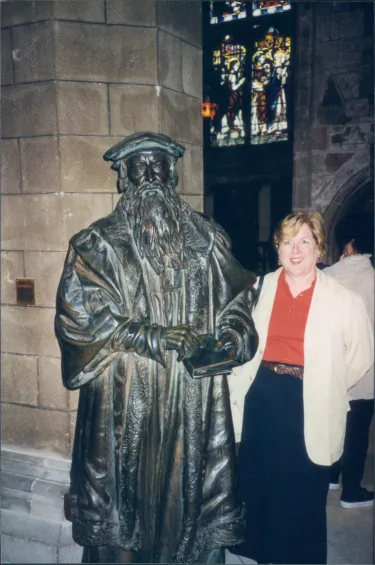
Near the end of the sermon, LeMon turned to a message Adams preached at North Decatur Presbyterian Church in 1988 titled “Necessary Losses.” In that sermon Adams reflected on the universal experiences of aging, grief and letting go. “I don't know about you, but when I appear before the judgment seat of God, I intend to ask why it was all so necessary, the growing up, the growing old, the letting go, the dying,” Adams had preached. “I still want to know. But in the meantime, it is enough to know that God knows why. It is enough to know that God can be trusted with our lives and our souls.” LeMon paused before adding, “Now she knows.”
That confidence in God's faithfulness ultimately anchored the service. The Heidelberg Catechism's assurance that believers belong to Christ “in life and in death” gave way to the congregation's final confession of a statement Adams helped bring into being during a historic period of Presbyterian reunification.
Today, A Brief Statement of Faith is one of the denomination's most widely used confessional texts and continues to find new audiences through translation efforts, including new Indonesian, Mandarin and Vietnamese versions released in recent years.
For one final hour last week, a preacher who spent a lifetime helping others profess their faith led the church in doing exactly that, reminding mourners that faith is not merely something to confess with words, but something to live and when the time comes, to let it all go and trust in our full belonging to God.
Listen to the newest translations of the Brief Statement of Faith in Vietnamese, Indonesian and Mandarin.
-
 Pernyataan Iman Singkat — "A Brief Statement of Faith" (In Indonesian)
 -
 簡要信仰聲明 (美國) 基督長老教會 “A Brief Statement of Faith” (in Mandarin)
 -
 Lời Tuyên xưng Đức tin ngắn gọn — "A Brief Statement of Faith" (in Vietnamese)
-
Pernyataan Iman Singkat — "A Brief Statement of Faith" (In Indonesian)
-
簡要信仰聲明 (美國) 基督長老教會 “A Brief Statement of Faith” (in Mandarin)
-
Lời Tuyên xưng Đức tin ngắn gọn — "A Brief Statement of Faith" (in Vietnamese)
In July 2026, the 227th General Assembly received a draft of a new confession to be considered for adoption. The special committee to write that confession was formed in 2022 by the 225th General Assembly. In June, members of that committee met with General Assembly commissioners to explain how they wrote and structured that confession and estimated that it would be 2030 at the earliest before that confession is incorporated into the Book of Confessions.
Eighteen-year-old, Nagwa Fokunang, Presbytery of Utah, was the youngest member of the special committee to write a new confession, formed after the 225th General Assembly where she served as a Young Adult Advisory Delegate. In a recent video series with Presbyterian Young Adults, Nagwa described what she learned about being Presbyterian from serving on a committee to write a new confession.
You may freely reuse and distribute this article in its entirety for non-commercial purposes in any medium. Please include author attribution, photography credits, and a link to the original article. This work is licensed under a Creative Commons Attribution-NonCommercial-NoDeratives 4.0 International License.


