Preserving and serving the sacred in an AI-shaped world
PC(USA) Innovation Network explores the Imago Dei, counter narrative storytelling, pastoral care and faithful AI use

“I believe the central theological question is not whether artificial intelligence bears the image of God, but more urgently is how human beings who do bear the image of God will exercise wisdom, dignity, responsibility and agency in an AI-shaped world,” the Rev. Dr. Winterbourne Harrison-Jones told participants in the Innovation Network meeting on Wednesday, Sept. 16.
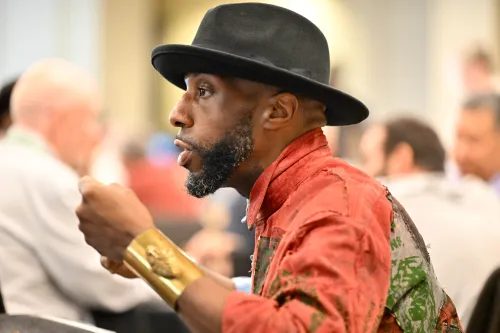
“The Imago Dei cannot be reduced to intelligence, productivity, language, creativity and the ability to generate information,” Harrison-Jones continued: “If intelligence alone constitutes the image of God, then we risk measuring human worth according to cognitive ability, educational efficiency, or even output, which would undermine the very dignity the doctrine is intended to protect.”
“The image of God speaks to the sacred worth of human beings and to our vocation to reflect God's character through relationships and creativity and stewardship, justice, and love,” said Harrison-Jones.
That question undergirded an hourlong conversation about artificial intelligence, theological responsibility and Spirit-led discernment. Facilitated by the Rev. Samuel Son, an associate in the Office of Innovation, the Zoom meeting drew 30 participants and five AI notetakers.
Presenters reflected on the AI and Church Summit, an annual ecumenical gathering begun in 2023. The 2026 summit was held Aug. 24-28 in Nashville, Tennessee at the offices of Discipleship Ministries of The United Methodist Church.
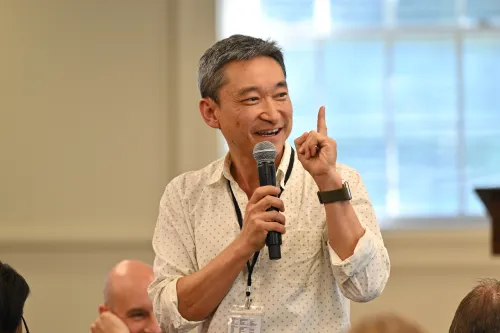
Son described the summit as a learning community rather than a conventional conference. Participants from multiple denominations brought their experiences into conversations about human identity, environmental costs, pastoral overreliance and the rapid pace of AI development.
Son particularly highlighted presentations from Indigenous leaders, Mackenzie Roberts and the Rev. Chebon Kernell, who examined technology through relationships with land, history and community. Son said their presentation challenged participants to consider not only human dignity but “dignity of all beings.” Their perspectives illustrated why discernment must include communities and ecosystems experiencing the environmental and cultural consequences of technological development.
The Rev. Olivia Lane introduced the Church AI Toolkit, an ecumenically developed collection of workshops, liturgies, formation materials and downloadable resources. The toolkit is intended to help clergy, chaplains and congregations prepare for difficult questions before an AI-related pastoral crisis occurs.
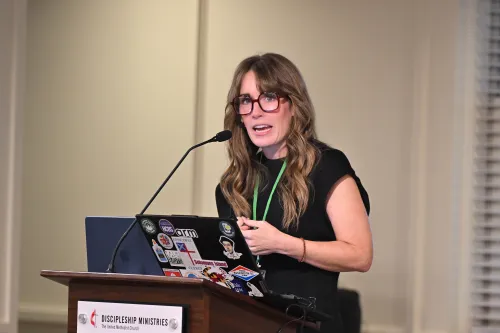
Lane said AI raises questions “about agency and about belonging and about whose voices are represented or underrepresented.” She emphasized precise language and resisted framing AI as an all-or-nothing choice, noting that pastors must care for people wherever they are in the conversation.
As the third presenter, Harrison-Jones approached AI not merely as a technological issue but as “a theological question, an ethical question, a pastoral question, a cultural question, and yes, even an institutional question.” Grounding his analysis in critical race theory, he asked whose interests AI serves, whose knowledge it recognizes, whose experiences it overlooks and whose humanity its systems may diminish.
He offered four central convictions: AI is never neutral; AI shapes culture; counter storytelling resists cultural erasure; and AI may support ministry but cannot replace discernment, relationships, pastoral presence or the work of the Holy Spirit. Counter storytelling, he said, lifts up “the experiences, the wisdom, the testimony, and interpretations of people whose stories have oftentimes been ignored.”
"Is there any ethical use of AI when we look at the environmental impacts of the technology?" director of Creation Justice Ministries, Derrick Weston, asked Harrison-Jones in a short Q&A that followed each presenter.
Harrison-Jones applied his framework to data centers and their effects on historically marginalized communities, land, water and wildlife. “What scares me most, brother Derek, is that I don't hear these questions being raised right in the public sphere,” he said.
“The theological question before us is not whether we can construct a machine that resembles us,” Harrison-Jones concluded. “It is whether we will use our God-given agency to create and govern technology in ways that honor God and protect one another.”
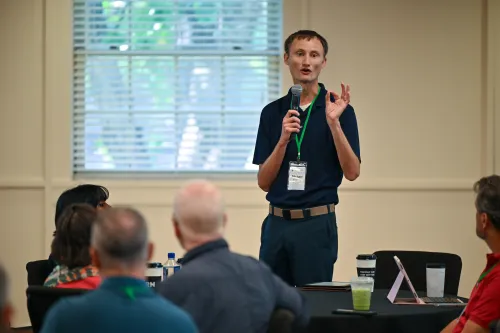
The Rev. Michael Gewecke invited participants to imagine tools that could reduce administrative burdens and help pastors remain present with their communities. He described using AI-assisted tools to coordinate a youth trip and monitor email for pastoral-care concerns.
“You don't ever have to use it for your sermon, and it can still change everything about how you do the administrative work of ministry,” Gewecke said. His approach distinguished between delegating proclamation to AI and using technology to support the human work surrounding ministry.
Son invited participants to shape future monthly conversations by identifying opportunities, risks, questions and needed resources. Alicia Demartra-Pressley, associate for Missional Equipping, called for the community to produce a denominational resource or concrete action. Gewecke suggested community organizing as a model for sustaining multiple, complementary areas of work.
Their exchange reinforced the meeting’s central conviction: AI does not relieve people of moral responsibility. In a world rapidly shaped by artificial intelligence, faithful innovation depends on human agency, accountable relationships and Spirit-led discernment.
You may freely reuse and distribute this article in its entirety for non-commercial purposes in any medium. Please include author attribution, photography credits, and a link to the original article. This work is licensed under a Creative Commons Attribution-NonCommercial-NoDeratives 4.0 International License.