Sowing the seeds of racial justice one family farm at a time
World Communion Offering helps Black farmers take action against structural racism

LOUISVILLE — Walter Mack is no stranger to the ebb and flow of the tides.
It was, in a sense, the tides’ irresistible force that pulled Mack homeward — home to his island, his people and his Gullah Geechee culture.
Born and raised on a small farm on South Carolina’s St. Helena Island — among the largest of the chain of Sea Islands off the coast of South Carolina, Georgia, and Florida — Mack initially left the rural Lowcountry to earn degrees in chemistry and business before returning to his roots.
“Unlike other people,” said Mack, “I came back home.”
Proud to identify as Gullah — a people descended from the formerly enslaved West and Central Africans who inhabited and worked the Sea Islands’ fertile farmlands — Mack still lives on land his family bought in the late 1800s.
As a lifelong resident of St. Helena, he was determined to safeguard the island’s rich cultural and agricultural heritage.
“I made a commitment to help preserve a lot of the Africanism here that was carried over from the slave trade,” he said. “We wanted to pass that culture — the food, the religion, the crafts, and most of all, the farming — on to the next generation. In the Gullah culture, without land, there is no culture.”
Yet, increasingly, the Gullah people’s land and their way of life were being threatened by rampant development.
And not only was big industry poised to disrupt the area’s native fauna and flora — including polluting its waterways, on which the residents depend for seafood — but the farming families’ lives and livelihoods were being systematically undermined by an even more sinister force, structural racism.
“Even though BIPOC [Black, Indigenous and People of Color] farmers can have the same exact or better produce than other non-BIPOC farmers,” said Mack, “they are always offered a lower price. It all has to do with racism. That’s the bottom line. For years, this has happened, and there was nothing anybody could do about it.”
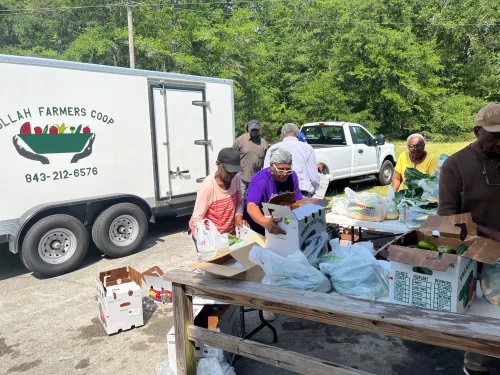
That is, until 2010, when Mack became one of the founding board members of the Gullah Farmers Cooperative Association, in which more than a dozen Black farmers with limited resources came together to secure markets for their products and to get paid fair prices.
“When you sell your product at a loss, how can your farms survive?” asked Mack. “The co-op stepped in to pay farmers the market price. Anybody who sells to us, no matter their color, they all get the same thing.”
As a former educator and executive director of the island’s Penn Center, one of the nation’s first schools for formerly enslaved people, Mack added that a second aspect of the cooperative’s mission is to provide the community with fresh, nutritional foods, including healthy meals for school children.
“It’s important that our children get the right nutrition for proper brain and body growth,” Mack said. “Through the cooperative, we are investing in our children, the future generations. We want our young folks to stay on the island by providing livable wages and mentorships.”
The cooperative helps farmers in a variety of ways, offering marketing and technical assistance such as how to package and how to focus on food safety and quality control, as well as helping with budgeting, farm certification and U.S. Department of Agriculture programs. Several years ago, the cooperative identified a 10,000-square-foot building on St. Helena Island and received federal funding to transform it into a fruit-and-vegetable processing facility.
And because such ambitious goals and programs require adequate funding, the cooperative applied for and received a grant from the Presbyterian Committee on the Self-Development of People (SDOP), a ministry that seeks to change the structures that perpetuate poverty, oppression, and injustice.
“The Gullah Farmers Cooperative Association is a shining example of communities being able to live lives of self-determination,” said the Rev. Dr. Alonzo Johnson, manager of SDOP. “The work of the Gullah farmers aligns with the World Communion Offering because of its distinctive ability to help them preserve their traditional African customs, which in turn strengthens their ability to uplift communities by providing fresh food and promoting more equitable labor and healthier food choices.”
Received by many congregations on World Communion Sunday, which falls this year on Sunday, Oct. 4, this new Offering can be celebrated at any time of the year. With its singular focus on reconciling God’s people around the sacrament of the Lord’s Supper, it supports the PC(USA)’s initiatives in racial justice, gender justice, peacemaking, global witness, and ecumenical and interfaith relations.
The prophet Micah’s charge to “love kindness” is uniquely embodied when siblings the world over join hearts and hands around Christ’s Table of grace.
“Giving to our Special Offerings is our distinctive Presbyterian way of honoring our call to faithful discipleship,” said Johnson. “It is our way of spiritual action and alignment with Jesus’ mission to bring the Good News and wholeness to the world. When people give to the World Communion Offering, they become the hands and feet of Christ’s important work of dismantling racism, practicing peacemaking, and assisting communities to find their voice and access their God-given power by being in solidarity with them.”
You may freely reuse and distribute this article in its entirety for non-commercial purposes in any medium. Please include author attribution, photography credits, and a link to the original article. This work is licensed under a Creative Commons Attribution-NonCommercial-NoDeratives 4.0 International License.