‘God has given us doors we didn’t have the sense to knock on’
Pastor and finance expert the Rev. Dr. Sidney S. Williams, Jr. delivers the Henderson Lecture at Pittsburgh Theological Seminary
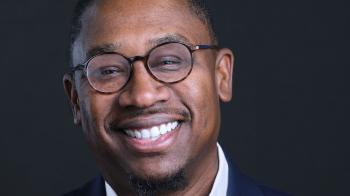
LOUISVILLE — Delivering the Henderson Lecture Tuesday in Hicks Chapel at Pittsburgh Theological Seminary, the Rev. Dr. Sidney S. Williams, Jr. drew on what he’s learned serving Bethel Church of Morristown, New Jersey and the acumen he’s accumulated as president and CEO of Crossing Capital Group and chairman of the Oikos Institute for Social Impact.
Williams’ talk was on “Fishing Differently: A Theology of Abundance, Stewardship and Social Impact.” He led with his connection to PTS’ president, the Rev. Dr. Asa J. Lee, who was away that evening on seminary business. Lee and Williams were classmates in seminary. “Asa was a church musician and scholar. We got into arguments nearly every day,” Williams said. “I was trying to prove the merits of capitalism. He said I needed to study my Bible better.”
A significant common thread between those worldviews is the need for storytelling, Williams said. Wall Street CEOs take to the road to explain why their company is worth investing in. Venture capitalists hear plenty of elevator pitches — two minutes of startups “telling their story to investors.”
“In the business world, they are quite bold with sharing their story with people they don’t know,” he said. “In church, we limit it to people we already know.”
Dutch priest and author Henri Nouwen taught that raising church funds “is not begging for money,” Williams said. “When we invite people to participate with us, it’s an invitation to discipleship.”
Upon graduation, a seminarian may land a calling to “a congregation that’s tired. They’ve tried everything, and it’s not working,” Williams said. “We come in and say, ‘Let’s go deeper! Let’s try something I learned in seminary,’ and it falls on deaf ears.”
Eight months into his own ministry, the church flooded, necessitating the need for about $1.5 million in repairs. Williams told nearby business leaders if they’d make the investment, the church would feed community members five nights each week.
The church sign had also been damaged, and a man came from two counties away and told Williams, “The Lord sent me to be a blessing.” During a tour, the man noticed how cold the building was and told church leaders, “I own an HVAC company and I can get you a new heating system next week.”
Just that week, Williams had told congregational leaders, “Let’s see what Jesus does.”
“He sent us a MAGA man to fix our heating system. He asked to help with the feeding program.” After he did, the man told Williams the program was “really small. I want to give you a bus to be a mobile food pantry.” The church went from feeding 60 families each week to 2,000 families countywide.
Both the man’s sons wanted nothing to do with their father. Williams went to his home for a visit and learned he had terminal cancer. Shortly after that, the man died.
“He didn’t know why the Lord had sent him,” Williams said. “I believe he came because he needed healing. He was invested in the mission we articulated for the community.”
Many church-goers are focused on preservation, “and that’s why we don’t want to do anything differently. It’s comforting,” Williams said. At one point, Williams wanted to remove the pews to create a more flexible space for the church. When the truck came to take the pews away, “people said, ‘Pastor! Where are the pews?’”
“We talked about this, remember?” Williams told them. “They wanted to preserve things just the way they were.”
Some complained about the new sign the man had provided the church. “You’re bringing all these new people into church, but we want it the way it’s always been,” they told their pastor, who responded: “That’s not stewardship. Stewardship is using the assets God has given us to help the community to flourish.”
Williams also differentiated between giving and investing. When we invest, there’s an expectation of return. “We are investing in a vision,” he said. “If I give money away, I’m done with it. If I’m investing, I want to do some due diligence. I want a relationship,” he said, again turning to Nouwen’s teaching.
He took on reparations as well. “You don’t owe us anything. God has provided all we need,” he said. “But you should make an investment.” It costs cities significant sums “when they divest from whole neighborhoods. It costs the city lost tax revenues because you chose not to invest in part of your city.”
“Our job as people of Christ,” he said, “is to invest in neighborhoods so they’ll flourish on Earth as it is in heaven.”
By feeding 5,000 men with just two fish and five barley loaves, Jesus is telling his disciples, “I’m going to teach you how to multiply the investment this boy is making,” Williams said. “Jesus’ vision was, ‘we’re going to feed everybody.’”
Once in his ministry, Williams and his wife sold their house and made their way with their four children to Africa to serve there. When it was time to return to the United States, Williams went to one of the African church mothers and said, “tell me not to go.”
“She said, ‘the work is done. God sent you here, son, so we could heal you. Our work is done. Now you can go home.’ I cried like a baby,” he said.
After his talk, Williams answered questions. He said that one of his colleagues once noted that “we look at social impact as discipleship.”
“When you ask a seminarian who Christ is, they can name divine attributes. But how many of those can we emulate? None of it,” Williams said. “The human aspects we can imitate — feed the needy, set the captives free. We can do that.”
“God has given us doors we didn’t have the sense to knock on,” he said of the ministry. “It’s worth the sacrifice.”
You may freely reuse and distribute this article in its entirety for non-commercial purposes in any medium. Please include author attribution, photography credits, and a link to the original article. This work is licensed under a Creative Commons Attribution-NonCommercial-NoDeratives 4.0 International License.